Cracks in the Walls of a Dubai Apartment: Which Ones Matter
First, check these in 60 seconds
Most cracks in a Dubai apartment are a finish problem. Board joints, plaster shrinkage and a tower still moving after handover account for nearly all of them. Four things sort those from the ones worth reporting: width, direction, position, and whether it is still growing.
Measure the width against something in your wallet
A bank card is 0.76 mm thick, everywhere in the world, because the ID-1 card standard fixes it. Stand one on its edge and offer it to the crack. If the card will not enter, you have a hairline. If it slides in with room to spare, the crack is past a millimetre and worth a second look.
The scale surveyors work from, BRE Digest 251, treats anything under 0.1 mm as negligible, up to 1 mm as a redecorating job, and up to 5 mm as a filling job. Past roughly 5 mm a crack has stopped being a decorator's problem. It was written for low-rise housing, and a reinforced concrete tower behaves differently. Treat the bands as a ranking of severity and confirm anything past the middle of it with someone who has seen the wall.
Read the direction, and where the crack starts
Direction narrows the cause faster than width does. Five patterns cover almost everything you will find indoors.
- A fine, dead-straight vertical or horizontal line. Straightness means the crack is following something built in: a board joint, a plaster stop, the line where two materials meet. Nothing in a stressed wall cracks straight on its own.
- A diagonal out of the corner of a door or window opening, at roughly 45 degrees. Openings concentrate stress, so a wall relieves it there first. Common, usually minor, and the pattern most worth monitoring.
- A stair-step zigzag tracking horizontal and vertical mortar joints. The movement is in the blockwork itself, below the finish.
- The same crack on both faces of one wall, or carrying round the wall-to-ceiling junction unbroken. That crack has passed through the full thickness of the wall.
- Displacement. Run a fingernail over the crack. If one side stands proud of the other, that is the single sign here that always earns a professional look.
Mark it, date it, and look again
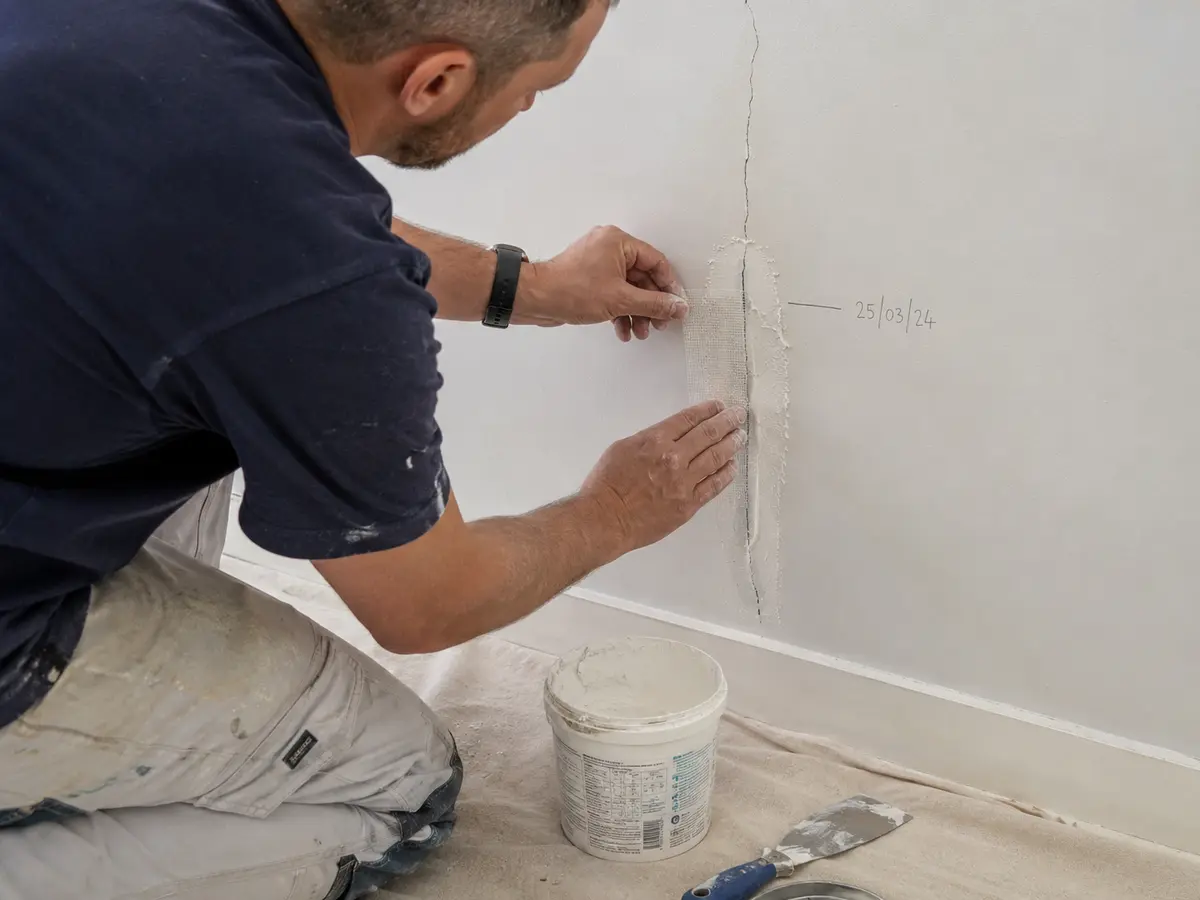
A crack is defined as much by its behaviour as by its size. Draw one pencil line across it, write the date beside it, then put two ticks 100 mm apart either side and note the measurement between them.
Re-measure at 3 months and again at 6, with one reading in the cool months and one after the summer, roughly March to October, so the pair spans a full cycle of the building expanding and contracting. A crack that has not moved through a Dubai summer has finished moving.
Knock the wall before you diagnose the crack
Dubai apartments are built from three different things, and the same crack means three different things depending on which one you are standing in front of. Rap the wall with a knuckle every half metre and listen.
The hollow wall is a gypsum partition
A drum note that goes dull every 400 to 600 mm is a gypsum board partition on metal studs, and the dull spots are the studs. These are the internal walls in most towers: bedroom dividers, wardrobe returns, the boxing round a riser.
Standard board is 1200 mm wide, so its joints recur at 1.2 m intervals. A crack that is dead straight, runs floor to ceiling and sits 1.2 or 2.4 m from a corner is almost always a taped board joint whose reinforcement has failed. That is a finishing defect, it says nothing about the building, and it returns if it is filled without re-taping.
The solid wall is blockwork under plaster
One flat, dead note everywhere means blockwork with a plaster skim over it. Wet walls, party walls and the walls carrying kitchen units are usually built this way.
Two patterns dominate. A straight vertical crack exactly where blockwork meets a concrete column or slab is a material-junction crack: the two shrink at different rates, and a skim carried across the join has to tear somewhere. A stair-step through the mortar joints is a different animal. There the wall itself is moving. Report that one and leave it alone.
The ceiling, and the concrete behind it
Ceilings here are either the underside of a reinforced concrete slab with a skim on it, or a suspended gypsum ceiling hung below the services. Concrete shrinks for months after the pour and creeps for years, the same reason a new tower produces floor tiles that drum and lift in its first seasons.
One ceiling pattern looks alarming and rarely is. A straight horizontal crack where a partition meets the ceiling, often with the cornice parting from the wall, usually means the partition was built tight to the slab soffit with no compressible head detail. The slab deflects under load, the partition carries weight it was never designed for, and the junction opens. That is a detailing miss.
If it is stained, soft or ringed by blown paint, it is water
One crack on this page has nothing to do with movement, and filling it is the worst thing you can do to it.
The margins around a crack tell you more than the crack does. A brown tidemark. A white chalky bloom of salts. Paint blistered or lifting in a halo. Plaster that gives under thumb pressure or powders when rubbed. Any of those and the crack is a path water has found.
The ceiling crack under a wet area upstairs
Work out what sits directly above it. If the answer is the bathroom, kitchen or laundry of the flat upstairs, treat it as a leak until somebody proves otherwise. Waterproofing that has failed under a wet-area floor tracks through the slab and surfaces at the nearest crack, which makes it a question of whose bill the damage is long before a decorator is involved.
The cool-wall crack that is condensation
Not every damp crack is a leak. A wall behind a wardrobe, or against a chilled duct run, can sit below the dew point for hours a day while a split system holds the room dry. Moisture condenses on the cold surface and soaks the finish from behind. The same conditions grow mould on cool wall surfaces through summer, and the fix there is airflow and insulation.
Read the crack alongside the rest of the flat
One crack on its own is weak evidence. Three signs pointing the same way in the same corner of the apartment is a pattern — and a pattern is what gets a building's engineer to come and look.
- Doors that have started to bind. A leaf catching on one diagonal means a frame gone out of square, and a door that drags or will not latch is the cheapest movement gauge you own.
- Windows that no longer close onto their seals the way they did last year.
- Floor tiles that have begun to sound hollow, or a joint that has lipped.
- Skirting or cornice pulling away along a whole run, end to end.
- The crack showing on both faces of the same wall, or carrying on into the ceiling.
None of these is a verdict on its own. But a hairline diagonal above a door, in a flat where that door has started to catch and the tiles below it drum, is a wall saying the same thing three times.
Report before you patch, because filler destroys the evidence
This is the part people get backwards. The instinct is to make the wall look right and then decide what to do about it — and by then there is nothing left to show anyone.
Inside the developer's liability window
A newer building has two clocks running. Dubai's jointly owned property law gives an owner one year from handover to have defective installations put right — the mechanical, electrical, sanitary and sewerage works it lists — and ten years from the completion certificate for defects affecting structural stability. Plaster and paint are not on that list. Cracked finishes usually fall under the defects liability period written into the sale and purchase agreement instead, so check what your contract promises and for how long.
The ten-year rule is federal and long-standing. It now sits at Articles 821 to 824 of the Civil Transactions Law, re-issued as Federal Decree-Law No. 25 of 2025 and in force since 1 June 2026, which makes the contractor and the supervising engineer jointly and severally liable for a decade after delivery for collapse and for any defect threatening the stability or safety of the building. It carries the rule over unchanged from Article 880 of the repealed Federal Law No. 5 of 1985, so older guidance citing that number is describing the same obligation. Quote the principle, since the numbering has already moved once.
Practically: photograph the crack with a rule and a dated note in frame, put it on the snagging list in writing, and then leave it alone. A filled crack is a repaired crack, and a repaired crack is very hard to claim for.
If you rent, report in writing and stop there
A tenant's job here is documentation, not repair. Email the landlord, the agent or building management with photographs, the date you first noticed the crack and your measurement, then keep the reply. Your tenancy contract, registered through Ejari in Dubai or Tawtheeq in Abu Dhabi, decides who pays, and its maintenance clause outranks the general rule.
Do not fill cracks before a move-out inspection. A patch you cannot account for reads as concealed damage, and that argument is never won on the last day. A dated email from month two of the tenancy ends it in a line.
What genuinely needs a professional look
Some cracks skip the monitoring stage. Get an opinion if you find any of these.
- A crack wider than about 5 mm, or one that has measurably widened between two readings.
- Displacement — one side proud of the other, or edges that have shifted sideways.
- A crack in a concrete column, beam or slab soffit, especially with rust staining or flaking concrete beside it. In a coastal, chloride-rich environment, corroding reinforcement expands and pushes the cover off.
- A long horizontal crack across the middle of a solid wall.
- Fresh diagonal cracks at several openings at once, or a ceiling that has visibly dropped.
Where a crack runs into a corridor, a lift lobby or a party wall, the first call is the building's managing agent, the RERA-regulated company that runs the common areas.
What a real repair involves, and why a filled crack reopens
A live crack refilled with rigid filler comes back, usually within a season, and comes back along exactly the same line. Nothing in the filler stops the movement that opened it. PABCO's guidance on cracking in gypsum panels puts the quiet part plainly: wait out a full heating and cooling cycle, typically a year, before making a permanent repair.
What re-taping a board joint involves
The failure is in the reinforcement, so the reinforcement is what gets replaced. Failed compound is cut back to sound board, fresh scrim or paper tape is bedded into jointing compound across the joint, then two or three thin coats go over it feathered well past the tape, sanded and primed. A rigid strip of filler over a joint designed to move simply splits again.
Plaster and blockwork get raked out and reinforced
On a solid wall the crack is opened into a shallow V so the repair has something to key into, brushed out, damped and filled in thin layers, each one left to go off before the next. Where it sits on a junction between two materials, a strip of fibreglass mesh is bedded across it before the skim goes back, which is the detail that should have been there originally.
The paint match is the part nobody budgets for
A wall painted four years ago has faded unevenly, and developer-installed emulsion is rarely a shade anyone can look up. A patch touched in with the nearest match reads as a bright rectangle in daylight, so making good in practice means rolling the wall corner to corner, and where a colour was mixed on site, the whole room.
That is why crack repair is really two jobs. Book wall and ceiling crack repair and the redecoration behind it as one scope, so the patching and the painting are priced against the same wall.
It is also why end-of-tenancy repainting turns on whether the wall needed making good in the first place.
Frequently asked questions
Are hairline cracks in a brand-new Dubai apartment normal?
Largely, yes. Concrete shrinks as it cures, plaster dries out, and a new tower moves for its first few years, so fine cracks at board joints, material junctions and the corners of openings are expected. What is not normal is width past a millimetre, displacement between the two edges, or a crack that keeps growing between measurements. Log them all on the snagging list anyway.
How long should I monitor a crack before repairing it?
Six months, and ideally a stretch that includes one full summer. Mark and date the crack, measure between two fixed ticks, then re-measure at 3 and 6 months. If the reading has not changed, the movement has stopped and a repair will hold. If it has widened, filling it buys a few months and hides how fast the crack is going.
A crack runs across my ceiling and down the wall. Is the building unsafe?
Almost certainly not, though it deserves a professional look before anyone reaches for filler. A crack carrying across that junction has gone through the finish into whatever is behind it, which is worth understanding before anything is covered up. Photograph it, measure it, report it to building management in writing, and ask for an inspection.
I am moving out next month. Should I fill the cracks myself?
No. Cracks that opened through normal building movement are not tenant damage, and filling them badly converts a defect that was never yours into visible poor workmanship that is. Report them in writing when you notice them, keep the reply, and hand the flat back with the record intact. Undocumented patches are what invite security deposit deductions.
Booking wall and ceiling repair on Everlook
Quotes for crack repair in Dubai vary more than the job description suggests — whether the crack needs monitoring before anyone touches it, whether a board joint has to be re-taped or a plastered wall raked out and meshed, and how much of the room has to be repainted before the patch disappears all move the scope. Everlook lets you compare offers from licensed UAE wall and ceiling repair contractors side-by-side before you commit, with no obligation.
Find your next pro on Everlook
Post a job in minutes and get offers from trusted local contractors. Free to start.
Find your next pro on Everlook
Post a job in minutes and get offers from trusted local contractors. Free to start.
Get started