Why Floor Tiles Crack, Sound Hollow or Lift in Dubai Apartments
Start here: three failures that look like one problem
In a Dubai apartment, a floor tile that rings hollow when tapped, one split in a dead straight line, and two risen against each other are three separate failures. They have three different causes, three different urgencies — and three different bill payers.
Kill the overhead lights and let daylight cross the floor from a window. A lip that has risen a millimetre throws a shadow that vertical light hides completely. Then tap.
- Hollow but perfect-looking. Flat, unbroken, grout intact, and tapping gives a drum note instead of a click. The tile has de-bonded and there is a void underneath.
- Cracked. The path is the diagnosis. A crack running dead straight across several tiles and the grout between them is tracking the substrate. A single crack going nowhere is a void or an impact.
- Risen against each other at a joint. Sometimes with a bang loud enough to wake the flat. This is tenting: the floor ran out of room and went up.
Urgency runs opposite to appearance: keep people off the tented pair today, but the drummy field decides how big the job becomes, and the straight crack says the tiling was never the problem.
The tap test, done properly
A coin held on its edge is the tool, or a knuckle if you would rather not risk a scratch. Work it along the grout grid tile by tile, in lines rather than at random, and cover the whole room, not just the tile that started the argument.
Solid tiles give a short, dead click. De-bonded ones give a longer, resonant note that carries — unmistakable once you have heard both. Put low-tack tape on every tile that drums, then photograph the room from the doorway. The map is the finding; no single tile is.
The pattern matters more than the count
One drummy tile in a sound floor is local: a trowel line that ran short, or a tile bedded when the adhesive had already skinned over. That is a one-tile job.
A drummy run along a wall, around a threshold, or across a whole field points at how the floor was laid. Every tile in that field was laid the same way, so expect the map to grow when you survey again.
Two things not to do first
Do not re-grout a hollow tile. Grout sits in the 2 to 3 mm gap between tile edges; the void is underneath, where fresh grout never reaches. The floor sounds identical afterwards, and a useful diagnostic sound is buried for a year.
Do not stand or kneel on a tented pair. A tile lifted clear of its bed at one edge is a beam supported at one end, and porcelain has no give. It snaps under a heel.
Why the bond fails: what went under the tile
The tile is almost never at fault. What fails is the layer between tile and screed, for one dominant reason: there was never enough adhesive under it.
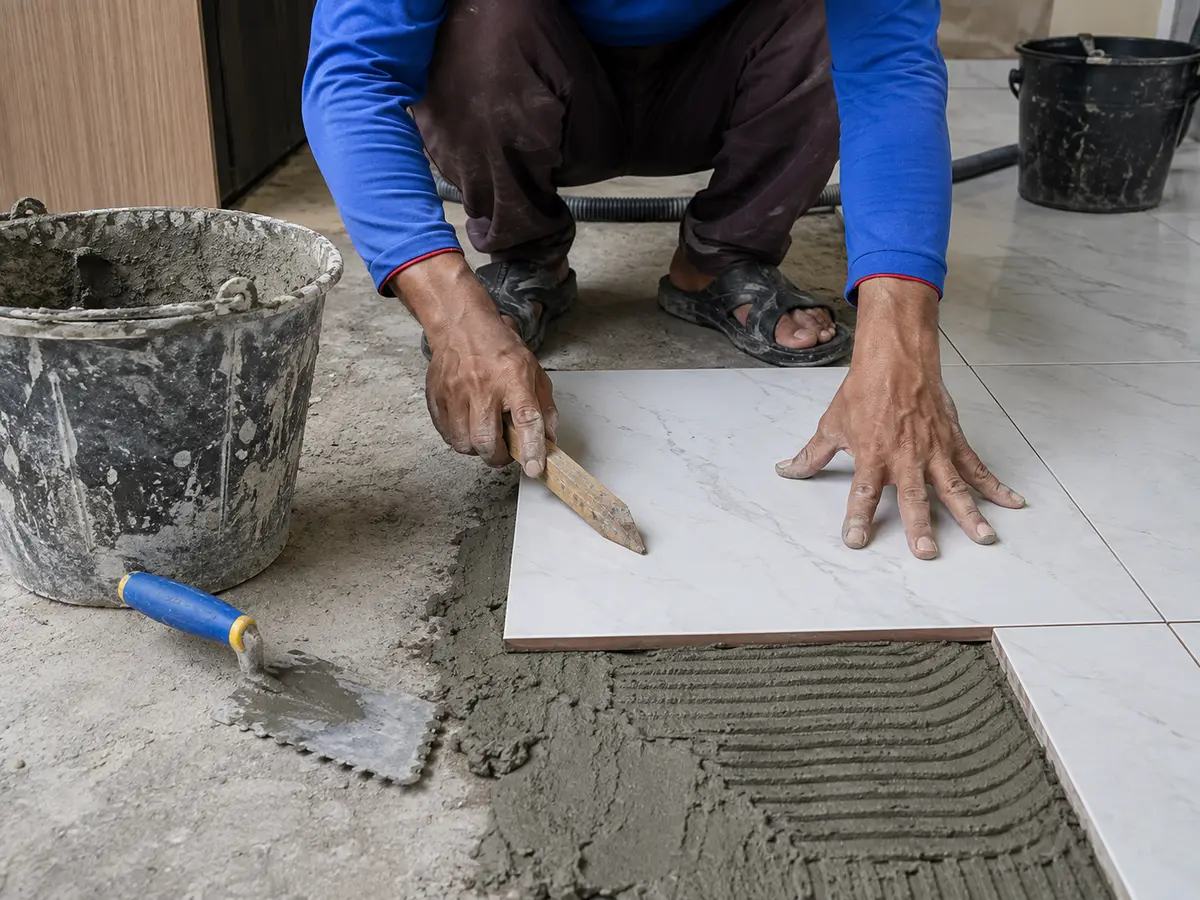
Adhesive is meant to go down as a solid bed, combed out with a notched trowel so the ribs collapse into continuous contact. On a fast programme what happens instead is spot bonding, or dot and dab: five blobs, one per corner and one in the middle. The tile sits flat, the floor looks finished, and well over half its back rests on air.
BS 5385-3, the British code of practice for internal floor tiling referenced by many UAE specifications, is unambiguous: floor tiles are to be solidly bedded with voids eliminated as far as possible. Adhesive manufacturers put a working number on it, generally around 95 per cent contact on floors, and add that a large tile needs adhesive combed onto its back too. Large format is what this market fits, and a 600 by 1200 mm porcelain plank has enough unsupported span that a void stops being a sound and becomes a hinge.
Three other causes change the repair rather than the diagnosis: a screed still shrinking months after the pour, a thin screed that flexes underfoot, and moisture reaching a void, since cement-based adhesive that stays wet loses strength. That last is where who pays after a leak stops being an abstract question.
A building still moving under finishes fixed early shows it elsewhere too: the same towers produce doors that stick and drag as frames go out of square.
The Dubai driver: one room, two temperatures
Everything above happens anywhere tiles are laid badly. What is specific here is what then loads the floor.
Take a living room with floor-to-ceiling glazing down one side. From late morning, sun heats a strip of tile a metre or two deep along the glass, while the rest of the room sits under a split system holding the air near a 24°C setpoint. One part of a continuous tiled field expands; the part next to it does not.
Tiles push against tiles. Given somewhere to go, the movement is absorbed. Boxed in — grouted hard to the walls, trapped under skirting, run unbroken from the balcony threshold to the far wall — the stress resolves at the weakest point. Where tiles are well bonded that point is the tile body, and you get a crack. Where they are not, the field lifts.
Where it shows up first
Balcony thresholds, where an unshaded external slab meets a conditioned internal floor and both were tiled through as one. The sunlit strip along glazing. Doorways, where a narrow neck of tiling carries the movement of two fields at once.
Why it turns up at the end of the season
Through summer, roughly March to October, the floor repeats one cycle daily: heat in by afternoon, cooled back overnight. Each cycle is small and the damage cumulative, which is why tiles rarely tent on the hottest afternoon of July. They tent once a season of it has walked a field, a fraction of a millimetre at a time, into a position it cannot come back from. Early September is when a floor that spent the summer loading up finally gives.
Does your floor have anywhere to move?
A tiled floor is supposed to stop short of every wall and fixed object, leaving a compressible perimeter joint that the skirting hides. That gap is not a cutting tolerance. It is the only room the floor has.
Look at where tile meets skirting in a corner. Visible grout or hard mortar filling that line means the joint is doing nothing, and skirting bedded straight onto tile in cement means the same. Slide a stiff card down behind it: the card should find soft sealant or a void, not resistance.
Large fields need intermediate joints too: a deliberate soft line cut across the tiling, not only at its edges. Manufacturer guidance on movement joints is blunt: movement accommodation is necessary in all floor tile applications, because it stops materials cracking and tenting, with joints suggested at roughly 6 m intervals in any direction.
Reading a crack
A cracked tile looks like a broken tile, and a broken tile looks like something that was dropped. Run a finger the length of the crack before you accept that story.
- Straight and continuous, crossing several tiles and their grout. It is following a crack in the screed or slab. Replace the tiles above and the new ones split along the same line inside a year.
- One tile, cracked outwards from a point, sometimes chipped at the centre. Impact, and in a tenancy the one crack that is straightforwardly the occupant's.
- Cracked edges and corners, or grout crumbling near a threshold. Compression: the tenting story, caught early.
Who pays: the developer, the landlord, or you
Three regimes can apply to the same cracked tile, and which one you are in depends on the age of the building and whether you own the flat.
Inside the developer's liability window
Dubai's jointly owned property law gives an owner two warranty periods: 10 years from the completion certificate for defects in the structural parts of the property, and one year from the date the unit is handed over for repairing or replacing defective installations. Both sit in Article 40 of Law No. 6 of 2019.
Where a de-bonded floor falls between those two is not something you can look up. The one-year period is written around defective installations and the ten-year around structural parts, so a failed finish gets argued rather than read off the page. What usually settles it is the contractual defect liability period in your sale and purchase agreement, so read that clause before reaching for the statute. Either way the tap-test map belongs on the snagging list, because a defect logged in writing while the building is new is a different conversation from one raised in year three.
In a tenancy
Renting changes who you take the question to, not what the answer turns on. Dubai's tenancy law leaves the landlord carrying maintenance and the repair of defects that interfere with living in the flat. It also lets the contract override that, so the maintenance clause in your Ejari-registered agreement (Tawtheeq, in Abu Dhabi) outranks anything you have read about the default position.
A tile that de-bonded because it was never properly bedded is a defect, and it was failing before you moved in, noise or no noise. A tile cracked by a dropped cast-iron pan is damage, and that one is yours. The same line decides security deposit deductions later, which is why a move-in condition record beats any argument made on the last day.
Past the window, as an owner
Outside the developer's year and outside a tenancy, the floor is yours, which at least means you set the specification instead of accepting whatever a rectification queue sends. Where a crack looks structural, or the tiling runs on into a corridor, call the building's managing agent before any contractor of your own. That is the RERA-regulated company the jointly owned property law puts in charge of common areas, working through its facilities management (FM) team. The same law retired owners associations as legal entities in 2019, and the owners' committee that replaced them advises rather than commissions.
What a repair actually involves
Four options, and they are not interchangeable. Which one applies is decided by the map you made with the coin.
Injection, for an isolated hollow tile
A tile that is flat, unbroken and drums on its own can often be re-bonded without lifting it. A specialist drills a small hole through a grout joint at the tile's edge, injects a low-viscosity resin into the void, then makes the joint good. Same day, no dust sheet over the flat.
Injection will not fill every void, and does not restore the coverage that should have been there. It stabilises one tile. Applied to a tile more than about half hollow, or to a field of them, it is effort spent on a floor that still has to come up.
Lift and re-bed, for a cracked or tented tile
The tile has to come out, and this one is contractor work rather than a weekend job. The grout is cut, the tile broken from the middle so its neighbours survive, the old bed chipped back to sound substrate, and a fresh full bed laid.
The hard part is not the work. It is the tile. Every handover pack is meant to include spares from the original batch, and that box in the storeroom is worth more than it looks: porcelain shade and calibration shift between production runs, so a later replacement reads as a patch. Where the range has been discontinued, and after a few years many have, the choices narrow to a deliberate contrast, a donor tile from inside a wardrobe, or re-laying the room.
Cutting in the joint nobody left
Where the diagnosis is compression, replacing what lifted is half a repair. A joint has to be created: a line of tiling cut out, the perimeter opened behind the skirting, the gap filled with flexible sealant or a proprietary profile instead of grout. Put the tiles back without it and the floor tents again.
When to stop repairing
Patching eventually becomes the expensive choice. The thresholds: drummy tiles forming a connected field rather than scattered singles, a map that has grown between two surveys, a cracked substrate, or matching tiles that no longer exist. Past those, the honest answer is a strip-out and re-lay with joints designed in.
For anything beyond a single tile, have a tile repair specialist survey and map the floor before a scope is agreed. The difference between four tiles and a whole room is settled by the survey.
Stop before you make it worse
Call someone once a tile has tented: the field is under load, and cutting into it carelessly releases that load unpredictably. Call when a crack crosses several tiles, when hollow tiles cover a connected area, or when the floor is in a wet room. And if the building is inside its warranty year, the first call is the developer or the FM office — not a contractor you pay yourself.
Never lift a tile in a bathroom or on a balcony to see what is underneath. There is usually a waterproof tanking membrane down there, and a chisel through it turns a tiling problem into a leak into the flat below.
Frequently asked questions
Is a hollow-sounding tile always a defect?
No. A few scattered drummy tiles are common in volume construction and many never move again. What signals a real defect is the pattern: a connected run, tiles clustered along a wall or threshold, or a count that grows between surveys. Map them, photograph the map, and re-check in a few months.
Can I just replace the cracked tile and leave the rest?
Only if the crack stopped at that tile. A crack running straight through several tiles and the grout between them is following the substrate, and a fresh tile laid over a moving crack splits along the same line. Deal with the substrate first, then replace the tile.
My tiles lifted overnight with a loud bang. Is the building unsafe?
Almost certainly not. Tenting is a failure in the tiled finish, caused by compression with no movement joint to relieve it, and says nothing about the structure holding the building up. Keep people off the raised area, photograph it untouched, and report it in writing if the unit is inside its warranty year.
Do I need to keep the spare tiles from handover?
Yes, and store them where nobody will clear them out. Porcelain shade and calibration vary between production batches, so a tile bought later rarely matches once daylight crosses it. One box from the original run is the difference between an invisible repair and a visible patch.
Booking tile repair on Everlook
Hollow tiles compound. One drummy tile left through another summer becomes a cracked one, then a lifted pair, and a job that started as a single tile ends as a re-laid room in a range nobody can match. Everlook connects you with licensed UAE tile repair contractors: verified credentials, transparent quotes, and reviews from real Dubai customers.
Find your next pro on Everlook
Describe your job once, get quotes from verified UAE contractors. Free, no commitment.
Find your next pro on Everlook
Post a job in minutes and get offers from trusted local contractors. Free to start.
Get started