Can You Tile Over Existing Tiles? Six Checks for the Floor, Walls and Shower
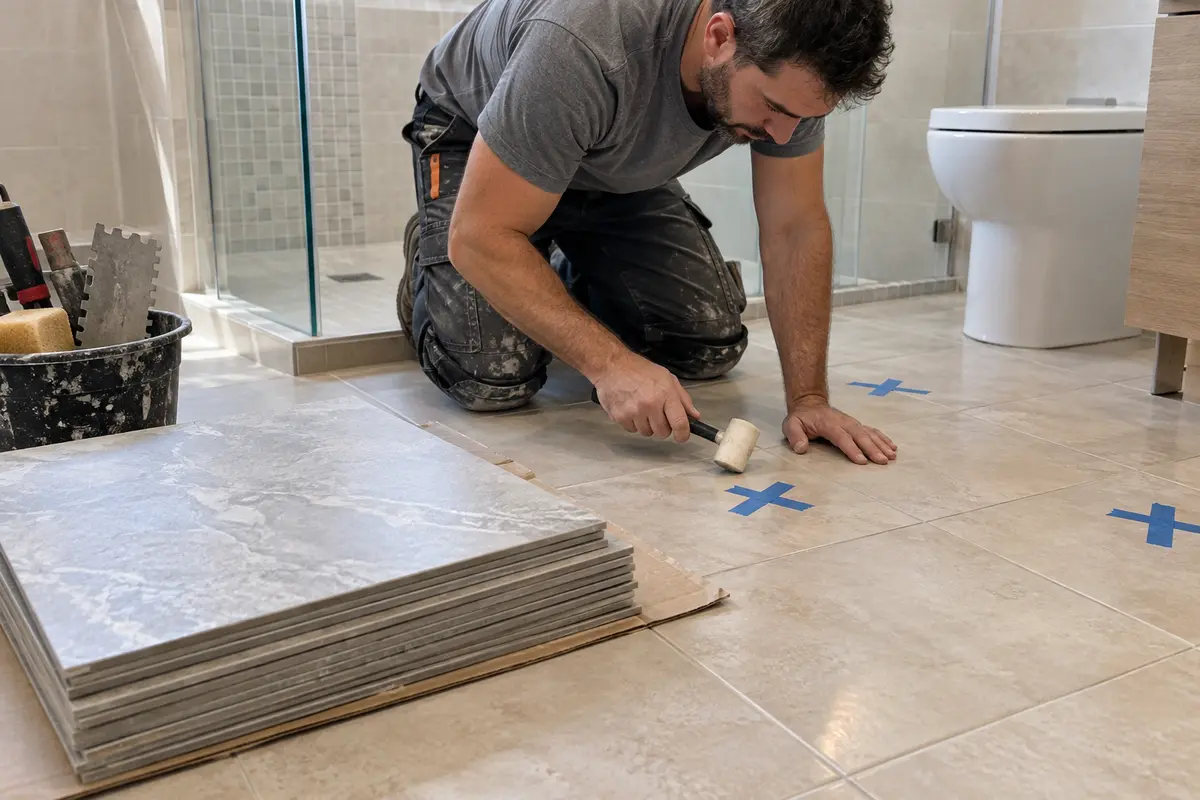
The old tiles: bonded, uncracked and clean enough to glue to
Three makers' instructions for laying tiles over tiles open with the same condition. Mapei's data sheet for Eco Prim Grip Plus, a primer sold for this job, says existing tiles must be well bonded to the substrate with no cracks. ARDEX's tile-on-tile bulletin wants a surface "sound with no loose or drummy tiles". Weber's fixing guide says hollow-sounding tiles must be removed and replaced or repaired.
None of them names an acceptable share of hollow tiles. ARDEX gives the reason: the new layer still depends on the old one staying stuck, so a tile that has let go of the screed takes the new one with it.
The same documents set the preparation. Mapei says to remove oil, wax and dust with a cleaner or by abrading the surface, then prime, and ARDEX's minimum is a sugar-soap wash, a rinse and a full dry. In a bathroom most of what has to come off is soap film and limescale. Mapei's primer goes on between 5°C and 35°C, which in a Dubai summer means the AC stays on while it dries. The adhesives the makers list for tile on tile are improved, deformable cement types, classed C2 with S1 in the code under EN 12004.
How to check. Tap every tile to be covered and mark the ones that drum, using the tap test from the guide to hollow and cracked floor tiles. Then look for a crack running straight through several tiles and their grout.
What the check cannot tell you. A tile can sound solid on a screed that is still moving. That straight crack is the warning, and its cause has to be known before anything is laid on top.
When it fails. A few scattered drummy tiles can be cut out and the gaps filled flush with repair mortar, as Mapei's data sheet provides. A connected run of them, or a crack crossing the room, means the old layer comes off. If the real complaint is black grout in a sound shower, a clean or a regrout may fix it without new tiles.
Flatness, and why large tiles ask more of the old floor
A new tile ends up as flat as the surface under it. Old floors can have lipped edges and recessed grout lines that a thin adhesive bed bridges badly.
How to check. Lay a 2 m level across the floor in several directions and look for daylight under it. Large format tightens the limit: the North American installation standard allows about 3 mm over 3 m under tiles with an edge over 380 mm, half its figure for smaller ones. Scaled to the 2 m level, that is a gap of about 2 mm.
When it fails. ARDEX notes that large tiles over old ones may need a smoothing coat first. It adds height and drying time, so it belongs in the quote.
Walls: what the old tiles are fixed to
On a wall, both layers hang from whatever is behind the old tiles. ARDEX says heavy and large-format tiles over existing tiles "should not be considered a safe installation".
Weber's wall-tiling table gives the limits, each including adhesive and grout: 20 kg per square metre on plaster, 32 kg on plasterboard tiled direct, 60 kg on sand and cement render. Makers' environmental declarations put 10 mm porcelain at about 22 kg per square metre before adhesive. The new porcelain alone passes the plaster figure, and with the old layer it passes the plasterboard one too. Rendered blockwork has room.
How to check. One bathroom can mix rendered block and board, with board most likely where pipes or a concealed cistern are boxed in. The cistern's access panel or the edge of a socket box usually shows which; if not, ask the tiler to confirm before quoting.
When it fails. On plasterboard or plaster, the old tiles come off before anything heavy goes up. Kitchen walls have their own makers' rules, covered in the guide to backsplash materials behind the hob.
Where 12 to 16 mm of extra floor runs into the flat
An overlay adds the new tile plus its adhesive bed. Indoor porcelain is commonly 9 to 10 mm thick (RAK Ceramics lists a 60 by 120 cm range at 9 mm), and Weber lists a 3 to 6 mm bed for its adhesive over existing tiles. That puts a floor overlay at roughly 12 to 16 mm, more with a smoothing coat. Take a tape measure to each place it lands:
- Internal doors. Measure the gap under each door that swings over the new floor. If it is smaller than the overlay plus clearance, the door is trimmed.
- The front door. In a tower it is normally fire-rated, and the gap beneath it is part of what was certified. A tiler should not trim it: ask the building first, or stop the new floor short of the door.
- Thresholds. Where the overlay meets a floor that stays, the step is the full overlay height. Agree where the tapered profile goes.
- Toilet and shower screen. A floor-mounted WC is refitted at the new level, and a glass screen standing on the old tiles is refitted or its door may catch.
- The floor drain. Its grating has to rise to the new surface. Ask the tiler to name the extension piece for your drain.
- Wall fittings. A wall overlay moves the face out. Flush plates and socket fronts need longer screws, and concealed mixer bodies work within a depth range: Grohe gives 75 to 105 mm for its Rapido SmartBox and sells 25 mm extension sets.
The fall to the drain has to survive too. When the tiles are set, pour a jug of water near the walls and watch it reach the drain without pooling.
Showers: the overlay inherits the old waterproofing
In a shower, what keeps water out of the flat below is a membrane under the old tiles, and an overlay leaves it as it is, breaks included. ARDEX says a new layer of tiles in a shower recess will not remedy waterproofing problems unless the leak itself is addressed.
How to check. Look for signs that water is getting out: a stain or blistered paint on the ceiling of the flat below, which the neighbour or the building's facilities team may already have raised, or damp skirting just outside the shower. Do not chip out a tile to look: a chisel through the membrane makes the leak you were checking for.
What the check cannot tell you. A dry ceiling below shows only that nothing has come through so far. A wet one shows that water escapes, and where from is a separate question: a supply pipe, the trap and waste connection and a failed silicone joint can all mark the same ceiling as the membrane can.
When there are signs of a leak. Have the source found before any tiling is agreed. A leaking pipe or waste joint is a plumbing repair, after which the shower may still take an overlay. A failed membrane means stripping the shower to the screed, inspecting the drain connection and laying a new one. That is plumbing and waterproofing as well as tiling, and a bathroom renovation contractor quotes it as one job.
When the shower is sound. Some membranes are made to go on top of old tiles. Mapei lists Mapelastic AquaDefense for "existing coatings in ceramic", with a water-tightness test possible 12 hours after the final coat, before tiling. Sika's sheet membrane names "overlaying existing, interior, firmly fixed ceramic tiles" among its uses. Either way the membrane has to be sealed into the drain with a piece made for that system, and taped at every wall-floor corner. Ask for the system by name and for photos of the flood test.
Soft joints in the old floor come up through the new one
A tiled floor needs flexible joints at its edges and across large areas, so it has room to expand. ARDEX says movement joints in the underlying tiles must be continued through the new layer, with control joints added where the tiling standard calls for them, or the new tiles can crack.
No source found gives a Dubai figure for their spacing. The nearest is the North American method known as EJ171, which, as industry summaries put it, allows about 6 to 7.5 m between joints indoors but no more than about 3.7 m where interior tile gets direct sun. A living room with a strip of sun along floor-to-ceiling glazing and the rest under the AC is that second case.
How to check. Find the soft joints the old floor has: sealant along the skirting, a flexible line across a doorway. If there are none, the overlay is the chance to add them, so ask the tiler to mark the joint lines on a sketch.
The building's rules, and the scope to get in writing
Work inside a flat in a tower still runs through the building's managing agent, the RERA-regulated company that Dubai's jointly owned property law puts in charge of the common parts. Rules vary by building, and many want a notice or NOC before a contractor brings materials up in the service lift. A strip-out adds chiselling noise, debris bags and often tighter working hours. Ask in writing what your building needs for each, and whether stripping a shower to its membrane counts as a modification.
The full order for owners is in the owner's approvals sequence. A tenant needs the landlord's written consent before any of it.
Whichever way the checks fall, put the answers in the quote so two tilers' offers line up. Send this list with your job for floor and wall tiling:
- which tiles drummed, and whether they are cut out and refilled or the whole layer is stripped;
- the cleaning or grinding method, and the primer and adhesive by product name, with the data sheet that lists tile on tile;
- the finished height, and which doors, thresholds, fittings and drain parts change because of it;
- where the movement joints go;
- for a shower, either the named overlay membrane and its flood test, or a strip-out and new waterproofing.
Each line has to be settled before the adhesive goes down. Once the new layer is on, a drummy tile or a tired membrane is sealed under it, and reaching it means breaking out both layers. Everlook lists vetted tilers across the UAE with verified licences, transparent pricing and reviews from your neighbours, so the same list can go to several at once.
Find your next pro on Everlook
Compare licensed contractors in your area in under a minute. Free to post, no signup needed to browse.
Find your next pro on Everlook
Post a job in minutes and get offers from trusted local contractors. Free to start.
Get started