Post-Construction Cleaning in Dubai: What It Covers and Why Normal Cleaning Won't Do It
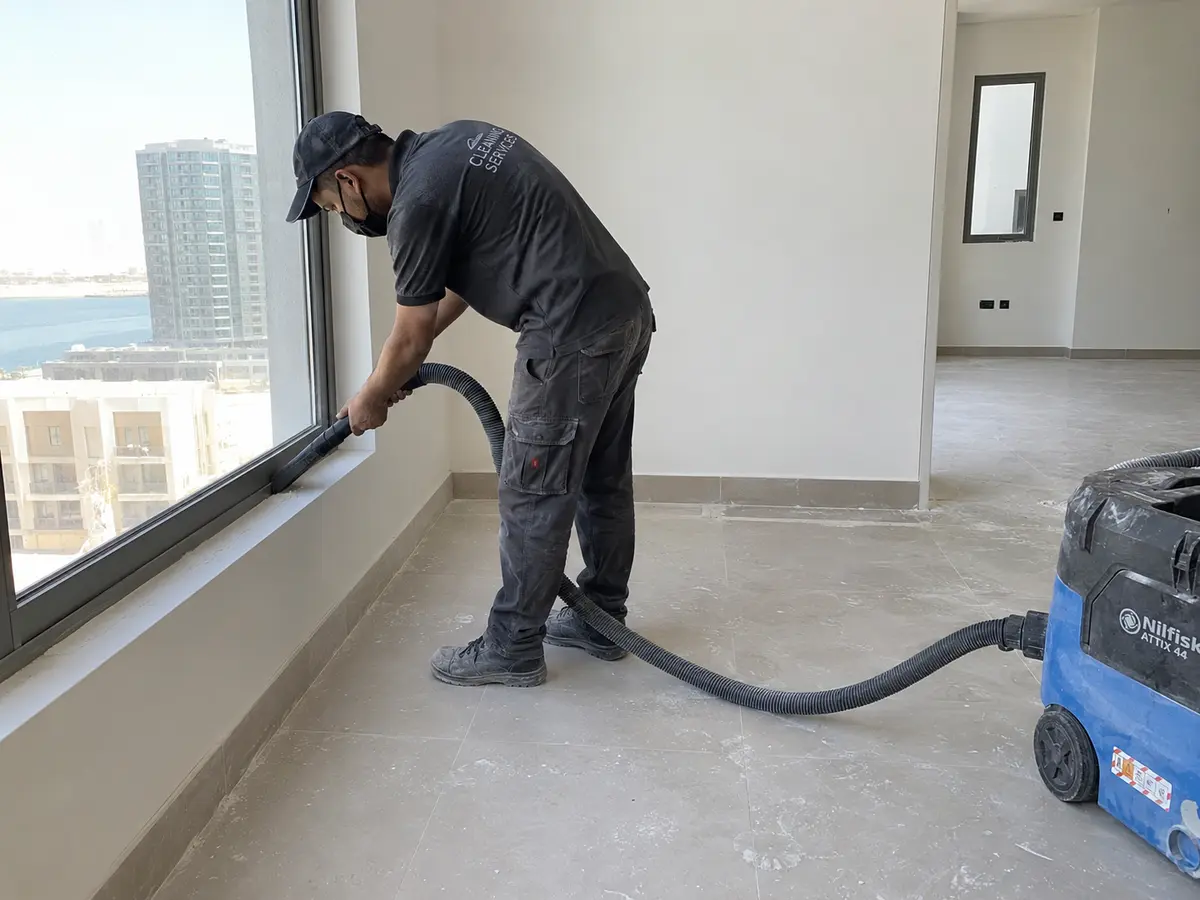
First, check three things before you book anything
Post-construction cleaning goes wrong at the booking stage more often than on the day. Three checks, none longer than a minute, decide whether you are buying one visit or three.
Has the last trade genuinely finished? Silicone, touch-up paint, the final fix of sockets and handles, one door that still needs easing. Any of those outstanding and the unit is dirty again by the time it is done.
Run a fingertip along the top of a door frame and down a skirting line. Household dust smears. Construction fines feel gritty and leave a pale, chalky film that returns within a day of being wiped — that film is the tell that this is a different job.
Look at the return-air grille on the AC. A grey mat on the filter behind it means the system ran during the works, and the dust it collected now has a delivery route into every room.
Then note two facts about the job: whether a wet trade was involved (tiling, screed, plaster, gypsum board) and whether debris is still in the unit. Both change what you buy and when the handover walk-through can happen.
The three passes, and what each one removes
This is a trade step in its own right, sitting between the last worker leaving and your furniture coming back in. It is normally more than one visit, and one visit booked at the wrong moment is how owners pay twice.
Pass one: the rough clean, while final fixing is still going on
Booked while trades are still on site, this pass takes out what cannot be vacuumed: offcuts and packaging, protective film and masking tape, labels on glass and sanitaryware, spent sealant cartridges, bagged rubble waiting to go down. Then a coarse sweep and an extraction pass across floors, so the finishing trades stop walking grit through fresh grout.
Pass two: the detail clean, once the last fixture is in
The long one. A crew opens things up: light fittings and switch plates, window and balcony door tracks, the tops of wardrobes and kitchen units, skirting and door-frame edges, the kitchen ceiling void where an extractor duct runs, the U-bend trap under every basin.
Cement residue, grout haze and paint spatter come off here, each by whatever method the surface underneath will tolerate. Glass and mirrors are done last, because everything above them sheds while the work goes on.
Pass three: the touch-up before handover or snagging
Short, cheap to add and easy to leave out of a quote, so name it when you ask. Between the detail clean and your walk-through more fines drop out of the air, fingerprints go onto door furniture, and anyone carrying furniture in marks a hallway. It takes the least time of the three, and it is the pass the inspection sees.
Why a regular cleaner will not get there
A routine cleaner and a construction site are mismatched at three points: the dust, the machine, and the chemistry.
The dust is abrasive and it is alkaline
A 2021 characterisation study of cement and concrete dust, published in the International Journal of Environmental Research and Public Health, measured more than 90% of particles below 2.5 micrometres, portlandite (calcium hydroxide, the alkaline fraction) at 38.5% by weight in cement dust, and over 30% crystalline silica in concrete dust. The larger fragments had sharp edges and pointed corners.
Dry-wiping that across glass, polished porcelain or chrome drags hard, angular particles over the finish and leaves fine scratching — the haze is in the material now, and no product lifts it off. The alkalinity dulls anodised aluminium, so window frames and balcony door profiles go patchy where somebody has scrubbed them dry.
A domestic vacuum is the wrong machine for this
A household vacuum handles lint, hair and floor grit. Particles this fine pass through its filter media and out of the exhaust, so the room reloads while you work, and the abrasive fraction that stays inside grinds the motor bearings.
Site equipment is classified for the job: under the international standard for industrial wet and dry vacuum cleaners, a dust class M machine must hold 99.9% filtration efficiency and carry an airflow alarm that sounds before suction drops too low. Asking what extraction a contractor brings is the fastest way to tell whether they have done this before.
Grout haze comes off by method, and the wrong method costs you a surface
Grout haze is the thin cementitious film left across tile after grouting. Detergent will not shift it; it needs a dedicated remover with dwell time, or a mechanical pass with the right pad. The trap is chemical. Most haze removers are acidic, and manufacturers put the limit on the label: keep them off polished marble and other acid-sensitive stone, because acid etches calcium carbonate on contact.
Paint and adhesive spatter runs the same way, with solvent choice set by what sits underneath. A routine deep clean is scoped and staffed for a lived-in home, and what that booking is built to reach is worth holding against a post-construction quote before you sign either.
Where the dust actually hides in a UAE home
Fine particulate settles where air slows down and where nobody has ever wiped.
The cooling system, which is the one almost everyone misses
If the AC ran during the works, the indoor unit has been acting as the site extractor. A split unit pulls room air across the return-air grille and the filter behind it, so every hour of running packed fines into the filter, onto the evaporator coil and, on a ducted system, into the duct run.
That is why a flat which has been finished, cleaned and signed off keeps greying over the following fortnight — the system re-deposits what it collected every time it cycles. Mini-split owner's manuals are direct about it, instructing owners not to run the unit during decorating work, and running it anyway can put warranty cover on the affected components at risk.
Treat a coil and filter service for the cooling system as its own line item, and schedule it ahead of the final pass, so whatever comes out of the vents lands on a surface someone is still going to wipe.
The rest of the list, in the order crews find it
The kitchen ceiling void first, where the extractor duct and often the water heater sit behind a removable panel. Fines get in through every service penetration and drop back down the first time the extractor runs at speed.
Then U-bend traps and floor drains, which take tile slurry, grout washings and brush water because they are the nearest outlet. Slurry sets hard, and a trap full of it is a slow drain this week and a blockage next month.
Then the ones you walk straight past: window and balcony door tracks, where grit grinds the rollers and the seals every time the door slides; skirting lines and the gap under kitchen units; light fittings and switch plates, where dust sits inside a diffuser and shows the moment the lamp goes on.
Anything fabric left in the unit has been filtering the air throughout. Sofas, mattresses, curtains and rugs hold fines below the surface where a vacuum head has no pull, and each is a separate booking with its own machine. The intervals and method questions for upholstery and rugs apply with the clock brought sharply forward.
Debris is a separate waste stream and a separate job
Construction debris does not go down a tower's rubbish chute or into the residential bins. Dubai sorts waste into five streams (general, green, construction and demolition, liquid and hazardous), and the UAE government's waste management overview sets out how each is handled and who regulates it.
That material moves through registered waste companies. Dubai Municipality monitors them through a smart tracking system called Rasid, and its waste department publishes circulars and technical guidelines covering collection and transport of this stream.
Get the boundary right before anyone quotes. Under a normal works contract the contractor removes their own debris (offcuts, packaging, broken tile, bagged rubble) through a licensed carrier as part of the job, while the cleaning crew is equipped for residue: dust, haze, spatter, slurry in the traps. Where those responsibilities meet deserves a written sentence in both quotes, because a crew arriving to find six bags of rubble in the hallway is a dispute on the day.
In most Dubai towers there is an access layer on top of that. Building management typically requires a booked and padded service lift slot, named passes for anyone carrying material through common areas, and a documented route out, with the works deposit standing behind damage to a lift door. Terms vary by building, so ask the FM (facilities management) team what applies before removal is scheduled. Where the works are still ahead of you, the order approvals and NOCs come in is the stage at which those terms get agreed.
Where the clean belongs in the sequence
Two ordering mistakes account for most of the money wasted on this job.
The first is booking the detail clean while a trade is still outstanding. Silicone, touch-up paint, the final fix of sockets and handles: each puts residue back into a room that has just been finished, and you pay a second crew to undo it. Confirm the last wet and dusty operations are done, then book.
The second is walking the unit for snagging before it has been cleaned. Dust hides precisely the defects the inspection exists to find: a hairline crack in a grout line, a chipped tile edge, a scratch across a worktop, an uneven paint cut-in. A snag list compiled through a grey film is a short list — and where a defect liability period applies, the reporting window is finite, so that short list is the one you are held to.
The workable order runs: trades finish, debris out, detail clean, inspection walk-through, defects fixed, touch-up, move in. Anything repaired after the walk-through makes its own mess, which is what the third pass exists for.
Booking windows through the cooler months
Renovation work in the UAE clusters into the cooler half of the year, roughly October to April, once the heat and the summer working restrictions stop pushing façade and open-window jobs out of the calendar. Crews with the right equipment get busy on the same curve, so if your works are being booked now for the autumn, put the passes in the diary alongside the trades and hold the dates loosely. Keep the glazing shut once the flat is clean: a shamal drops desert dust through an open window in an afternoon.
What you can finish yourself, and where that stops
Some of this is genuinely yours to do, and doing it saves a pass.
The final wipe-down in rooms that are already dust-free is straightforward: worktops, shelves, emptied cupboards, door furniture. So is laundering soft furnishings that fit in a machine, bagging protective film and packaging as it comes off so it never becomes debris anybody has to remove, and glass at arm's reach once the abrasive layer is off it. Wet first, always. A dry cloth on construction dust is how a window gets scratched.
Five things belong to a crew with equipment. Fine-dust extraction, because without an M-class machine you are moving dust between rooms and calling it cleaning. Grout haze and spatter over natural stone, where a wrong product does damage a second attempt cannot reverse. The whole AC path, from filter to coil to ducting. High-level and external glass, which past a step ladder needs access equipment and the building's written permission. And traps that have taken slurry.
The other half of the decision is which product you buy. A deep clean is priced, timed and staffed for a lived-in home, so a crew arriving with domestic kit onto a construction-dust job under-delivers at both ends: they cannot reach what has to be reached, and you have paid for a service built to do something else. Ask instead for a post-construction clean quoted pass by pass, and name the passes you want in the request.
Frequently asked questions
How long does post-construction cleaning take in a Dubai apartment?
Budget around two working days across all three passes for a one- or two-bedroom flat, and longer in a villa or where tiling and joinery were extensive. The rough clean takes a few hours, the detail clean absorbs most of the total, and the touch-up is usually half a day. Crew size moves that as much as floor area.
Should debris removal sit in the contractor's quote or the cleaner's?
The contractor's, in almost every case. Removing their own offcuts, packaging and rubble through a licensed carrier is normally part of a works contract, while a cleaning crew's scope stops at residue. Write the boundary into both quotes, and confirm which party books the service lift slot for the removal.
Does the AC need more than a filter change after renovation work?
Usually, yes. A filter catches what reaches it, while the evaporator coil, the blower wheel and the return-air housing hold the rest, and anything that got into ducting keeps re-entering the room for weeks. A full AC chemical wash is the normal remedy after building work, with its own technician and equipment.
What should I ask for when requesting quotes?
Name the passes you want and the date each is expected. Ask what dust extraction the crew brings, whether natural stone is present and how they will treat haze on it, whether the cooling system is included, and what happens to debris still on site. A quote answering those four can be compared against another. One reading only "deep clean" leaves you guessing.
Is post-construction cleaning needed if only one room was worked on?
Often yes, at reduced scope. Fine dust travels on air movement and a closed door does not stop it, a running cooling system distributes it through the flat, and a shared building riser can carry it between units. Clean the worked room properly, service the AC, then inspect tracks, traps and skirting lines elsewhere.
Booking post-construction cleaning on Everlook
Everlook lists licensed UAE cleaning contractors with verified credentials and reviews from real Dubai customers. Sort by response time and rating, then read what each crew proposes to do: the extraction class they bring, the passes they will quote for, whether the cooling system sits inside the scope. With three offers side by side you can compare method against method and pick the crew whose plan matches the state your property is in.
Find your next pro on Everlook
Compare licensed contractors in your area in under a minute. Free to post, no signup needed to browse.
Find your next pro on Everlook
Post a job in minutes and get offers from trusted local contractors. Free to start.
Get started