Deep Cleaning vs General Cleaning in a Dubai Apartment: What You Actually Need
When a general home clean is the right booking
General home cleaning is a cadence service. It holds a line rather than moving one, and the point of booking it regularly is that the apartment never gets far enough out of hand to need something heavier.
A standard visit runs roughly two to three hours in a one-bedroom flat. It covers what you see and touch daily: floors vacuumed and mopped, worktops and dining surfaces wiped down, bathrooms sanitised at the basin, toilet, shower tray and mirror, kitchen cabinet fronts and the hob top lightly degreased, beds made, bins emptied, and the interior face of windows and balcony doors cleaned. Many contractors will also dust the outside of the AC vent grille.
Weekly suits an apartment occupied full-time, where someone cooks most evenings, or where the balcony door gets opened. Fortnightly is usually enough for a couple who eat out often, travel for work, or live high up in a sealed unit with the cooling running flat out from March to October.
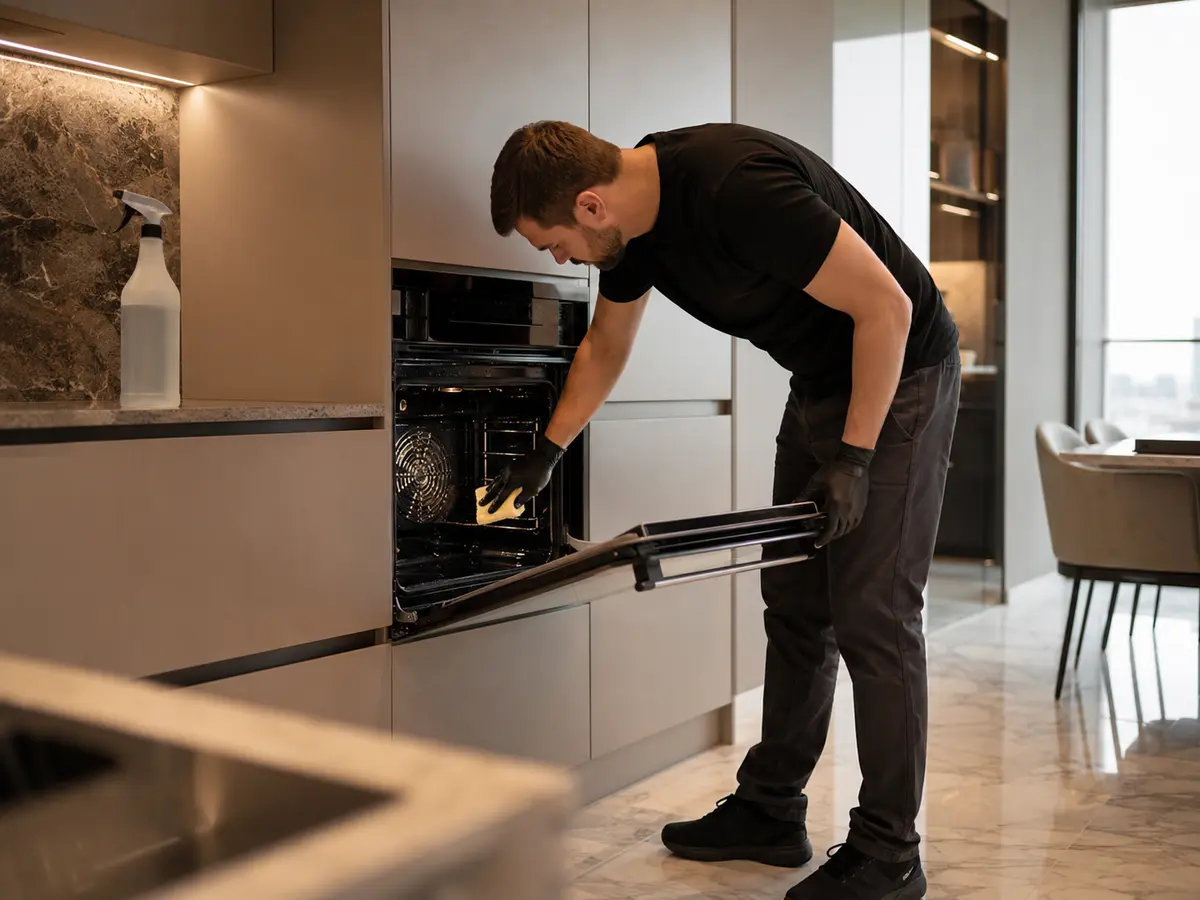
What the visit cannot do is reach anything that needs dismantling, moving, or soaking. Your cleaner will wipe the front of the oven; they will not strip the carbonised layer off its inner walls. They will wipe the shower screen; they will not take a descaler to the mineral haze that two years of evaporation has left on the glass. Those developer-installed fixtures accumulate a specific kind of residue that a cadence service is not equipped to remove.
When the apartment needs a deep clean instead
A deep clean is a reset, not a longer version of the same visit. It is a different job with different tools, a different crew size and a different unit of time. A one-off apartment reset typically absorbs four to eight hours in a one-bedroom flat, and a three-bedroom can run past a full working day.
What a deep clean physically reaches
The list is specific, and it is worth reading before you book so you can hold it against the quote you are given.
- Kitchen: oven interior and racks degreased, hob burners and trivets removed and soaked, extractor hood filter degreased or replaced, the inside of every cabinet and drawer emptied and wiped, and behind and underneath the fridge, washing machine and dishwasher wherever they can safely be pulled out.
- Bathrooms: grout scrubbed line by line, shower screens and taps descaled, showerhead soaked, drain covers lifted and cleared, extractor fan grille removed and washed, and silicone seals treated for surface mould.
- Whole apartment: the inside of wardrobes and built-in storage, skirting boards, door frames and door tops, light switches and socket faceplates, window tracks and runners, balcony tiles and railings, AC grilles and accessible vent covers, and interior glass throughout.
The difference is operational, not adjectival. A general clean is measured in surfaces covered. A deep clean is measured in things opened, lifted, soaked and scrubbed.
The triggers that should put one in your calendar
Deep cleans work best booked against events rather than a vague sense that the place feels grubby. Five triggers cover most tenancies.
Before you move in. The unit has been empty, possibly for months, with fine particulate settling through window gaps and nobody running the cooling. Book the reset before the furniture arrives, while every cupboard is still empty and every corner still reachable. If you are also recording the condition you received the place in, it pairs naturally with the handover-day inspection walkthrough.
After construction or fit-out work. Gypsum dust and sanding residue travel further than anyone expects, and they are abrasive, so wiping them with a damp cloth scratches the surface you are trying to save. This applies whether the work was inside your unit or in the flat next door, because a shared building riser and corridor pressure move fine particulate between apartments.
End of tenancy. Most landlords apply exit-clean expectations at handover, and the dated invoice is the proof. This one has its own sequence: the move-out services playbook and refund timeline sets out what to book and in what order.
After a pest treatment. Residual gels and sprays need a controlled interval before surfaces are wiped, so ask the technician when the clean can safely follow. Cleaning too early strips the treatment and wastes the visit.
Pre- and post-summer. One reset in late February, before the cooling load ramps up, and another in October once it drops off, brackets the hardest months of the year for an apartment here.
What a deep clean usually does not include
This is where booking goes wrong. A deep clean covers the fabric of the apartment: its hard surfaces, its fittings, its built-in storage. It does not, in most quotes, cover soft furnishings or anything on the outside of the glass.
Each of the following is normally scoped, priced and staffed as its own service, with its own equipment, whether that is a hot-water extraction machine, upholstery tooling, or ladder and rope access:
- Sofa and upholstery cleaning
- Mattress cleaning
- Carpet and rug cleaning
- Curtain cleaning, including take-down and re-hang
- External window and façade glass, which on a mid- or high-floor unit needs specialist access
- Water tank cleaning, which in most apartment blocks sits with building management rather than with you
- Duct cleaning and a full AC chemical wash, which is a cooling-system job rather than a cleaning-crew job
Name what you want covered when you request quotes, then read the scope line in the reply. A tenant who books a deep clean assuming the three-seater will be shampooed is going to be unhappy on the day, and the crew that arrives will not be carrying the machine to fix it. If the cooling side is what is actually bothering you, a fixed servicing interval for the unit solves more than any amount of surface work will.
Disinfection is not the same purchase as cleaning
Cleaning removes soil; disinfection targets microbial load, and in Dubai it is a regulated activity. Dubai Municipality publishes a list of accredited cleaning and disinfection companies alongside its approved professional-use biocides. If disinfection is what you need, ask for it by name and check the contractor against that list.
What both services are up against in a Dubai apartment
Neither service is fighting ordinary household dirt. Local mechanisms set the pace, and understanding them is what turns "the place feels dusty" into a booking decision you can defend.
Airborne mineral dust, and the cooling system that redistributes it
The dust here is not domestic lint. Shamal winds carry fine mineral particulate off the desert, and it enters through window frames, balcony door seals and unsealed service penetrations long before anything is visible on a surface. A peer-reviewed survey of settled indoor dust across 20 locations in the city, published in the journal Toxics in 2023, found calcium, potassium, magnesium, aluminium and iron at the highest concentrations of any elements measured — a soil-and-mineral signature rather than an organic one.
Then the cooling system takes over. Through the hot months a split unit runs close to continuously, pulling room air across the return-air grille and the filter behind it. Every hour of that is an hour of particulate being drawn to one point, packed into a filter, and pushed back out across the room. Mineral dust is also abrasive, which is why dry-wiping a dusty glass table eventually leaves it hazed.
Humidity turns grease into film, and rinse water leaves scale
Summer humidity changes the chemistry of household soiling. In a dry climate, kitchen grease settles as a dust-bound layer you can lift with a cloth. In humid kitchens the aerosolised oil from cooking combines with moisture and airborne particulate into a sticky film that bonds to cabinet fronts, extractor housings and the wall above the hob. Film needs a degreaser and dwell time, not a wipe.
Bathrooms follow the same logic with soap residue, which holds moisture rather than drying off. Layer hard water on top and the picture is complete: the supply carries enough dissolved calcium and magnesium to leave carbonate scale on taps, shower screens, glass and showerheads every time water evaporates instead of being wiped away. Scale is not dirt. It is a mineral deposit that has to be dissolved with an acidic descaler, which is precisely the step a two-hour cadence visit has no time for.
Where moisture persists behind sealant or around chilled surfaces, cleaning stops being the answer — mould on walls and around vents is a moisture problem first, and scrubbing it without fixing the source only resets the clock.
Trade-offs to weigh before you book
Cadence versus reset, and why skipping the reset compounds
The most useful thing to understand about these two services is that they are not alternatives. They are a pair, and they fail in a particular way when you run only one of them.
Routine cleaning steadily loses ground to buildup it was never equipped to remove. Grout darkens a shade at a time. Scale thickens on the shower screen. Grease film on the extractor housing goes from wipeable to solvent-only. None of it is visible week to week, which is why people conclude the cleaner is doing a poor job when the cleaner is doing exactly the job that was booked.
Skip the reset for two years and the next deep clean is not the same job — it is longer, harder, and likelier to end with a fitting that cannot be recovered. Descaling a shower screen at six months is a soak and a scrub. At three years the etching is permanent, and that cost does not appear until the panel has to be replaced.
Household factors shorten the interval. Pets shed dander and hair into upholstery and skirting lines. Small children eat and spill at floor level. Anyone with asthma or an allergy has a direct stake in how much settled particulate the apartment holds. A kitchen used hard every evening loads the extractor and the cabinet fronts far faster than one used at weekends. Two or three resets a year is a reasonable default for a couple in a one-bedroom flat, and four is not excessive for a family with a pet. When you are ready to price it, compare cleaning contractors across Dubai and ask each to quote the cadence visit and the reset separately, so you can see what each one is doing for you and adjust the mix.
The tenancy angle for renters
Tenancy contracts here commonly require the property to be returned in the condition it was received, fair wear excepted, and in practice the kitchen and the bathrooms are where inspections slow down. Oven interiors, extractor filters, grout lines and limescale on shower glass are the items a landlord's representative reaches for, because they are objective and photographable in a way that "the flat looks tired" is not.
The practical read: a reset booked a month or two before handover is doing double duty, and the dated invoice is evidence. Where the exit clause is ambiguous, check what your registered contract actually says rather than what the agent tells you; the Ejari record is the document that governs. The mechanics of security deposit deductions and the refund window are a subject of their own, and are covered in the move-out playbook linked earlier rather than repeated here.
Frequently asked questions
How often should a Dubai apartment be deep cleaned?
Two to four times a year suits most apartments. Twice is enough for a lightly used one-bedroom where the balcony door stays shut and nobody cooks much. Four is reasonable with pets, small children, or a kitchen in heavy use. Anchor the bookings to the cooling season rather than the calendar quarter: one reset before it starts, one after it ends.
Does a deep clean include the sofa and the curtains?
Usually not. Sofa and upholstery cleaning, mattress cleaning, carpet and rug cleaning, and curtain cleaning are quoted as separate services, because each needs its own machine and its own drying time. Ask for them explicitly when you request a quote, and check the scope line in the reply rather than assuming the word "deep" stretches to cover everything soft.
Can frequent regular cleaning replace a deep clean?
No. Frequency does not substitute for method. A cadence visit never opens the oven, pulls out the appliances, or applies an acidic descaler with dwell time, so the buildup those steps address keeps accumulating however many visits you book. Regular cleaning holds the surface layer steady while the deeper layer quietly thickens underneath it.
How long should you wait after a pest treatment before deep cleaning?
Ask the technician who carried out the treatment, because it depends on the product used. Residual gels and sprays are designed to stay on the surface and keep working, so cleaning too soon strips them and wastes the visit. Most treatments need a defined settling period before skirting lines, cabinet interiors and floor edges are wiped down.
Is hard water damage to shower glass reversible?
Early scale is; later etching is not. Carbonate deposits sitting on the surface dissolve with an acidic descaler and a long enough soak. Once the minerals have pitted the glass itself, no cleaning product restores clarity and the panel has to be replaced. That is the strongest practical argument for a scheduled reset rather than an occasional one.
Booking your apartment cleaning on Everlook
Cleaning debts compound quietly. Leave the reset for two summers and the grout has darkened past recovery, the extractor filter becomes a replacement rather than a wash, and the shower glass carries etching no descaler will lift — the job you deferred turns into a fittings bill you never planned for. Everlook connects you with licensed UAE cleaning contractors for both the routine visit and the one-off reset, with verified credentials, transparent quotes, and reviews from real Dubai customers.
Find your next pro on Everlook
Describe your job once, get quotes from verified UAE contractors. Free, no commitment.
Find your next pro on Everlook
Post a job in minutes and get offers from trusted local contractors. Free to start.
Get started