Curtain Cleaning in Dubai: How Often Yours Actually Need It
Why curtains load faster in a cooled Dubai flat
A curtain is a large sheet of open textile hanging in moving air. In a sealed apartment that air passes through it several times an hour, making the fabric a filter with no service interval of its own.
The cooling loop pushes room air through the weave all day
A split unit and district cooling look identical from inside the room: air is drawn across a chilled coil, dried, and pushed back out, with almost nothing exchanged with outside. Whatever is suspended in that air keeps going round until something catches it, and a panel hanging near a supply vent or a return grille catches a great deal of it.
The mechanism is plain mechanical filtration. Particles arrive at the fabric, lose velocity in the still layer against it, and settle into the gaps between yarns. That is why weave decides the interval. An open weave offers many shallow gaps per square metre, so it loads fast and shows it early; a dense lined construction loads slowly and holds what it takes far deeper, where a vacuum head has no chance of pulling it back out.
Outside dust arrives with the windows shut
Full sandstorms are rarer than the reputation suggests: a long observational record from Abu Dhabi airport counted roughly three a year against haze on some 242 days — the haze is the part that matters for textiles, because it is continuous.
Shamal winds hold fine mineral particulate aloft for days at a time, and a closed window is only a partial defence: it works past frame gaskets and along the bottom channel of a sliding balcony door long before anyone opens anything. The pair over a balcony door sits directly in that stream and is usually the first to grey along its leading edge. Fit-out work in the building adds a second, harsher stream, because gypsum and cement fines are angular and cut fibre; the scope of a clean aimed at construction fines exists for exactly that reason.
Humidity swings fix the dust in place
Indoor moisture here is not stable. Coastal humidity pushes in whenever the cooling is off, a compressor cycle drops it again, and the fabric rides the swing. Dry dust shakes out of a weave; dust that has taken on moisture and dried again cakes into a film that stays. Natural fibres move with the swing too — Kvadrat notes that a wool curtain can lengthen on the track as temperature and humidity change.
The interval, fabric by fabric
No standards body sets a cleaning interval for domestic curtains. The figures below are where manufacturer care documentation and trade practice converge, tightened for the dust load a cooled flat here carries. A general soft-furnishings schedule says once a year and is right about the average home; sorting by fabric moves most panels in a Dubai apartment ahead of that. Treat them as defaults your own flat overrides.
Sheers and voiles: every 3 to 6 months
The most open weave in the flat, usually the layer left closed all day, and often the one hanging closest to the window seal. It collects fastest and is the cheapest fabric to clean, so there is little argument for stretching it. A sheer that has gone from white to warm grey has already passed the point where one wash brings it fully back.
Unlined cotton and linen panels: about every 6 months
Medium weaves load at a middling rate and tolerate water, which widens your options. Linen is the fibre to watch: Kvadrat's own care documentation for a heavy linen curtain specifies a 30°C wash on a mild process, no tumble drying, and quotes approximately 3% shrinkage along the warp. On a 2.8 m drop that is roughly 8 cm off the floor line, which is visible from the doorway.
Lined, blackout and velvet: every 6 months in a dusty flat
Heavy constructions hide loading well and that is the trap. The face fabric looks acceptable while the lining and the header pleats hold a season of fine particulate, and the first sign is usually a smell that returns each time the cooling starts rather than any visible mark. In a quiet inner bedroom, 12 months is defensible. Anywhere with a balcony door, a road-facing elevation or a household that cooks with the kitchen open, six months is the working figure.
Blinds, and the pair over the balcony door
Roller and vertical blinds carry less fabric but the same exposure, and slats hold dust on the upper face where nobody looks. Twice a year suits any blind in a room used daily, and whichever window opens most often takes the shortest interval.
Five things that reset the clock
Some events put a panel back to zero whatever the calendar says. A respiratory symptom that follows you into one room and eases when you leave it. Fit-out work on your floor. A smoker moving out. Water ingress, or a damp patch on a lining. A shake of the leading edge that visibly clouds the light. Handovers count in both directions: book on the way in and on the way out.
What you can do between cleans, and what it will never reach
For most of the year this is your job, and it takes a few minutes a fortnight. Two habits carry it.
Vacuum with the upholstery attachment, fortnightly. Use the soft brush head on low suction, work top to bottom so you are pulling with gravity, and give the header tape and the top 30 cm the most passes — that band collects the heaviest load and is the part everyone skips. Support the fabric with your free hand so the weight goes into your palm and not into the track fixings.
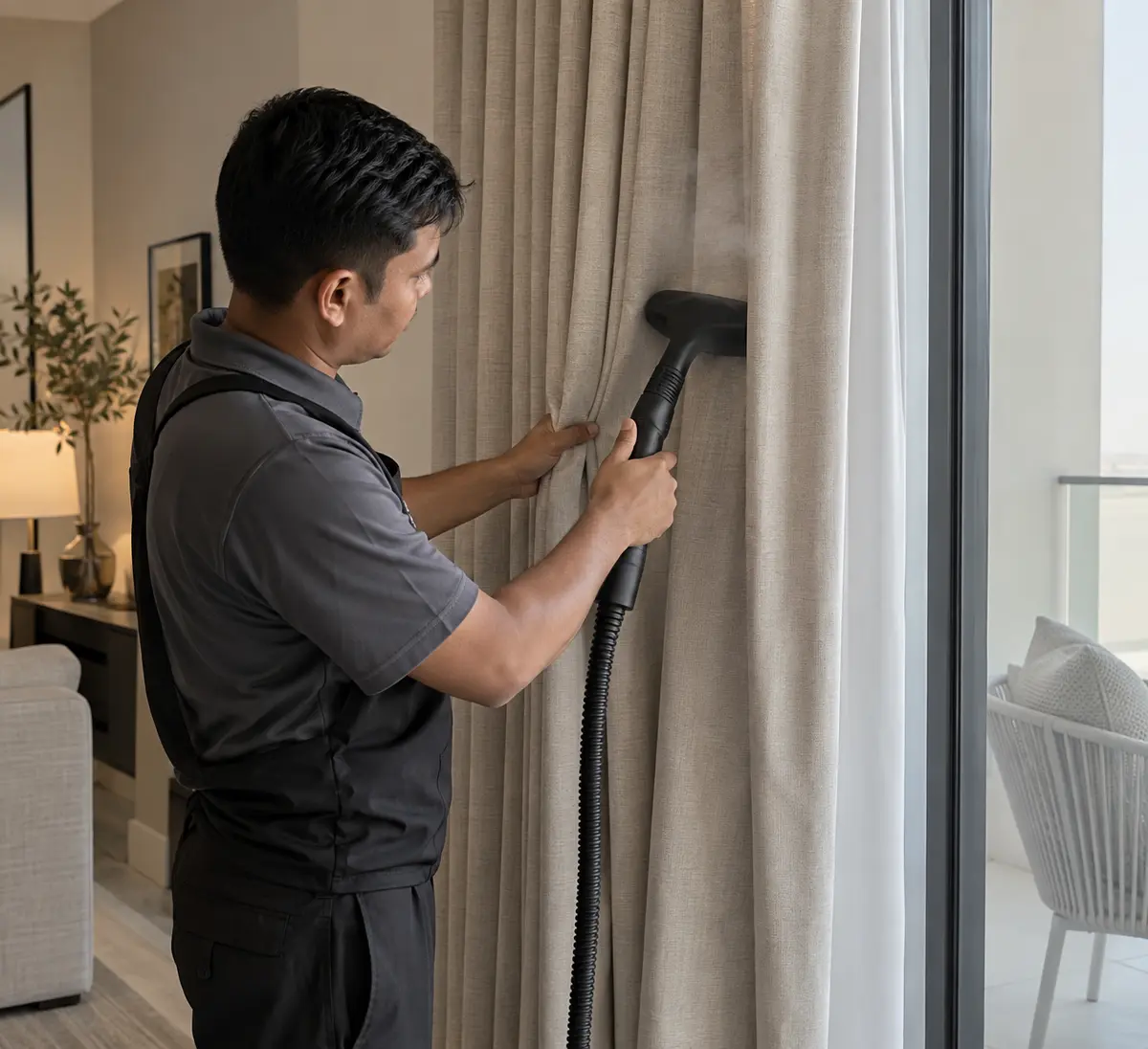
Run a garment steamer down the panel, monthly. A vertical steam pass relaxes creases, lifts light odour and loosens surface particulate so the next vacuum takes more. Keep the head moving and off the fabric, work in a room with the cooling running so the moisture leaves quickly, and never steam a foam-backed blackout lining, where heat and moisture can lift the coating away from its face cloth.
Know the limit honestly. Both of those move dust sitting on or just inside the surface. Embedded soiling is bound into the yarn by that humidity cycle, and shifting it takes agitation plus extraction or a solvent bath. When your own passes stop changing how the fabric looks, the load has moved below where you can reach, and the same threshold applies across every soft furnishing in the flat, as the wider machine-cleaning schedule sets out.
On-site clean or take-down: what each method actually reaches
This decision shapes the whole booking, and most people make it on convenience alone.
On-site, with the curtains left hanging
A crew arrives with a steam unit or a dry-solvent kit and works the panels in place. Nothing comes down, the flat stays usable, and a typical apartment is done in one to three hours with the fabric dry again shortly after. What it reaches is the face and the near-surface load. What it does not reach is the deep reservoir in a lined header or a velvet pile, and it will not fully even out a panel that has greyed unevenly across its width.
Because the same steam kit is already on the floor, this is the visit to bundle. Adding the sofa, the dining chairs or a mattress to the same slot costs one mobilisation instead of two, and a crew set up for fabric work is already holding the right kit.
Take-down, off-site, and the four-day gap
Off-site work opens up full immersion or solvent cleaning, controlled drying and proper stain treatment, which is what a heavily loaded lined pair needs. Plan for the panels to be away around four days door to door, and plan for the window meanwhile: a bedroom with no curtain over a west elevation is a different room to sleep in.
Removal and re-hanging is where tenants get hurt, so check whether it is included before booking. Heavy lined curtains carry real weight, and pulling a track fixing out of plasterboard turns a cleaning job into a repair the landlord will notice. Most curtain cleaning bookings with removal included cover the take-down and the re-hang as part of the service; confirm it in writing instead of assuming.
The constructions that must never be wet-washed
Lined and blackout curtains are two or three materials sewn together, and each moves differently in water. A face cloth that shrinks 3% against a lining that shrinks 1% does not shorten neatly; it puckers along every seam and the panel never hangs flat again. Foam-backed and coated blackout linings add a second failure mode, where agitation separates the coating from the cloth.
Manufacturer care documentation is the authority here and it is specific in both directions — IKEA's room-darkening panels state a maximum 4% shrinkage and carry a do-not-dry-clean instruction, while heavier woven curtain fabrics are labelled for professional dry cleaning and a cold, gentle wash at most. Read the label sewn into the header before anything else, and hand that instruction to the contractor.
Rehang slightly damp and let gravity do the ironing
The oldest trick in the trade, and it survives because it works. A washed panel put back on the track while still faintly damp carries its own weight downwards through the drying process, so the creases pull out on their own and the pleats reset. Fully dried and folded curtains come back with fold lines that then need an iron near a lining that should never meet one. Kvadrat's guidance points the same way, specifying ironing while damp for its curtain linens.
If they re-soil within weeks, read the interval as a symptom
A cleaned curtain that looks tired again inside a month is telling you something about the flat. Cleaning it a second time treats the symptom and buys another month.
Three upstream causes explain nearly all of it, and an afternoon separates them.
A loaded or bypassing AC filter. Pull the return filter and hold it to a window. If light barely passes, it stopped filtering some time ago; if it looks clean but the frame does not seat squarely in its housing, air is going round the edge and carrying everything with it. Either way the filter is the cheapest thing to rule out. If a fresh one greys again within a fortnight, the deposit is coming from further up the system.
Dusty ducting or a fouled coil. Look at the supply grille itself. Grey fur on the vanes, or dark streaking on the ceiling paint fanning out from the grille, means the deposit is coming from inside the system. That is a technician's job with the unit open, and no amount of curtain cleaning offsets it.
A failed window or balcony-door seal. Run a hand along the frame on a windy day, or hold a tissue at the rubber and watch for movement. A fine gritty line on the sill under one window, with the sills elsewhere clean, is close to conclusive. Perished seals are a building-fabric item, so raise it with the landlord or the building's facilities management team in writing.
Once the source is fixed, the curtain interval lengthens on its own.
Before you wash a curtain that came with the flat
In most furnished and semi-furnished lets here, the curtains and tracks are developer-installed fixtures that belong to the owner. That changes what a botched DIY wash costs you.
Dubai's tenancy law is clear on the end state. Under Article 21 of Law No. 26 of 2007, a tenant must hand the property back in the condition it was received, allowing for ordinary wear and tear or damage outside their control. A panel that has shrunk 8 cm, discoloured in patches or lost its blackout coating is none of those things, and it lands as a security deposit deduction at move-out. Article 16 puts general maintenance on the landlord unless the contract says otherwise, so the wording of your own tenancy contract, registered through Ejari, decides who pays for a scheduled clean. Check that clause before you book anything and keep the dated invoice either way.
The practical position: professional cleaning of a landlord's curtains is safe and often part of exit-clean expectations, while a DIY machine wash of the same panels carries the risk. Sequence the fabric work before the hard surfaces, since a deep clean covers the flat itself and each fabric item is scoped separately on top of it.
When to book the next one
Two fixed points a year handle most flats. Book the first once the worst of the shamal activity has passed, so the panels start the long cooling stretch clean. Book the second before you close the flat up for a summer trip, because a sealed, warm apartment is where a loaded lining develops the smell that outlasts the dust.
Hold a third date in reserve for the triggers above, and note the last clean somewhere you will find it a year later.
Frequently asked questions
Can curtains be steam cleaned while they are still hanging?
Yes, and for most apartment curtains it is the sensible default. On-site steam handles surface dust, light odour and creasing in one to three hours with no take-down risk. It will not clear deeply embedded soiling in a lined or velvet panel, and foam-backed blackout linings should be kept away from direct steam entirely, so match the method to the construction.
Do blackout curtains shrink if you wash them at home?
Often, and unevenly, which is the real problem. The face cloth and the lining shrink at different rates, so seams pucker and the panel stops hanging flat even when total shrinkage looks small. Manufacturer labels quote figures up to about 4% and many coated linings are marked do-not-wash or dry-clean-only. Whatever the label sewn into the header says, follow it.
How long are curtains away for an off-site clean?
Around four days door to door for a standard apartment order, covering collection, cleaning, controlled drying and the re-hang appointment. Heavily soiled or stain-treated panels can run longer. Ask for the return date in writing when you book, and arrange something over any bedroom window facing the morning sun before the panels leave.
Is curtain cleaning the tenant's cost or the landlord's?
Routine cleaning during the tenancy normally sits with the tenant, while repair or replacement of an owner's fixture through ordinary use sits with the landlord. Your contract clause usually draws that line, so read it before assuming either way. Where a panel is harmed beyond fair wear, the cost follows whoever caused it, and a shrunken curtain is easy to attribute.
Booking curtain cleaning on Everlook
Curtain problems compound quietly. Leave a loaded lined pair through a full cooling season and the fine particulate bonds into the yarn, the leading edge greys where the balcony door breathes, and a job that would have been a routine clean turns into a panel that no longer matches its twin. Everlook connects you with licensed UAE cleaning contractors — verified credentials, transparent quotes, and reviews from real Dubai customers.
Find your next pro on Everlook
Compare licensed contractors in your area in under a minute. Free to post, no signup needed to browse.
Find your next pro on Everlook
Post a job in minutes and get offers from trusted local contractors. Free to start.
Get started