How Often a Villa Water Tank Needs Cleaning, and How to Check It Was Done Properly
Twice a year, and on a villa the tank is yours
The six-month figure in every water tank cleaning advert traces back to Dubai Municipality. Its Food Code 2020, as Gulf News reported it in 2022, says drinking-water tanks should be cleaned and disinfected at least twice a year. Cleaning firms summarise the municipality's 2024 technical guideline on unbottled drinking water the same way.
Who has to keep to that schedule depends on who owns the tank. DEWA's responsibility ends at the meter, and everything after it, including the tank and the pump, belongs to the owner. In an apartment block that means building management, which is why the tank never appears in what a flat's deep clean covers. On a villa it means you.
The inspection campaigns reported in the press have been aimed at buildings, so nobody is likely to ask a villa owner for a certificate. The schedule is for the water your household cooks with and drinks.
Book sooner than six months when
- There is no record of the last clean.
- The villa is new or newly handed over. Municipality guidance treats a new tank as needing a clean before it is first used, and construction dust finds its way in. Book it alongside the post-construction clean of the house.
- The lid was found off, cracked or unlocked, or the mesh on the vent is missing.
- The house stood empty for weeks over the summer and the water sat still and warm in the tank.
- Tap water has turned cloudy, smells musty or leaves grit in the sink.
That last item is an observation, and it does not always point at the tank. Brown or smelly water from the hot taps only usually starts in the water heater. Discoloured water along the whole street after DEWA works usually comes from the main. If a garden tap fed straight from the mains runs clear while the kitchen tap does not, the tank or the pipes after it are the likelier source.
Rooftop and underground tanks go wrong differently
Many villas have an underground tank of GRP panels or concrete, filled from the mains, and a pump that lifts water to a rooftop tank. The underground one collects sediment and can let ground water in through a crack or a loose manhole cover. The rooftop one sits in the sun all summer, and warm, still water loses its chlorine faster and suits algae. If you have two tanks, the quote should name both.
Choosing the company and getting the house ready
Dubai Municipality publishes a list of approved cleaning and disinfection companies among its health and safety approved lists. Look for the company's name on it, and ask the company for its approval document as well: in September 2026 the list posted there was dated July 2021, so a newer firm may hold approval without appearing on it.
When you request quotes for the tank clean, say which tanks you have, where they are and roughly how big. The capacity is often stamped on a GRP panel or shown in the villa drawings. Ask each company how it measures the disinfectant and what its report contains.
On the day:
- Water will be off for most of the visit. Ask the company for its time window; one villa tank is commonly a job of a few hours, longer with two. Fill buckets beforehand.
- Clear the access. Move the car or planter off the manhole, and clear a route to the roof.
- Agree who switches off the booster pump. Once the tank is drained, a pump left on can run dry and damage its seal. Switch it off at its isolator, or ask the crew to, before draining starts.
- Keep everyone off the taps during disinfection. If the crew draws chlorinated water through the pipes, the taps run water far too strong to drink or wash in until it has been flushed out.
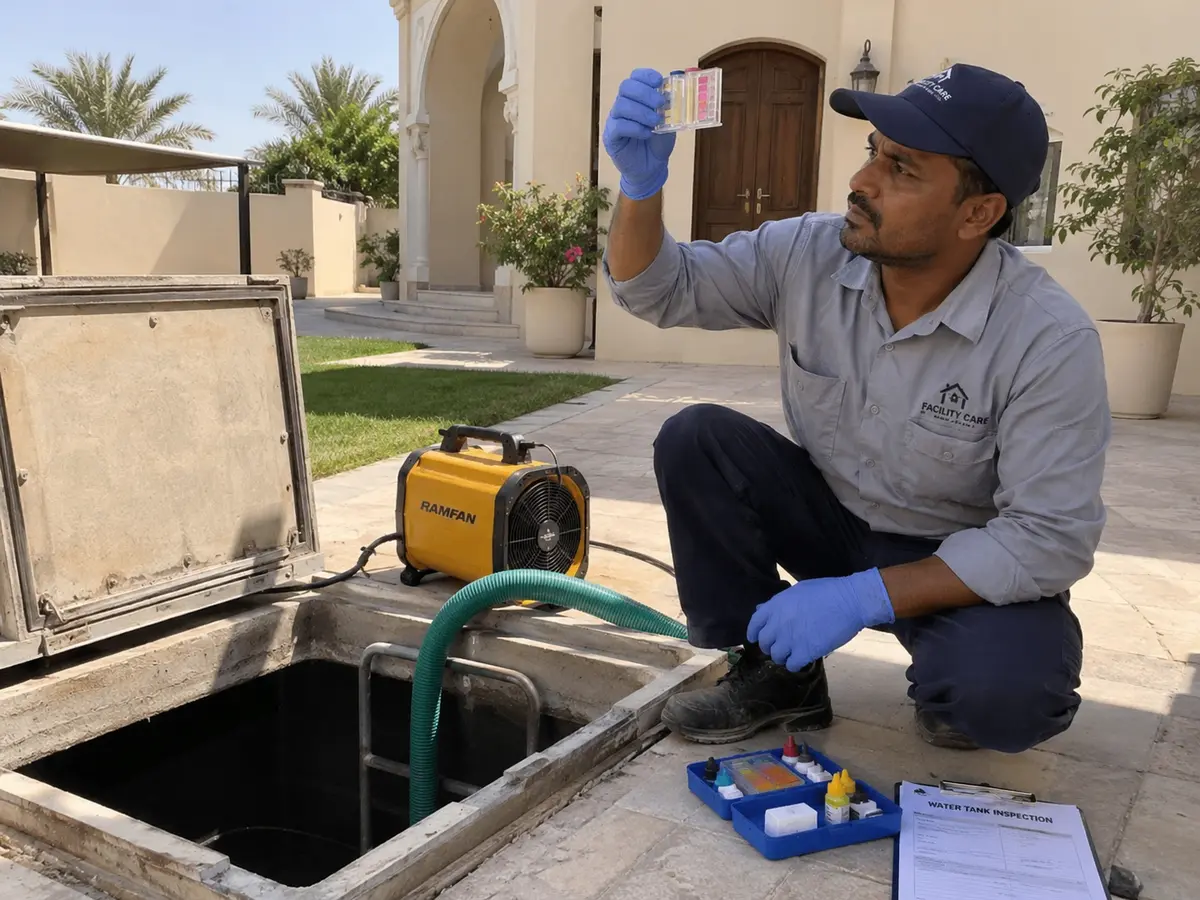
Stay out of the tank yourself. An underground tank is a confined space, and the WHO's guidance for tank cleaners is to blow fresh air in before anyone enters and keep a second person at the hatch throughout. A crew that sends one worker down with no fan and nobody at the manhole is showing you how the rest of the job will go.
Four checks that separate a clean from a rinse
The method below follows the UK Health and Safety Executive's guidance on disinfecting cold-water storage tanks (HSG274 Part 2) and the WHO's technical note on cleaning water tanks; the municipality decides which chemicals an approved Dubai firm may use. You do not need to watch every minute. You need to see four things yourself, or in time-stamped photos.
The tank drained to the floor and scrubbed
Done properly: the tank is emptied completely, sludge is vacuumed or scooped off the floor, and the walls, floor and underside of the lid are scrubbed by brush or pressure jet, then rinsed. HSG274 adds that the cleaning method must not damage the tank's internal coating.
How to check: ask for photos of the floor before and after, taken from the same spot. Sediment in the first and none in the second is the evidence. Walls seen by torch from the hatch should show no slimy film and no brown line at the old waterline.
If it was skipped: a tank refilled over a layer of silt has had that silt stirred into the house water. Ask for the clean to be redone.
Chlorine measured, and left long enough
Done properly: the disinfectant goes in at a measured strength and stays for a set time. The HSE benchmark is chlorine at 50 ppm for at least one hour, with no less than 30 ppm left at the end. Lower strengths with longer contact times are also accepted, and the WHO's field method leaves the tank standing for 24 hours.
How to check: ask the technician to show you the test-kit reading when the dose goes in and again when the contact time ends, and to write both readings and both times on the report. A crew without a test kit is guessing the dose.
If it was skipped: a splash of chlorine and an immediate refill does little to the slime on the walls where bacteria live. Ask for the step to be repeated at the company's cost, with readings recorded.
Flushed, refilled and closed
Done properly: the strong solution is drained, the tank rinsed and refilled with fresh mains water, and the pipes flushed until the disinfectant has gone. The lid then goes back on its seal and is locked.
How to check: by evening, tap water should smell no more of chlorine than before the clean. A strong swimming-pool smell means the flush was cut short, so call the company the same day. Check the lid locks before the crew leaves.
The report, and a water test taken at the right time
Done properly: a written report naming the company and its approval, the date, the tanks cleaned, the chemical and its measured strength, the contact time, before-and-after photos, any defects found, the laboratory result or the date the sample is due, and the next due date. Approved firms are expected to keep visit records anyway.
How to check the water: Dubai Municipality's guidance, as Gulf News reported it, is for an approved laboratory to test the water once the tank is clean. Ask the company whether it arranges the sample or you do. Timing matters: HSE guidance is to take microbiological samples two to seven days after refilling, because leftover disinfectant can make a sample taken straight after the clean come back clear when it should not. A certificate built on a same-day sample proves less than it appears to.
What to look at while the tank is open
The clean is the one time the tank is empty and lit. Ask the crew to photograph these four parts, or look from the hatch yourself.
- The lid and its seal. It should close tight and lock. A warped lid lets in the dust of every shamal.
- The vent and overflow screens. Every opening to the air should carry an intact insect screen, fitted so it does not hold water. Torn mesh or a bare overflow pipe is an open route for insects and geckos.
- Walls and joints. In a GRP tank, look for cracks, weeping joints between panels and, on a rooftop tank, daylight showing through the walls. In a concrete tank, look for cracks and flaking internal coating.
- The manhole surround on an underground tank. The frame should sit above the paving so irrigation water and rain run away from it. Staining below the cover, or soil and roots inside, suggest water is getting in from outside.
A lid seal or a screen is often something the crew can fit on the day. Cracks, leaking joints, failed coating and ground water getting in are repairs: a tank that keeps taking in dirty water will foul again however often it is cleaned. Have those quoted separately by a tank or waterproofing specialist, and, as HSE guidance suggests, have the tank inspected at least once a year, more often if debris or vermin turn up.
When a step is missing: what to send the company
Write the same day, and keep to what you saw and what you want done:
- "The report does not record the chlorine strength or the contact time. Please send the test readings, or come back to disinfect the tank with the readings recorded."
- "The after photos show sediment still on the tank floor. Please arrange a return visit to remove it."
- "The lid does not lock and the overflow has no screen. Please quote to replace both, separately from the cleaning."
A tank-cleaning company that knows villas in Dubai asks about a second tank on the roof before it quotes, turns up with a test kit and a ventilation fan, and knows where the approval certificate is before you ask. Everlook surfaces vetted tank-cleaning firms with verified UAE experience and reviews from your neighbours, so the checking starts before anyone lifts the manhole cover.
Find your next pro on Everlook
Compare licensed contractors in your area in under a minute. Free to post, no signup needed to browse.
Find your next pro on Everlook
Post a job in minutes and get offers from trusted local contractors. Free to start.
Get started