Concrete Spalling Repair, Stage by Stage: What to See Before Each Layer Hides It
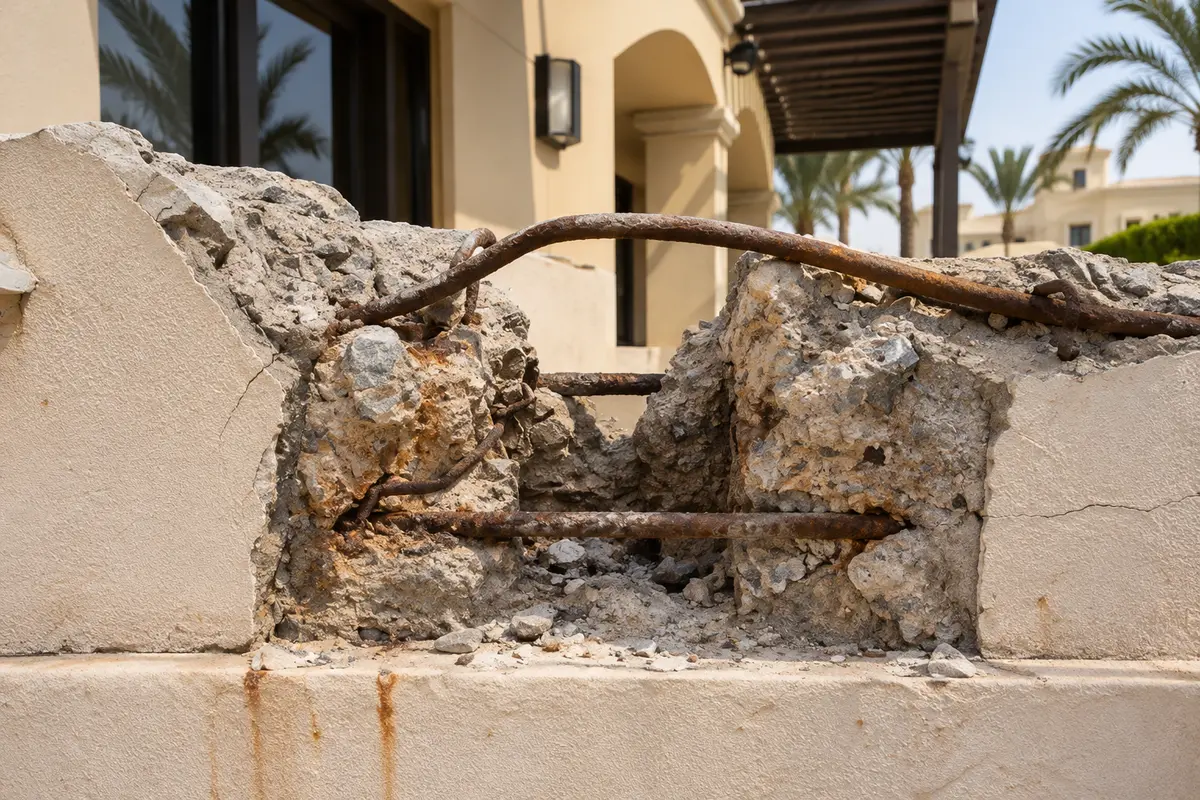
What the piece on the ground can tell you, and what it cannot
Most of what decides whether a concrete spalling repair lasts happens in the days the hole stays open, and nearly all of it is buried by the end of the week. The checks below are timed for that window, with dated photos covering the visits you cannot make.
For a villa, the structure is yours to repair. In an apartment, a spalling balcony or façade is common property: report it to the building's managing agent, which looks after the common parts under Law No. 6 of 2019.
Start with what came down, and keep it.
- Stones through the broken face, and a rust-brown groove on the back. Usually spalled concrete: the steel rusted, rust takes up more room than steel, and the outer concrete was pushed off.
- A flat layer of fine sand and cement, a centimetre or two thick, with no stones. Usually render that has let go. If the hole shows hollow block, the job is a render repair, and the guide to reading cracks by width and direction covers any cracks around it.
- Flakes thinner than a fingernail. Paint or a coating. Sound grey concrete underneath suggests a coating fault. A brown stain or a straight crack suggests the steel may be pushing from inside.
These are observations; a rust stain can come from a tie wire, and render can hide a spall. Do not knock off loose pieces or lean a ladder on the spot. A spalling soffit can drop more concrete without warning, so keep people and cars out from under it until it is made safe.
Who should see it first: an engineer or a repair contractor
Location matters more than the size of the hole. Ask for a structural engineer before any quote when:
- the spall is on a column or a beam, or under a balcony slab that projects with nothing supporting its outer edge;
- a straight crack runs along a bar beyond the hole, or rust stains show in several places on the same element;
- the bar looks thinner at one point than on either side, or has snapped;
- the outer edge of a balcony or canopy sits visibly lower than where it meets the wall.
A single small spall on something that carries only itself, such as a decorative band or a parapet coping, is a job a repair contractor can usually quote from photos, though what the contractor finds can still send it to an engineer.
Dubai Municipality's Administrative Resolution No. 109 of 2022 sorts repairs to existing buildings into three tiers. Structural defects that affect only durability, such as cracks in the main structure, take a self-issued permit, filed by a pre-qualified consultant or contractor. Defects that affect structural safety need a full permit, an engineer-approved method and laboratory tests on the concrete and steel first. The English text lists "fall of concrete cladding" and "substantial rust in reinforcing steel" among the examples of that higher tier, so ask whoever you book, in writing, which tier they will file under and why.
Villas in areas regulated by Trakhees or the Dubai Development Authority generally answer to that body instead. Many master communities also ask for their own NOC or a contractor access permit before work starts, so check with the community office. The guide to the order villa approvals move in covers each one.
Where an engineer is needed, the same office usually writes the repair method and files the permit; the internal-wall removal guide explains the licence that engineer needs.
To get either first visit, post the job under construction and structural repair with your photos, and say whether you want an engineer's assessment before anyone breaks out concrete.
Why the steel rusted decides how far the repair goes
The alkaline cement around a bar protects it until chloride salts reach the steel, or carbonation (carbon dioxide from the air slowly neutralising the concrete) gets there first. Thin cover speeds up both. A 2018 study of 30- to 50-year-old Gulf structures, in the ASCE Journal of Performance of Constructed Facilities, found both had reached the steel in most members. Salt arrives on sea air near the coast, and from sabkha, the salty ground of coastal flats, at the base of a building.
The American Concrete Institute's TechNote 364.6T rates the risk of corrosion carrying on as high where chloride at the bar exceeds 1% by weight of cement or the paste has carbonated, and asks for both to be measured first. Ask for an indicator spray on the broken face, which turns pink where concrete is still alkaline, and for dust drilled at bar depth to be tested for chloride. Carbonation with low chloride usually points to a patch and a protective coating. High chloride around steel that still looks sound points to wider removal, galvanic anodes, or both.
Eight hold points, from the first hammer tap to the last coat
Agree that the contractor stops at each point and sends a dated photo before the next layer goes on. The figures come from guidance by ACI and the International Concrete Repair Institute (ICRI), and from one manufacturer's UAE data sheets. The products on your job have their own sheets, and those numbers bind.
Jump to: extent · edges · behind the bar · steel · anodes · bonding · mortar and heat · curing and coating
1. The damaged area, sounded and marked out
The contractor taps around the spall with a hammer. Sound concrete rings; concrete that has lifted sounds dull, over an area usually larger than the hole.
What to see: an outline marked on the surface past the visible damage, photographed before the breaker starts. Missed if there is no outline, or one traced round the hole.
2. Edges cut square, in a simple shape
Euclid Chemical's repair notes, written to ICRI's guide, ask for a saw cut at least 12 mm deep, square to the surface, in straight lines forming a simple rectangle, with the blade kept off the steel.
What to see: straight, vertical edges. Missed if the hole is a ragged saucer whose rim thins to nothing. Repair mortar has a minimum layer (5 mm for the mortar whose data sheet is quoted in stage 7), and a feathered rim is where a patch cracks and lifts first.
3. Concrete removed from behind the bar
ACI's TechNote, citing ICRI 310.1R, asks for a clear gap behind a corroded bar of at least 6 mm plus the largest stone in the repair mortar, with removal continuing along the bar until the steel is essentially free of rust. Some specifications set 19 mm as a floor, and the Euclid notes say to involve the engineer before breaking into a column.
What to see: a gap behind every exposed bar, and clean steel at both ends of the opening. Missed if a bar is still half-buried at the back, where mortar cannot reach and the rust keeps working.
4. Clean steel, and a bar that has been measured
The UAE data sheet for Sika MonoTop-412 HS, a structural repair mortar, asks for steel blast-cleaned to Sa 2 under ISO 8501-1: no loose rust or scale anywhere on the bar, including the back. Sika's anode sheet asks for the stricter Sa 2½ where chlorides caused the corrosion.
Then a calliper reading at the thinnest point, against the drawings or an untouched stretch of bar, gives the section loss. ACI's TechNote 364.10T treats a loss under 10% as generally acceptable when the engineer is satisfied with the original design, and at 10% or more asks for the design to be checked. Extra bars are the engineer's decision.
What to see: the calliper on the bar at its worst point. Missed if brown pits still show, or the programme goes straight from breaking out to mortar.
5. Protection for the steel just outside the patch
Once part of a bar sits in fresh, salt-free mortar while the rest stays in salty or carbonated concrete, the steel just beyond the patch can corrode faster. ACI calls this the ring or halo effect: the patch stays solid while new cracks open around it.
The usual remedy is a galvanic anode, a zinc core in a mortar casing tied to the bar near the patch edge, which corrodes in place of the steel. Sika's Galvashield XP sheet claims 10 to 20 years of service depending on chloride, moisture and spacing, and asks for a continuity reading of 0.1 to 1.0 ohm between anode and bar. If a corrosion inhibitor is offered with or in place of anodes, ask for its data sheet.
What to see: anodes wired tight to clean steel, with the meter reading in the photo. If the chloride test came back high, ask in writing whether anodes are included.
6. A prepared surface and a fresh bonding coat
The 412 HS sheet says a bonding agent improves adhesion on large areas or dense concrete, and the mortar must go on while that coat is still wet. Where the surface is soaked instead, Sika's Gulf sheet for its finishing mortar describes the target: dark and matt, with no shine and no water in the pores. Any bar coating must stay out from between an anode's tie wire and the steel.
What to see: bonding coat and first mortar minutes apart on the photo timestamps. Missed if the hole is pale and dusty, or the bonding coat has dried to a skin.
7. Mortar placed within the data sheet's temperatures
The UAE edition of the Sika MonoTop-412 HS data sheet limits air and surface to 5°C to 40°C, asks for precautions in summer to keep the mixed mortar below 32°C, and says to avoid direct sun and strong wind. It allows 5 to 60 mm per layer, so a hole deeper than 60 mm is built up in layers.
A sunlit wall in July runs hotter than the air. The midday break stops outdoor work in direct sun from 12:30 to 3:00 pm between 15 June and 15 September, but the fresh patch still sits in the afternoon heat. Ask for the cooler months, or shaded early mornings with cool mixing water, and an infrared surface reading in the photo.
What to see: mortar packed hard round and behind the bar. Missed if it was mixed in the sun at noon, or a hole deeper than 60 mm was filled in one go.
8. Curing, then a coating over the whole element
Mortar that dries before it hardens cracks and loses strength. The 412 HS sheet asks for curing straight after finishing, with a curing compound or damp hessian under polythene; ask how many days the cover stays on and who keeps it damp. Last comes a protective coating over the whole element, sold to resist carbonation or chloride, so the old concrete around the patch gets a barrier too.
What to see: sheeting in place the morning after, and the coating's data sheet. Missed if fine map-pattern cracks cross the patch, or the surface leaves powder on your finger.
The message to send before anyone breaks out concrete
Send it with your photos, and ask every contractor to answer each line:
- Will an engineer assess this first, and which permit tier, or which authority outside Dubai Municipality's area, applies?
- Which mortar, bonding coat, bar coating and protective coating, with data sheets?
- Will you test carbonation and chloride, and fit anodes if the chloride is high?
- Will you send a dated photo at each of the eight stages, including the calliper and continuity readings?
- Which days and hours will the mortar go on, and how will the patch be shaded and cured?
- What does your warranty cover if the patch, or the concrete around it, cracks or spalls again?
If a photo shows a stage was skipped, write before the next layer: name the stage, attach the photo, and ask for it to be put right first. Once the patch is closed, the only check left is breaking it out again.
If the villa was handed over within ten years, keep the before photos. The builder's ten-year liability under the 2025 Civil Transactions Law can reach defects that threaten the structure; the guide to villa extension contracts explains it, and whether your spall qualifies is a lawyer's question.
On Everlook, this job is listed under structural works, the service for load-bearing repairs and foundation work. Licensed UAE contractors there show verified certifications and reviews, so you can pick by rating, response time and how fully each quote answers the six questions above.
Find your next pro on Everlook
Post a job in minutes and get offers from trusted local contractors. Free to start.
Find your next pro on Everlook
Post a job in minutes and get offers from trusted local contractors. Free to start.
Get started
