How to Read a Dubai Villa Extension Contract Before You Sign It
The law behind the contract, and what it settles on its own
Federal Decree-Law No. 25 of 2025 replaced the 1985 Civil Code, and its contracting chapter (muqawala, Articles 812 to 839) now fills every gap your contract leaves. A draft signed before 1 June 2026 stays under the old code, so the date on the signature line decides which text a court reads.
Article 813 expects a contract for works to state the work, the method, the completion period and the price. A two-page quote with a total and the words "as per drawings" covers the first and the last, and leaves the middle to argument.
Most of the chapter can be varied by agreement. The ten-year structural liability cannot. Article numbers below come from published law-firm analyses of the new code, and the Arabic text prevails.
Who the consultant works for, and whose name the permit carries
An extension has three parties to the work. The engineering consultant designs it, files it with the authority that has jurisdiction over your plot (Dubai Municipality, Trakhees or the Dubai Development Authority) and supervises the build. The contractor builds. You pay both. The order of approvals for a villa extension sets out who files what and when; the contract has to draw the line between the first two parties.
Find out who appoints the consultant. Where the consultant is the contractor's own subcontractor, the engineer who approves each stage is paid by the firm whose stage is being approved. If design comes as part of the contractor's package, the draft should say the consultant's supervision duty is owed to you.
Dubai's Law No. 7 of 2025 on contracting activities bars owners from engaging a contractor who is not on the register; firms already licensed have until January 2027 to register, so a missing entry is a question to ask until then. Before weighing clauses, check the trade licence and the classification against the company name on the draft. That name should also be the one on the permit: in the municipality's procedure the building permit is issued in the contractor's name, and a replacement contractor gets a new permit.
If only one contractor has quoted, a second offer from a licensed construction contractor gives you something to compare each clause against.
Questions to send:
- "Which consultant will file the drawings and supervise the work, and will I sign their appointment directly?"
- "Is the company named on this contract the one whose licence and classification will appear on the permit?"
- "Which parts of the work will you subcontract, and can you change a subcontractor without my approval?"
Stage payments that each wait for a document or an inspection
Most draft schedules are a column of percentages: some on signing, some at the slab, the balance on handover. A percentage says how much. Rewrite each stage so it also names the evidence that must exist before you pay.
- Signing and mobilisation: keep this modest until the permit exists. A larger advance is commonly secured by a bank guarantee of the same amount, which is practice the contract has to ask for.
- Permit issued: the building permit in the contractor's name, and the developer's modification NOC where your community has one.
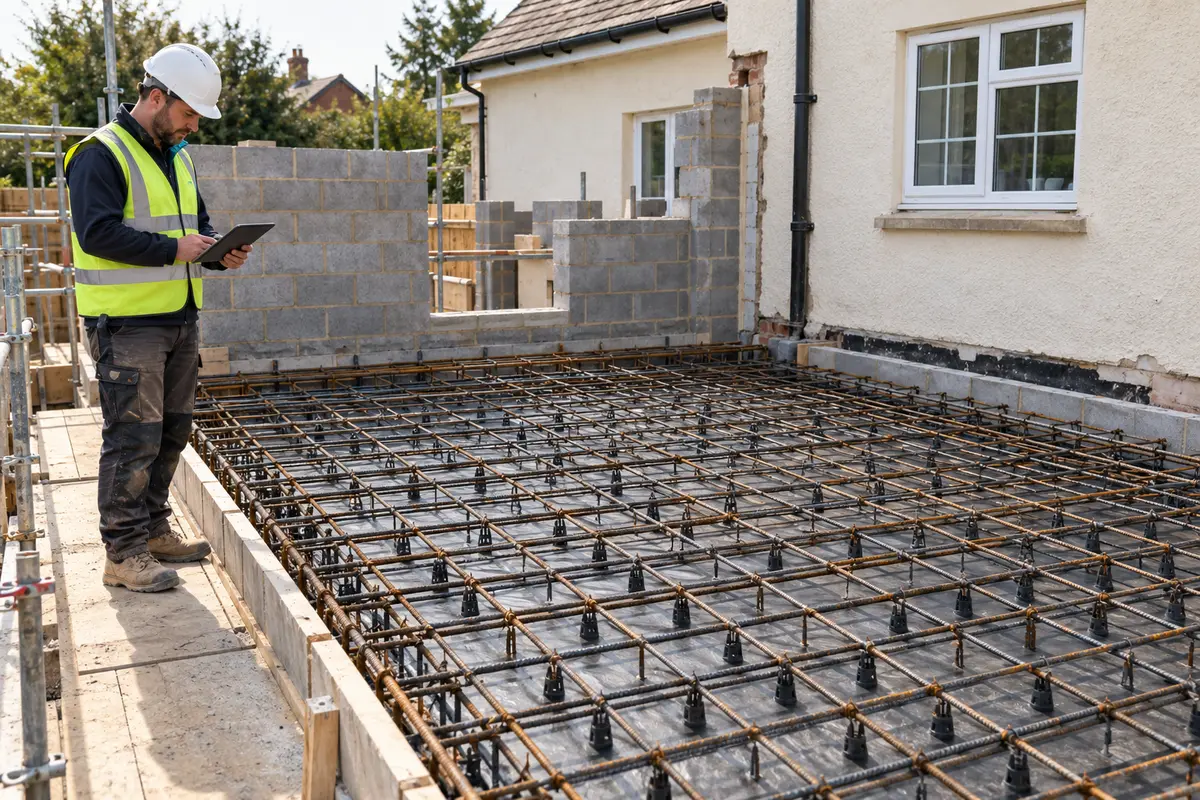
- Foundations: footings cast after the consultant's written approval of the excavation and the reinforcement. The municipality inspects sites by stage of work, so ask the consultant which authority inspections apply to your permit and attach stages to those.
- Structure and roof: the roof slab cast after the consultant approves the steel, and the roof waterproofing laid and water-tested before the screed covers it.
- Services and finishes: the consultant's inspection of the electrical, plumbing and AC first fix before the walls are closed.
- Completion: the completion certificate issued. Under the municipality's Administrative Resolution No. 275 of 2024 the contractor applies for it stating the consultant's consent, so the certificate also proves the consultant signed off. Where the extension changed the electrical load, add the final DEWA connection to this stage.
Put the consultant's approval into the payment clause itself, with a fixed number of days for you to pay once you receive it, so every transfer has a document behind it.
Question to send: "Can each payment stage be tied to the consultant's written approval, and the final one to the completion certificate?"
Changes after signing: who can order them, and when the price is agreed
A fixed price covers the drawings attached to the contract. Under Article 829 of the new code, as K&L Gates summarises it, a contractor on a lump-sum job is entitled to more for changed or added scope only by agreement with you, or where you caused the change, and the parties may agree a different rule. The same article lets a court adjust the price or the time when exceptional general circumstances nobody could foresee break the contract's financial basis. A rise in material prices on its own does not qualify.
The clause that protects you is a procedure. It should require:
- a written variation order, signed by you, before the changed work starts;
- the price and any extra time agreed in that same document;
- unit rates in the contract for the items most likely to change, such as blockwork, plaster and floor tiling per square metre, so pricing an extra is arithmetic;
- a statement that work done without a signed order is not paid as an extra.
If the authority or the developer asks for a redesign, the contract should say who carries its cost. A structural change on site, such as widening the opening in the old exterior wall beyond what was drawn, goes back to the engineer and sometimes to the authority; the guide to walls that need an engineer's sign-off covers what that check involves.
Question to send: "Will you price and sign every change in writing before doing it, using the unit rates in the contract?"
Retention, the defects period and the ten years after handover
Retention comes from practice, and only the contract creates it. UAE construction contracts commonly hold back 10% of each payment, release half at handover and the other half when the defects liability period ends, usually 12 months later. No law sets those figures, and a small residential contract often has no retention at all unless you ask.
During the defects period the contractor returns to fix what you report. The code's own remedy for defective work is written for the build itself, so the defects clause should supply one for after handover: if the contractor does not act within a stated period of your written notice, you may have another contractor fix it and deduct the cost from the retention. Retention is the money that pays for that without a court claim.
The ten-year liability runs alongside, and no clause can remove it. Under Article 821, where an engineer designed the building or installation and the work was carried out under the engineer's supervision, engineer and contractor are jointly liable for ten years from delivery for total or partial collapse and for defects that threaten its stability or safety. Article 823 makes the liability mandatory and bars any clause that excludes or limits it. Article 824 gives you three years from the collapse or the discovery of the defect to bring the claim. Because the article is framed around supervised work, keep supervision inside the consultant's appointment.
Those ten years cover structure. A leaking roof, cracked tiles or a sticking door belong to the defects period and to any specific warranties the contract lists, so ask for those in writing: the waterproofing membrane, the aluminium windows and doors, and the AC units, each with the manufacturer's and the installer's terms.
Question to send: "What retention will you accept, when is each half released, and which warranties will you hand over at completion?"
Insurance, delay and the way out
The permit rule on insurance is narrower than most owners expect. Executive Council Resolution No. 28 of 2022 makes the contractor submit a policy covering damage to the works and civil liability to third parties before a permit is issued, but for alterations and additions only where the works cover 300 m² or more. A one-room extension falls well short of that, so its insurance is whatever the contract demands. Ask for cover on the works and third-party liability until completion, with you named on the policy.
On delay, the contract needs a completion period counted from a stated event, such as the permit date or site handover, and a rate of delay damages. If no period is agreed, Article 818(1) asks only for completion within a reasonable time, which is hard to hold anyone to. Article 340 lets a court reduce agreed damages that are exaggerated, so set a rate you can justify by what a late finish costs you, such as rent on a second home while the villa is a site. Extensions of time should pass through the same written process as variations, triggered by the immediate warning Article 816(3) already requires from the contractor.
On termination, Article 836 lets you end the contract at any time before completion, provided you pay the contractor's expenses, the value of the work done and its lost profit, which a court may reduce. Ending it for the contractor's failure runs through Article 818: notice and a reasonable period to put things right, or a court's decision where the delay or refusal is serious.
The permit side has its own procedure. Under Administrative Resolution No. 275 of 2024, the municipality can replace a contractor without its consent on your declaration, a stated reason and the consultant's report on the stage of the works. The outgoing contractor has up to five working days to object, and where the dispute is financial or contractual it gets up to 30 days to hand over the site. Trakhees and the DDA run their own procedures. None of this covers drawings or test reports, so the contract should provide for their handover and for your right to use the design with a new contractor, a right that usually sits with whoever prepared the drawings.
Question to send: "If the contract is ended by either side, what happens to the site, the drawings, the test reports and the permit?"
Sign it, mark it up, or take the other offer
Hold both drafts against the same seven points: who the consultant works for, payment stages tied to documents, a written variation procedure with unit rates, retention and a defects period, insurance, a completion period with delay damages, and an exit clause that covers site, drawings and permit. Check too whether each total includes VAT at 5% and who pays the authority fees and the developer's deposit. Two totals that differ only on those are the same offer.
If a contractor accepts the missing points in writing, sign the amended version. If the contractor refuses to tie payments to approvals, to sign changes before doing them or to accept any retention, that refusal previews how a dispute would run, and the other offer is the safer one. So is any draft that waives or caps the ten-year liability: the clause is void under Article 823, and its author is asking you to accept a term the law forbids.
Where the extension is a large share of the villa's value, have a lawyer read the final wording.
If neither draft will take those changes, a third offer is quick to get. Everlook lists licensed villa extension builders with verified licences and reviews, so you can choose by rating, response time and the terms a contractor is willing to sign, before a single recommendation decides it for you.
Find your next pro on Everlook
Describe your job once, get quotes from verified UAE contractors. Free, no commitment.
Find your next pro on Everlook
Post a job in minutes and get offers from trusted local contractors. Free to start.
Get started
