How Stone Cladding Stays on a Villa Wall, From Flexible Sheets to Natural Slabs
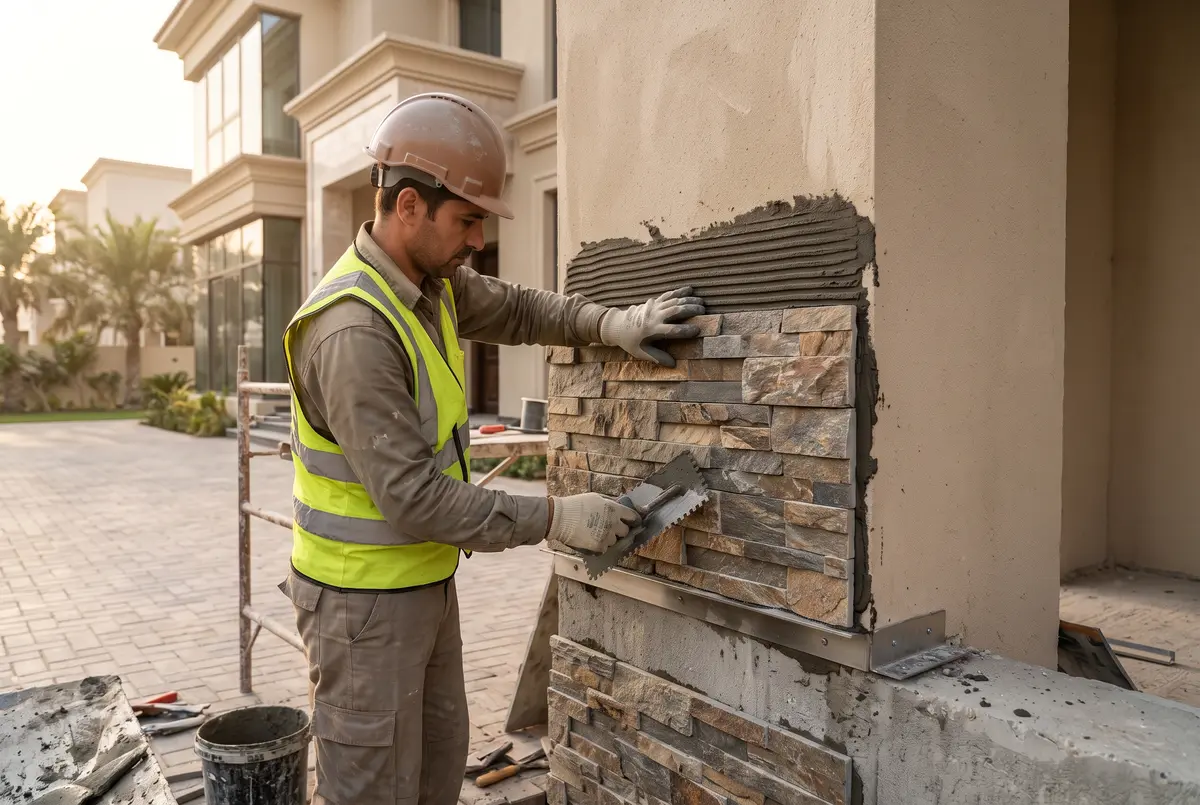
What sits behind the face of each sample
Turn the showroom samples over and they are four different products, each held to the wall its own way, and each with its own limits once a west-facing wall in Dubai heats up from May.
- Flexible stone sheet. A skin of real stone on a resin backing. Slate-Lite, a German maker, specifies a stone layer of 0.1 to 1.4 mm on polyester reinforced with glass fibre: about 2 mm thick and 1.5 to 2.8 kg per square metre.
- Manufactured stone veneer. Cast concrete, coloured and moulded to look like stone, set in mortar one piece at a time.
- Natural thin veneer and stack stone. Sawn real stone. Stack-stone panels are strips glued into a block with resin; Ardex's Australian technical bulletin gives typical panels of 600 by 150 by about 25 mm, weighing 50 to 80 kg per square metre.
- Natural stone slabs. Thicker cut stone, usually hung on stainless steel anchors set into the wall.
The wall it goes on, and how much it can carry
Most Dubai villas have concrete-block walls finished with cement render and exterior paint, and that paint is the first problem for adhered cladding. The ICC-ES evaluation report for Eldorado Stone, an American veneer brand, allows its stone straight onto concrete or masonry only when the surface is free of paint, water repellents and release agents. Expect the installer to grind the paint off, or to fix mesh and fresh render over it.
Weight decides the rest. A flexible sheet adds a few kilos per square metre, far less than the render it sits on; stack stone at 50 to 80 kg per square metre is another matter. Ardex recommends that blocks be reinforced and core filled wherever mechanical fixings go in, because the thin web of a hollow block can break out around a loaded bolt. A single-skin boundary wall or a parapet over the entrance may suit the light options and nothing heavier.
Heat, sun and the installation calendar
Dubai's July mean temperature, day and night averaged together, is 35.3°C at the airport station on National Centre of Meteorology data, and a sun-facing wall runs hotter than the air. That matters while the adhesive cures, and then every afternoon after.
The temperature the makers allow for fixing
Slate-Lite recommends processing its sheets between 10°C and 35°C. Laticrete gives the same surface range for Latapoxy 310, an epoxy used to spot-bond stone. On a Dubai wall in summer, both ceilings are passed by mid-morning. Book adhered cladding for the cooler months, or get the installer to say in writing how the wall will stay inside the maker's range: early starts, shading, or working each elevation while it is out of the sun.
What the sun does to each face
Slate-Lite rates its sheet heat-resistant to 120°C and reports "hardly or minimal" colour change after a 1,000-hour UV test, but says its limestone decors are not suitable outdoors. No published facade warranty for flexible stone turned up in the research for this article, so ask the supplier in writing whether a south- or west-facing Dubai wall is covered, and for how long.
The Cultured Stone warranty, from an American maker of cast veneer, excludes "normal weathering", which it defines as sunlight and weather making a coloured surface oxidise, fade or stain. It also excludes heat reflected from windows and doors. Natural stone carries its own colour, though pale stone can darken where the wrong sealant or adhesive sits behind it.
Glue, dabs or metal: how each one is held
Adhesive over the whole back
Flexible sheets, manufactured veneer and most thin natural veneer are bedded in adhesive or mortar. For exterior work, Mapei's guidance calls for 100% coverage of the back, with adhesive spread on each piece as well as on the wall (back-buttering). Its facade adhesives are deformable cement-based ones, class C2 under EN 12004 with an S1 or S2 rating.
Large areas also need sealant-filled movement joints. A Spanish adhesive maker's guide for exterior walls sets them at least 8 mm wide every 3 to 4 m; ask which spacing your installer's adhesive maker sets. Slate-Lite recommends a natural-stone silicone at its edges, because other silicones may not adhere properly.
Epoxy dabs, within stated limits
Some installers fix natural stone with a few dabs of epoxy, a recognised method inside limits. The Latapoxy 310 data sheet, written for North America, caps exterior stone at 50 mm thick, 0.46 m² per piece and 73 kg per square metre, no higher than 9.1 m. It rules out sandstone and slate for the method and asks for the maker's approval before any exterior use.
Metal support for heavy stone
Ardex's Australian bulletin recommends added mechanical support, such as stainless steel angles at least 2 mm thick, where stack stone goes 3 m or more above ground or exceeds what the wall can carry. It warns against unprotected aluminium angles, which can react with the cement in tile adhesive. In the UK, BS 8298-2 covers natural stone held by metal fixings and leaves adhesive-only stone outside its scope.
Neither document binds a villa in Dubai, and no height threshold for adhered stone turned up in the parts of the Dubai Building Code available for this article. So ask which document the installer's fixing design follows. For anything heavier than a flexible sheet above head height, over a doorway or along a path, ask for a written fixing detail: anchor type and grade, spacing, and what the anchors go into.
Cutting is the other half of fixing. HSE, the UK safety regulator, lists slate at up to 40% crystalline silica, sandstone above 70% and concrete and mortar at 25% to 70%, and treats dry cutting of engineered stone as unacceptable. Any stone or cast veneer cut at your villa should be cut wet or with on-tool extraction, away from open windows and AC intakes, with children and pets kept clear.
What a warranty's years actually cover
Lifespans of several decades are easy to find quoted for stone cladding, rarely with a source. The figures that can be traced are warranty terms, and they cover less than the headline suggests.
The Cultured Stone warranty runs 50 years for the original buyer and passes to a new owner only within the first 15. It repairs, replaces or refunds the product; labour to take the stone down and refit it is not covered. It excludes installation outside the maker's instructions or local code, water from irrigation systems or poor flashing, non-breathable sealers, power washing and chemical washes. Laticrete and Eldorado both state that efflorescence is not a defect under their warranties.
Read those exclusions as a list of how cladding fails: water behind or under it, the wrong treatment on its face, and an installation that departed from the instructions.
Reading cladding that is already up
Each sign below is something you can see or hear, and each has more than one possible cause.
White powder or crust on the face
Usually efflorescence. Laticrete's efflorescence data sheet names three conditions that must coincide: soluble salts, often from cement-based adhesive or grout; water to dissolve them; and a path to the surface. Look for the water: sprinklers wetting the lower courses, an AC condensate line, or a roof outlet discharging down the wall, which the pre-rain roof outlet checks cover.
Acid cleaners dissolve most efflorescence, but Laticrete warns they can mark marble, limestone and travertine, and Slate-Lite says acid attacks its stone face. Test a hidden spot first, and seal only after the water source is fixed, with a breathable impregnating sealer; a sealer does not stop salts that water carries out from behind the stone.
Dark patches or bands
Several causes look alike. Stone darkens while wet, so a patch that stays dark long after the sprinklers stop suggests water held behind it. A dark band along each piece's edges fits oils from an unsuitable silicone creeping into the stone. Regular dark spots on pale stone may be adhesive showing through, which is why Mapei recommends white adhesive under light stone. Green or black growth in shaded corners points to damp again.
Orange-brown streaks
A 2023 review in the journal Molecules names two sources of iron staining on stone: metal in contact with it, such as screws and fixings, and iron minerals in the stone itself. A streak running down from a fixing point makes the first more likely; only opening up the fixing shows whether a non-stainless anchor is corroding.
Pieces that sound hollow
Tap each piece lightly with a coin. A hollow note can mean a lost bond. It can also mean the stone was spot-bonded, since a few epoxy dabs leave most of the back unsupported by design. Movement is what separates them: a piece that shifts when pressed, a joint cracked all round it, or a run of hollow pieces among solid neighbours.
Cracked joints and pieces on the ground
Cracked joints across a whole elevation with no movement joint anywhere fit a wall that had nowhere to expand. If a piece has fallen, look at its back. Bare stone with little adhesive suggests the bed never covered it; adhesive stuck to the stone and none left on the wall suggests the bond to the wall gave way.
If pieces are loose above a doorway, a path or the drive, keep people from walking beneath them and do not prise them off from a ladder; a piece pulled off often brings its neighbours with it. A cladding and facade contractor can tell you whether a few pieces can be refixed or the elevation needs stripping and redoing once the water source is dealt with.
Matching the cladding to the wall
- A feature panel at eye level, out of sprinkler reach: any of the four. A flexible sheet is the lightest and quickest, provided the decor is rated for outdoor use and the sun exposure is covered in writing.
- Over an entrance, a parapet or anywhere above head height: a flexible sheet, or natural stone with a written mechanical fixing detail. Heavy stack stone on adhesive alone 3 m or more above ground is the case Ardex's bulletin warns about.
- A single-skin boundary or garden wall: the lighter options, unless an engineer confirms it can take the weight and the anchors. Height and approval rules are in the boundary wall NOC guide.
- A wall whose base the sprinklers or a drain keep wet: move the spray heads or fix the drainage before any cladding goes on.
- Existing cladding with a few hollow or cracked pieces: refixing those pieces may be enough if their neighbours are solid and the water source is fixed. If pieces have fallen and their backs show little adhesive, the pieces still up were probably laid the same way, and removal is the safer quote to ask for.
- A wall you only want to look fresh: a repaint is the smaller job, and what an exterior repaint quote should list covers it.
Ask every installer for four things in writing: the product and its data sheet, the adhesive and its class, the fixing method above head height, and the months they will work in. Check with your community first. Emaar Community Management's FAQ for The Valley says any alteration to a villa needs Emaar's approval and that external modifications changing a villa's look are not permitted, so some communities may refuse stone on the facade outright.
Cladding that is shifting, cracking at the joints or dropping pieces does not settle back; each summer's heat and each wet winter works on the same weakened bond. Everlook lists vetted facade cladding specialists across the UAE, with verified licences, transparent quotes and reviews from other villa owners. Post photos of the wall, any water source near it and any pieces that have come off.
Find your next pro on Everlook
Describe your job once, get quotes from verified UAE contractors. Free, no commitment.
Find your next pro on Everlook
Post a job in minutes and get offers from trusted local contractors. Free to start.
Get started
