What a Garden Shed Can Safely Hold Through a Dubai Summer, and How to Choose One
How hot the air inside a closed shed gets
That 35.3°C is the National Centre of Meteorology's July mean for the Dubai airport station, day and night averaged over 49 years. A closed shed sitting in the sun starts from that air and then adds heat of its own.
No one has published measurements of garden sheds in Dubai. The closest measured proxy is the steel shipping container. The transport information service of the German Insurance Association records that at about 25°C outside, the air inside a brown-painted container rises to about 50°C, and inside a white one to about 38°C. The hottest air sits directly under the roof.
Those figures come from mild weather and do not transfer degree for degree. They do show the size of the effect: 13 to 25 degrees above the outside air for a closed steel box in sun. Put even the smaller rise on top of a 40°C afternoon and the top shelf passes 50°C. That is a rough estimate, and 50°C is the limit printed on a typical aerosol can.
Sorting the garage pile by what the labels allow
The temperature limits below come from a maker's label or safety data sheet, or from an authority. If the label on your own tub or battery gives a lower figure, follow that one.
Out of the shed from May to October
- Pool shock (calcium hypochlorite). The safety data sheet for one major brand, HTH Extra Super Shock, says not to store it "where the daily average temperature exceeds 95°F", which is 35°C, a line the July average already crosses. The same sheet warns that a small amount of water can make it react violently, giving off heat and toxic gas, and that it must be kept apart from other pool products, acids and nitrogen-containing compounds.
- Chlorine tablets and pH reducer. If they leave the shed with the shock, they still go on a different shelf from it, in a different place if you can. A 2025 case study of a warehouse fire in Sri Lanka traced it to calcium hypochlorite stored next to incompatible water-treatment chemicals, including trichloroisocyanuric acid, the compound in trichlor tablets.
- Aerosols. Spray paint, lubricant, insect spray and expanding foam typically carry the same standard precaution: protect from sunlight and do not expose to temperatures above 50°C.
- Lithium-ion batteries. Bosch's manuals permit storage of its power-tool packs between –20°C and 50°C, and its battery storage guidance recommends 0°C to 20°C for a long service life. Segway-Ninebot lists the same 50°C ceiling for several of its kick scooters. The RTA has warned riders that leaving an e-scooter in the sun damages the battery.
- Gas cylinders. Abu Dhabi Civil Defence advises keeping cylinders at ground level, outdoors or somewhere well ventilated, and out of direct sunlight. Leaking LPG is heavier than air and pools at floor level, and a closed shed gives it nowhere to go. A spare barbecue cylinder belongs upright in a shaded, open-air spot.
- Petrol. Vapour from a fuel can collects in a closed shed the same way LPG does. If you run a petrol mower or generator, keep the can outside the shed, in shade, and buy only what the next few weeks need.
Stop there if a battery pack is swollen, hot to the touch or smells sharp. Do not charge it. Move it into the open, away from anything that burns, and call the emergency services if it smokes. Treat a tub of pool shock the same way if it has got damp or the lid has bulged: leave it closed and ask the pool company how to dispose of it.
In the shed only with care
- Paint. Hempel's paint storage guideline says paint should not be kept above 40°C, recommends air-conditioned storage in hot climates and notes that shelf life at 35°C is about half what it is at 25°C. A tin of emulsion kept for touch-ups may come out lumpy in October. Solvent paints and thinners go with the aerosols.
- Fertiliser. Keep it dry and sealed, because damp granules cake. Most garden fertilisers contain nitrogen, and the pool-shock sheet names nitrogen-containing compounds as incompatible. So the fertiliser and the chlorine never share a shelf, wherever each one ends up.
What a hot shed is good for
Steel hand tools, spades and rakes, hoses and reels, ladders, empty pots and planters, bags of sand or gravel, folded covers and pedal bikes. Heat does these no real harm. Plan an indoor, air-conditioned shelf for the short list above before buying anything.
Steel, timber or resin, judged on the same points
Five points separate the three materials: heat inside, sun and sand, salt and damp, termites, and wind.
Galvanised or coated steel
- Heat: thin sheet passes the sun's heat straight through, so a dark steel shed is the hottest of the three. A pale roof and high vents narrow the gap, as the white container shows.
- Sun and sand: the baked-on paint fades and wears where sand blows against it, and scratches go through to the metal.
- Salt and damp: the coating is the only protection, so cut edges and scratches rust first. On a plot near the sea, look for hot-dip galvanising: Arrow's warranty terms, as its retailers publish them, give standard electro-galvanised sheds 12 years and the hot-dip range 15. On clear winter nights a bare steel roof can also cool below the dew point and drip onto whatever is stored underneath.
- Termites: none.
- Wind: light panels on a light frame, so it must be anchored. The same Arrow terms exclude damage when the shed was not anchored as instructed.
Timber
- Heat: boards slow heat down far better than sheet steel, though a closed, dark timber shed still traps it.
- Sun and sand: untreated timber greys and splits in UV. Expect to re-coat it at whatever interval the maker sets.
- Salt and damp: no rust, but a timber floor that sits in winter puddles or on wet irrigated ground soaks up water and rots.
- Termites: this is timber's real weakness in the UAE. A UAE University survey identified six subterranean termite species in the country, all present in Dubai, and all reach wood through earthen tunnels from the soil. Put a timber shed on a concrete slab, never directly on soil or lawn, and check the base for mud tubes each season.
- Wind: heavy and stable once built, and still fixed to its base.
Resin (HDPE or polypropylene)
- Heat: double-wall panels in light colours help. Some models have translucent skylights in the roof (one Lifetime 8 by 10 ft model has four), and those let the sun fall directly onto the top shelf.
- Sun and sand: the resin is UV-stabilised. Lifetime describes its HDPE sheds as UV-protected "to help prevent fading and cracking" under a 10-year limited warranty. Keter's warranty excludes wear and tear and acts of nature, so check whether fading counts as a defect before relying on it.
- Salt and damp: the panels do not rust. Some models carry steel reinforcement inside, usually powder-coated.
- Termites: none in the panels themselves.
- Wind: the lightest of the three. Lifetime rates one 8 by 10 ft model at 65 mph, about 105 km/h, without its extreme-weather kit, and the NCM has issued alerts for gusts above 80 km/h. A shell this light relies on its anchors, so fit the maker's kit.
Where it stands and what it stands on
Afternoon shade is the cheapest way to keep the inside cooler. A spot against the villa's east or north wall sits in the house's shadow when the sun is at its hottest. A west-facing corner takes the full afternoon sun, the same exposure that decides which living walls survive on a west façade. Leave a gap behind the shed for air and for maintenance. Keep it clear of the AC outdoor units, which push hot air out and need room to draw cool air in.
Give the hot air a way out. A vent low on the shaded side and another high near the ridge let the layer under the roof escape. Vents cannot bring the inside below the outside air, but they let some of the trapped heat escape.
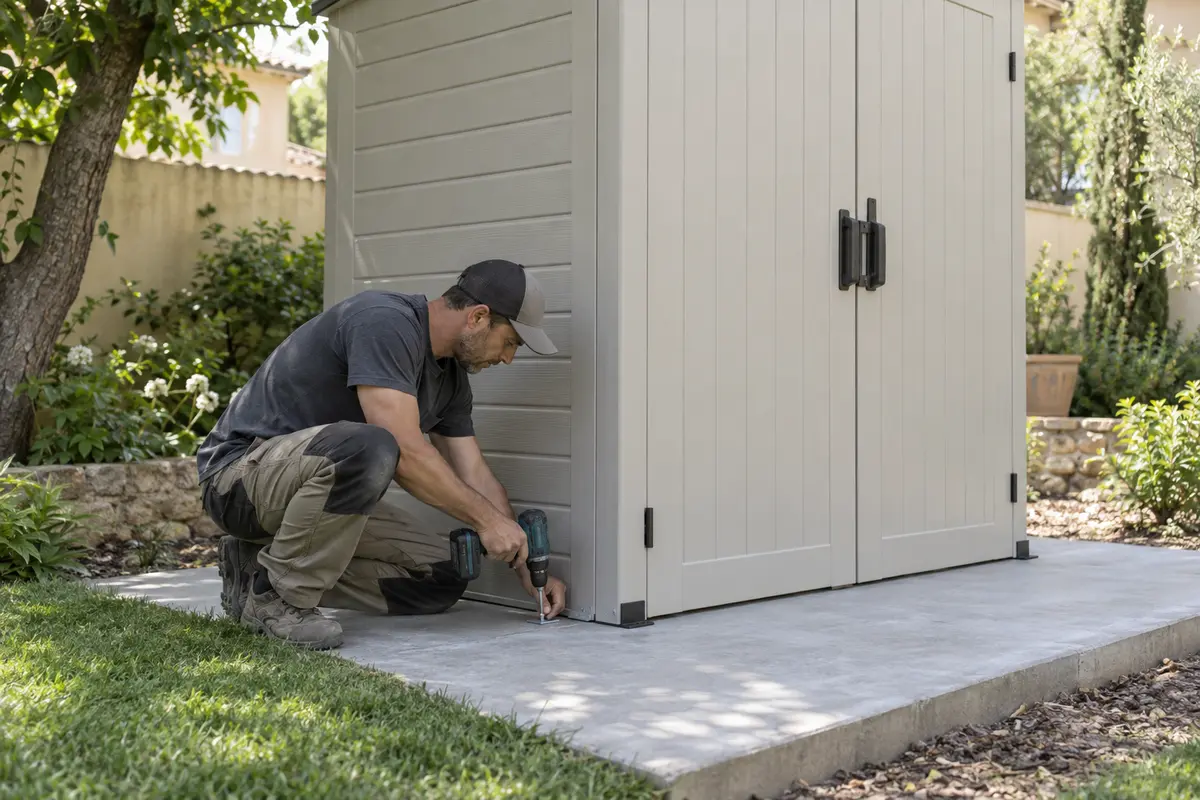
The base is usually sold separately. Lifetime's data sheet says plainly that the foundation is not included, and the makers' instructions ask for firm, level ground. A concrete slab or paving on a compacted bed does the job. Set its top above the level the water reached in your garden during the 16 April 2024 storm, the heaviest rainfall in the UAE since records began in 1949, and slope the surround away from the door. Then fix the shed to the base with the maker's anchor kit.
Base, assembly and anchoring can be one booking with many outdoor storage and shed installers. Ask for the slab and the anchors in the same quote, so one crew answers for both.
A light or socket in the shed is outdoor wiring. It needs a licensed electrician and weatherproof fittings, and it can change how your community classifies the job. Charge batteries indoors, where their temperature range holds.
Ask the community before you order
Whether a kit shed needs approval depends on the master developer, and the published rules differ:
- Nakheel communities (now looked after by Dubai Holding Community Management): the Nakheel community rules dated January 2013 list "enclosures of any kind such as gazebos, pergolas, sheds" among the exterior changes that need the managing agent's prior written approval, with documents approved by the agent and the relevant authority before work starts.
- Emaar communities: Emaar Community Management tells owners that any change to the villa or the back garden goes through the community portal under Home Modifications, which issues the NOC.
- Meraas communities: minor modifications go through RealConnect or Dubai Community Management, with approval typically in two to three working days. Work done against the community guidelines without a NOC draws a violation notice.
- DAMAC and other developers run their own processes. Ask the community desk directly.
Three questions get a clear answer quickly: does a movable kit shed need a NOC here, what height and distance from the boundary wall are allowed, and which colours are permitted. Have the brochure with dimensions and colour ready, and a sketch of the plot showing where the shed goes.
Blockwork, a poured foundation tied into the villa or permanent wiring can move the shed from a community matter into one for the authority that issues building permits. The privacy-screen guide explains how the developer NOC and authority permit fit together. Either way, get the approval in hand before ordering the shed or laying the base.
Which shed for which garden
- If the main reason for the shed is pool chemicals and batteries, it will not solve that from May to October. Find the indoor shelf first and buy the shed for tools.
- If the garden is a townhouse strip with an irrigated lawn, a small, pale resin shed on a paved base is the simplest to keep dry and to move later.
- If the plot is within sight of the sea, choose resin or hot-dip galvanised steel, and rinse salt off steel in the cooler months.
- If you need heavy shelving or a workbench, timber on a slab handles the load best, provided it gets termite checks and vents. A pale steel shed in full afternoon shade is the alternative.
- If you want power inside, raise it with the community desk in the same application and book a licensed electrician for the wiring.
Everlook lists licensed UAE outdoor storage installers with verified credentials and reviews from villa owners. Choose by response time, rating and quote, and send each one the same details: the shed model, a photo of the spot at 3 pm, the base you want, and whether the community NOC is already approved.
Find your next pro on Everlook
Describe your job once, get quotes from verified UAE contractors. Free, no commitment.
Find your next pro on Everlook
Post a job in minutes and get offers from trusted local contractors. Free to start.
Get started