What Dubai's Private Pool Guideline Asks of a Villa Pool Fence and Its Gate
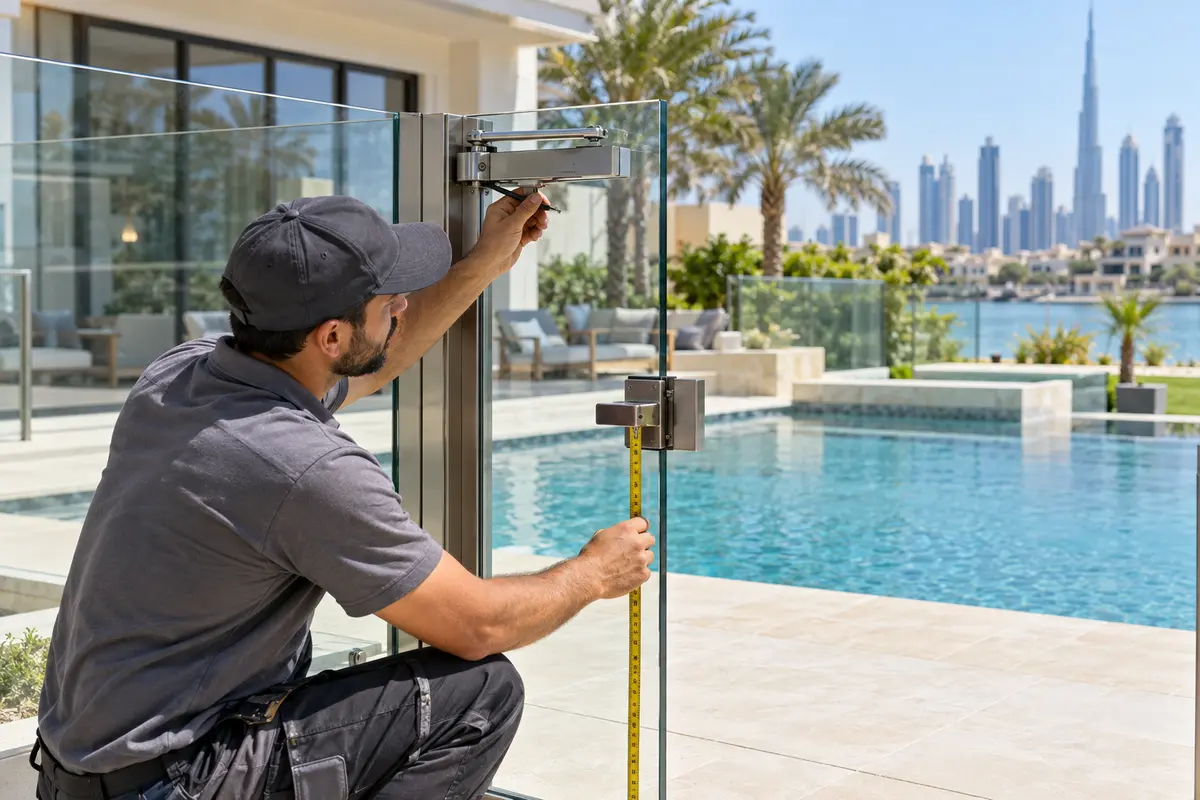
What the municipality's private-pool guideline asks of a villa
The document is the Private Swimming Pools Safety Guidelines (reference DM-HSD-GU80), issued by Dubai Municipality's Health and Safety Department in January 2020. It covers any pool at a private villa that can be filled to 300 mm or deeper, so a spa, a hot tub and an inflatable paddling pool are in scope alongside the main pool.
Every private pool "shall be equipped with an enclosure", and that enclosure must be permanent: impossible to remove without tools. Safety covers and nets are only recommended, as an additional layer. The barrier is the fence or wall with its gate.
The rule that changes most villa layouts concerns the house itself. For an outdoor pool, doors may not give direct access to the pool or form part of the enclosure. If the living-room slider opens straight onto the pool deck, the fence has to run between that door and the water. An automatic garage door or a perimeter gate that opens onto the pool area is excluded in the same way.
Windows that open onto the pool area need a fixed stop that limits the opening to under 100 mm, or security screens or bars held by fasteners. A key lock on the window does not count. A balcony over the pool, or within 900 mm of the fence, needs a balustrade that meets the same enclosure rules.
In 2018 the department's director told Gulf News it cannot enter private properties to inspect pools, so do not count on an inspector checking the fence for you. The same report quoted a 90 cm minimum, which the 2020 guideline replaced. Anything under 1.20 m measured outside, the old 90 cm figure included, falls short.
Height, gaps and the clear zone around the fence
Heights and ground gaps are measured on the side facing away from the pool, where a child starts climbing.
- Height: at least 1.20 m. The fence must stand upright and may lean towards the pool by no more than 15°.
- Gap at the bottom: no more than 100 mm over paving. Over grass, pebbles, gravel or soil the limit drops to 50 mm, and under a removable mesh fence to 25 mm.
- Gaps between bars: no more than 100 mm on a rigid fence such as steel or aluminium bars.
- Mesh and lattice: chain-link openings no larger than 30 mm square, or 40 mm where slats are fitted. Lattice or diagonal openings no larger than 40 mm.
- Horizontal rails: the highest rail a foot can use from outside must sit at least 1.10 m below the top of the fence. Rails that brace the bars go on the pool side, at least 900 mm apart.
The requirement installer brochures tend to skip is the clear zone. Anything a child can climb (planters, boulders, outdoor furniture, steps, a storage box) has to stand at least 1.20 m from the fence on the outside and 300 mm on the inside. A deck, a raised sill or a low wall built against the fence counts as well, because it shortens the effective height.
Where the garden is too narrow for 1.20 m of clear ground outside, the guideline accepts a 1.80 m fence with a 900 mm clear zone instead. On a narrow side return between villa and boundary wall, measure the strip before settling on a height.
A solid boundary wall can serve as part of the enclosure if it has no openings or grips. The guideline also wants pool chemicals in a lockable store, and a box of chlorine tubs against the fence is a step for a child. The guide to what a garden shed can hold covers where those tubs can safely sit through the summer.
The gate: the part of the fence that wears
A fence can meet every number above and still be left open by a gate that no longer latches. The guideline's gate rules:
- It opens outward, away from the pool.
- It is self-closing and self-latching from any position, and the closer must not let it swing open by itself.
- The latch release sits at least 1.50 m above the ground outside. A lower latch has to go on the pool side, shielded, where a child would have to reach over or through the gate at 1.20 m or higher.
- The gap between the gate and the fence post is 10 mm at most, and the 100 mm ground gap applies under the gate too.
- Hinges are at least 900 mm apart, with caps that cannot be climbed.
- There is a lock as well, with the key kept from children. A lock on its own is not enough.
Test it as it will be used. Open the gate a hand's width and let go: it should close and latch. Then open it fully and let go. A gate that stalls from a small opening fails "from any position", and a gate nudged partly open by an adult with full hands is often how one gets left.
Spring hinges and hydraulic closers lose tension with use, and sand blown in on shamal days packs into the latch striker. A gate that closed cleanly at handover can stop latching later. Hardware makers sell 316 stainless for pool gates because 304 pits faster around chlorinated splash, so ask which grade the hinges and latch are, and get a closer adjustment visit into the warranty.
How glass, metal railing and removable mesh meet those rules
The guideline says nothing about glass. The glass points below come from European and Australian practice that installers borrow, and are labelled as such.
Fixed glass panels
- As a barrier: no rails or bars to use as footholds. Panel joints and the base gap still fall under the 100 mm rules.
- Glass type: frameless pool-fence panels in Australia are typically 12 mm toughened safety glass. Toughened glass can shatter without impact because of a tiny nickel sulphide inclusion. Heat-soak testing to EN 14179-1 makes most affected panes break in the factory, and Western Australia's glazing guidance for government buildings requires it for toughened glass. Ask for the heat-soak record.
- When a panel breaks: toughened glass falls into small pieces, leaving a panel-wide hole in the barrier. Laminated glass holds together after breaking but is heavier and costs more. Toughened panels are cut and drilled before toughening, so a replacement is made to order: ask how long that takes.
- Fixing: spigots core-drilled into the slab, spigots on bolted base plates, or a continuous channel. The quote should say what the fixings go into, and whether any drilling crosses the pool's waterproofing or pipework.
A broken panel, or one chipped at its edge or around a clamp, is a stop point. Keep children off the pool deck and call the installer. Leave the clamps alone: their pressure on the glass is the installer's setting.
Aluminium or steel railing
- As a barrier: vertical bars at 100 mm or less meet the gap rule easily. Horizontal rails and decorative scrolls are the footholds, and the 1.10 m rule applies to them.
- Material: powder-coated aluminium does not rust. Steel depends on its coating staying intact, and rust tends to start at welds and fixings that sit in chlorinated splash.
Removable mesh
- As a barrier: poles drop into sleeves cored into the deck, and the mesh is too fine to climb through. The guideline sets its tightest ground gap, 25 mm, for this type.
- The permanence question: the guideline also wants an enclosure that cannot be removed without tools, yet in at least one maker's manual a section comes out by releasing its latches by hand and lifting the poles. The guideline does not reconcile the two. The cautious reading is that a mesh fence counts where its sections take a tool or key to undo. Get the installer's answer on this in writing.
- Sand in the sleeves: an open sleeve fills with sand, and a pole that will not seat fully lifts the mesh off the ground. Keep the sleeve plugs in whenever a section is out.
- Sun: ask what the warranty says about UV on the mesh and plastic latch parts.
Small children at home, visiting grandchildren, a narrow garden, a rented villa
- A child under five lives in the villa and the house opens onto the pool: a fixed fence, glass or railing, between the doors and the water, with the gate on the route adults actually use.
- Grandchildren visit, and the pool is otherwise for adults: the guideline expects the enclosure in place whenever the pool is not in use, so a fence put up only for visits falls short. Tool-locked mesh suits a household that wants a cheaper start and may swap it for a fixed fence later; the enclosure itself stays either way.
- The pool sits in a narrow side garden: the 1.80 m fence with its 900 mm clear zone, in whichever material the community allows at that height.
- You rent the villa: coring sleeves or spigot holes into the deck is an alteration, so the landlord's written consent comes first. Removable mesh leaves the least behind when you move out.
Once you know the type, a fence installation contractor can walk the line with a tape, mark the clear zone and the gate position, and quote against the figures above.
Covers, nets and alarms sit on top of the fence
If you fit a safety cover or net, the guideline wants it over the whole water surface and compliant with the American cover standard ASTM F1346-91. Over a pool wider than 2.4 m it must hold 220 kg, roughly two adults and a child. It must drain standing water within five minutes, and its anchors must be locked or out of children's reach.
A cover or net has to come off completely before anyone swims and go back on afterwards, so it protects only on the days someone remembered. It helps most where the fence is weakest, such as a pool with a balcony above it. A pool maintenance company that already services the plant can measure, fit and tension one.
Door alarms appear in the guideline only for indoor pools, where a door may form part of the enclosure and must sound at 85 dBA at 3 m. The US barrier guidelines the municipality cites treat door alarms as a layer where the house forms one side of the barrier, a layout the Dubai guideline rules out for outdoor pools. A pool-surface alarm sounds once something is already in the water, which makes it a last signal after every barrier has been passed.
Approvals before the installer drills
Which desks see the fence depends on where the villa sits and who owns it. In order:
- Landlord, if you rent. Written consent first. Dubai's tenancy law (Law 26 of 2007) bars a tenant from making alterations without the landlord's approval, and the community usually expects the NOC application from the owner.
- Master developer or community. Most communities treat a pool fence as an exterior alteration. Emaar, for instance, takes these as a Home Modifications NOC request on its community portal. Attach a site plan with the fence line, elevations with heights measured from outside, the product sheet and the gate hardware. The walkthrough of community NOCs for screens and walls covers how that desk works.
- The building authority. The municipality registers a villa pool before it is built and requires approval for changes to the pool itself, such as a slide or diving board. A fence added to an existing pool is not named, so ask the community whether its NOC needs an authority submission behind it. In communities where Trakhees is the building authority, that submission goes to Trakhees.
Developers have fined owners for villa alterations built without approval, and community rules can require the work to be altered or removed. A fence taken down for that reason leaves holes in the deck and the pool unfenced while it is redone.
Lines the installer's quote should name
- Fence height measured outside, any 1.80 m sections, and the ground gap over each surface.
- Gate direction, closer type, latch height and side, the steel grade of hinges and latch, and the lock.
- For glass: thickness, toughened or laminated, heat-soak record, fixing method, and replacement lead time. For mesh: whether removing a section needs a tool.
- Who clears the 1.20 m zone of planters and boxes.
- Who prepares the drawings for the NOC, and whether work starts only after it is issued.
- What the warranty covers on the gate closer and latch, and for how long.
Everlook lists licensed fence installers with verified credentials and reviews from villa owners. Pick by response time, rating and how fully each one answers the lines above in writing, and send the same list to every installer so the quotes compare.
Find your next pro on Everlook
Compare licensed contractors in your area in under a minute. Free to post, no signup needed to browse.
Find your next pro on Everlook
Post a job in minutes and get offers from trusted local contractors. Free to start.
Get started
