Villa Pool Green or Cloudy After a Dubai Summer: What Went Wrong and What Fixes It
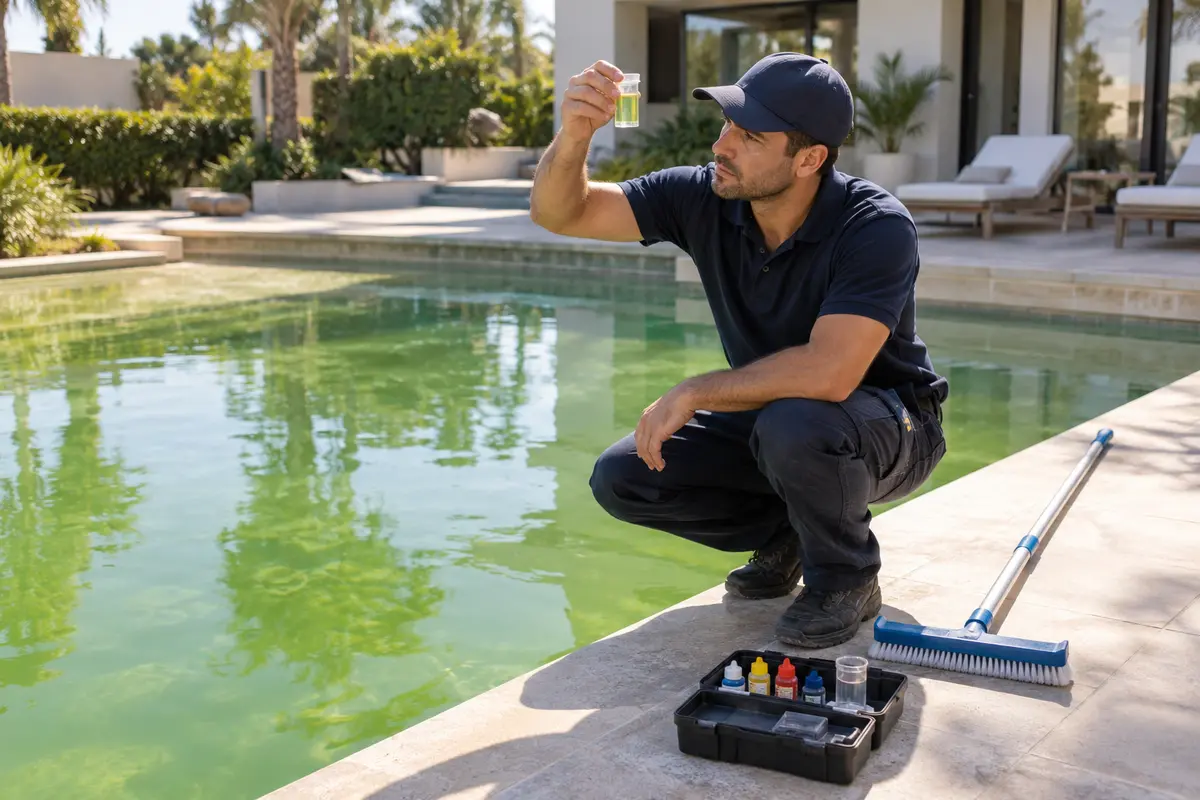
First, check these in 60 seconds
A villa pool that turns green or cloudy after a Dubai summer has run short of working chlorine, filtration or both, usually after months of heat and shamal dust. Test before you buy anything — two readings decide between a few days of shock and brushing and a partial drain.
Stand at the deep end first. If you cannot see the main drain, nobody swims — a child who slips under in murky water can vanish from view. That is the clarity check the Centers for Disease Control and Prevention (CDC) in the United States gives swimmers.
Next, match the water to one of these:
- Green. Algae is growing, usually because free chlorine has sat at or near zero for days.
- Cloudy or milky. Particles are getting past the filter: a clogged filter, too few pump hours, or scale from high pH and calcium. A haze for a day after shocking is common.
- Yellow-brown powder on shaded walls that brushes off and returns. Mustard algae, which tolerates chlorine levels that clear green algae.
- Dark spots rooted in the grout that will not brush away. Black algae.
- A brown, rusty or teal tint after shocking. Dissolved iron or copper made visible by chlorine, often from corroding equipment.
Then run five checks that need no chemistry training:
- Pump: is it running, and how many hours does the timer allow?
- Baskets: full skimmer and pump baskets starve the pump of water.
- Filter gauge: compare it with the clean reading in the service log.
- Test strip: read free chlorine and pH. Strips are less precise than a drop-test kit, but they separate zero from plenty.
- Water level: mark it against a tile joint in case you need the bucket test.
Why a Dubai summer breaks pool chemistry
A villa pool here faces several pressures at once for months, and the damage tends to show after the travel season.
Hot water and strong sun use up chlorine
Pool chillers are common villa equipment in the UAE because unshaded pools get uncomfortably warm in peak summer, and warm water generally speeds up both algae growth and the reactions that consume chlorine.
Ultraviolet light also breaks down unprotected chlorine. Outdoor pools have been dosed with a stabiliser, cyanuric acid, since 1958 to slow that loss, according to a 2018 review in Journal AWWA, and standard chlorine tablets (trichlor) carry it built in.
Stabiliser builds up with every tablet
When a tablet's chlorine is spent, its stabiliser stays behind. A 2023 review in Frontiers in Public Health notes that cyanuric acid does not decompose easily and accumulates, and the more there is, the more chlorine it holds back.
Dubai Municipality's private pools safety guideline sets stabiliser at 20 to 60 mg per litre (the same as ppm on a test strip), free chlorine at 1 to 2 and pH at 7.4 to 7.6. A summer on tablets alone can push stabiliser well past that range.
Dust storms and garden water feed algae
The summer shamal lifts dust for days at a time. Studies of dust storms over the Arabian Gulf link them to phytoplankton growth fed by the nitrate the dust carries, and a pool catches the same fall-out, plus sand that clogs the filter.
Sprinkler spray that reaches the pool adds soil and fertiliser, and in a 2018 experiment on samples from 39 urban water bodies, a nutrient pulse boosted algae far more than warming did. If you are weighing turf or a real lawn beside the pool, plan where the sprinklers will throw water.
Top-ups, travel and a pump on short hours
Evaporation takes pure water and leaves minerals behind. A 2025 Loughborough University study estimated about 600 million litres a year evaporating from 1,859 pools and water features in one Dubai development, close to a centimetre of depth a day on average. Each top-up adds calcium, and the pool drifts towards hard water that scales and clouds.
Then owners travel, visits get skipped, and pump timers get cut to trim the DEWA bill. The private pools guideline caps retention time at 4 hours, meaning the system should pass the whole pool through the filter at least that often. On a system sized to that standard, two or three pump hours a day never filter the full volume once.
If free chlorine reads zero: shock, brush and filter around the clock
Zero chlorine with green water is the simplest case: raise chlorine high enough to kill the algae, hold it there, and let the filter remove what dies.
Move quickly. In one California county in 2007, an aerial survey found most green, neglected pools producing mosquitoes, alongside a 276% rise in human West Nile virus cases, according to a study in Emerging Infectious Diseases.
Clean, circulating water leaves larvae nowhere to develop, the same principle behind any standing-water mosquito checklist.
Before you open any chemical
The CDC's pool chemical guidance says never to mix different pool chemicals, including different types of chlorine product, and never to mix chlorine with acid, which can release toxic gas. If a label says to pre-dissolve, add chemical to water and never water to chemical, because the reaction can be violent.
Wear goggles and gloves, dose with nobody in the water, and keep chemicals in the locked, dedicated storage the municipal guideline requires.
Shock, brush, filter, retest
- Empty the baskets and net out leaves.
- Bring pH to 7.4 to 7.6 first, because chlorine loses strength as pH climbs. Let the pump circulate the pH product through the water and follow each label's waiting time before the next product goes in.
- Shock with unstabilised chlorine (liquid chlorine or calcium hypochlorite) at the label's algae dose. Remove tablets from the skimmer or floater first, and never add granules to a feeder that has held tablets.
- Brush walls, steps and floor daily so the chlorine reaches the algae.
- Run the pump around the clock, backwashing whenever the gauge climbs.
- Retest morning and evening. Chlorine that vanishes overnight usually means live algae, so dose again.
The water normally turns a cloudy blue-grey as the algae dies, then clears. Once chlorine holds overnight and the drain is visible, return to normal dosing.
If chlorine reads high and the water will not clear: too much stabiliser
Here the strip shows plenty of chlorine and the water stays green or dull. Test stabiliser, which many basic kits leave out.
A reading at the top of the guideline's 20 to 60 range, or past it, points here. Stabiliser binds free chlorine reversibly, so the more of it the water holds, the more chlorine the pool needs to do the same work. In lab tests cited by the 2023 review, 30 mg per litre of stabiliser made weak chlorine (0.5 mg per litre, at pH 7.0) take 4.8 to 28.8 times longer to inactivate viruses.
That is why the CDC advises keeping free chlorine at 2 ppm or more in any pool that uses stabiliser.
The dependable fix is dilution. Replacing half the water halves the reading, so a pool testing at 120 needs about half its volume changed to get back to 60. Before you drain:
- Expect a metered refill. DEWA's responsibility ends at the meter, and the refill water goes through it onto the villa's bill.
- Rebalance. Fresh water shifts pH, alkalinity and calcium, so retest once the pool is full.
- Fix the cause. Dose unstabilised chlorine routinely, and test stabiliser every 15 days, as the private pools guideline asks.
If the chemistry is right and the water stays cloudy: the filter or the pump
When chlorine, pH and stabiliser are all in range and the haze stays, look at filtration, circulation or scale.
A filter that has stopped filtering
One sand filter manual (Hayward's Pro Series side-mount) says to backwash once the gauge reads 6 to 8 psi (0.41 to 0.55 bar) above the clean start-up pressure, and warns that low chlorine or unbalanced pH makes it hard for the filter to clean the water. Check the figure in your own filter's manual, since models differ.
Pressure that climbs straight back after a backwash usually means caked sand. Pressure that barely moves while the pool stays cloudy often means water is bypassing the sand through a cracked part inside the tank.
A weak pump, or a haze of scale
Check that the pump primes quickly and pushes steady flow from the return jets. Bubbles in the pump lid point to an air leak that cuts flow quietly. If the villa still runs its developer-installed pump from handover, have a technician check it against the pool's volume.
A fine white haze with a crust at the waterline is usually scale from high calcium and high pH. The same guideline sets calcium hardness at 100 to 500 ppm, and bringing pH down usually settles the cloud.
If the water level keeps dropping: evaporation or a leak
Summer evaporation alone lowers the waterline visibly each week. The bucket test separates evaporation from a leak:
- Stand a bucket of pool water on the top step so the water inside sits level with the pool.
- Mark both levels, switch off any auto-fill, and keep everyone out.
- Compare after 24 hours. If the pool dropped further than the bucket, it is leaking.
Repeat with the pump off. A bigger loss with the pump running usually points to the return pipework, a bigger loss with it off to the suction side, and an equal loss either way to the shell or a fitting.
What needs a pool technician, and when the maintenance company is the problem
Stop dosing and call a technician for any of these — no chemical fixes them, and a leak or a failing pump costs more every week it runs:
- A pump that hums without starting, trips the breaker, leaks or will not prime.
- A filter that will not hold steady pressure after backwashing, or sand on the pool floor.
- A pool chiller or heat pump showing a fault code or no longer changing the water temperature.
- A bucket test that shows a leak.
- Etched or rough plaster, stains that will not brush out, or tiles and grout loosening after a spell of bad chemistry.
Tablets can damage a chiller or heat pump too. One heat pump manual (G&F Manufacturing's Gulfstream) warns that solid chlorine left in the skimmer causes premature corrosion inside the unit, and excludes chemistry damage from the warranty except on titanium-tube models.
The first four belong with pool maintenance and repair specialists, who handle pumps, filters, chillers and leak detection.
Etched plaster and failing grout usually mean draining the pool for surface repair or a resurface, the work of pool resurfacing and renovation contractors.
What a proper weekly visit includes
The private pools guideline puts maintenance on the owner or occupier, carried out by a competent person, with pH, chlorine and temperature tested daily before use, fuller balance tests every 15 days, and every reading logged. A summer visit that meets that standard covers:
- Chlorine and pH tested and logged, with stabiliser and calcium on the 15-day cycle.
- Walls, steps and floor brushed, shaded corners included.
- Baskets emptied and the floor vacuumed.
- The filter gauge read, and the filter backwashed when the reading is high.
- Pump timer, chiller and water level checked.
Daily strip tests between visits fall to whoever lives in the villa.
Signs the visits were being skipped
Look for gaps or identical readings in the log, no stabiliser result all summer, full baskets and a high gauge the day after a visit, and a dust line at the waterline. From the next company, ask for dated readings after every visit, stabiliser tested every 15 days, and a written plan for July and August that covers the pump timer.
If you rent the villa
Pool upkeep is usually allocated in the tenancy contract registered with Ejari, so read that clause before paying for a recovery. If the contract is silent, Article 16 of Law No. 26 of 2007 puts maintenance on the landlord, although the private pools guideline still expects the occupier to keep the water safe. A pool handed back green can also cost you security deposit deductions: Article 20 lets the landlord hold the deposit against the property's upkeep, and Article 21 requires it returned in the condition you received it, fair wear and tear aside.
Frequently asked questions
How long does it take to clear a green pool?
A lightly green pool usually clears in two to four days with high chlorine, daily brushing and the pump running around the clock. Dark green water that hides the floor can take a week or more, especially with a tired filter or high stabiliser. A cloudy blue-grey stage between green and clear is normal while the filter catches dead algae.
Is it safe to swim in a cloudy pool?
Only once the main drain at the deepest point is clearly visible from the deck, which is the CDC's check for swimmers. Someone in difficulty underwater cannot be spotted in murky water, and cloudiness also signals weak disinfection or filtration. After a shock dose, also wait until chlorine has dropped back to its normal level.
Why won't my pool hold chlorine in summer?
Usually because algae, dirt or sunlight use it faster than you add it. Strong sun breaks down unstabilised chlorine within hours, and hot water speeds everything up. Chlorine that vanishes overnight points to live algae. If the reading looks fine but the water does not, test stabiliser: the more the water holds, the more chlorine it takes to do the same work.
How often should a villa pool be serviced in a Dubai summer?
A weekly professional visit is the practical minimum through summer, with a quick strip test by whoever lives in the villa on the days between. The municipal guideline sets the testing rhythm that visit has to fit around, daily before use with fuller checks fortnightly. In July and August, when heat, dust and evaporation move the chemistry fastest, a second weekly visit is worth considering.
Booking pool maintenance on Everlook
Pool water problems compound. A summer of untested stabiliser turns a weekend of shock and brushing into a partial drain, and months of low pH leave etched plaster that no chemical can repair. Everlook connects you with licensed UAE pool maintenance and repair technicians — verified credentials, transparent quotes, and reviews from real Dubai customers.
Find your next pro on Everlook
Describe your job once, get quotes from verified UAE contractors. Free, no commitment.
Find your next pro on Everlook
Post a job in minutes and get offers from trusted local contractors. Free to start.
Get started