Mosquitoes and Ants in Your Dubai Apartment: How to Stop Them in Summer
Why summer changes the pest equation in the UAE
From roughly March to October, warm air and humid kitchens turn an ordinary apartment into prime habitat for two pests with very different motives. Mosquitoes arrive to breed; ants march in to drink and feed.
Mosquitoes need only a teaspoon of still water to reproduce, and in warm weather an egg becomes a biting adult in about 7 to 10 days. That short cycle is the whole reason prevention here is a weekly habit, not a one-off spring clean — skip a week and a fresh generation has already hatched on your balcony.
The species that matter for public health are Aedes mosquitoes, which bite in the daytime and can carry dengue. Both Aedes and Anopheles species are present in the UAE, and dengue cases were reported after the heavy storms of recent years, according to the World Health Organization's dengue guidance. Risk to any individual resident stays low, but the prevention logic is the same regardless: deny mosquitoes the standing water they need.
Ants are a comfort-seeking problem rather than a disease one. When it is brutally hot and dry outside, foraging ants trail indoors looking for water and sugar, slipping along skirting lines and through the gaps where pipework enters a wall.
The 6-step summer prevention checklist
These are the steps a tenant can do without a contractor. Each carries a rough time-to-complete so you can fit them around a normal week.
1. Kill every standing-water source weekly (20 minutes)
This is the single highest-value habit, because it removes the mosquito nursery before eggs can mature. Walk the apartment once a week and empty or dry anything holding still water.
The usual culprits in a Dubai flat are the Aedes mosquito's favourite small containers: plant-pot saucers on the balcony, the drip tray under a window AC or a split-unit's condensate path, decorative bowls, and any bucket left part-full after cleaning. Female mosquitoes glue their eggs to the inner walls of water-filled containers just above the waterline, so wiping the sides dry matters as much as tipping the water out.
2. Keep drain U-bend traps wet and balcony drains clear (10 minutes)
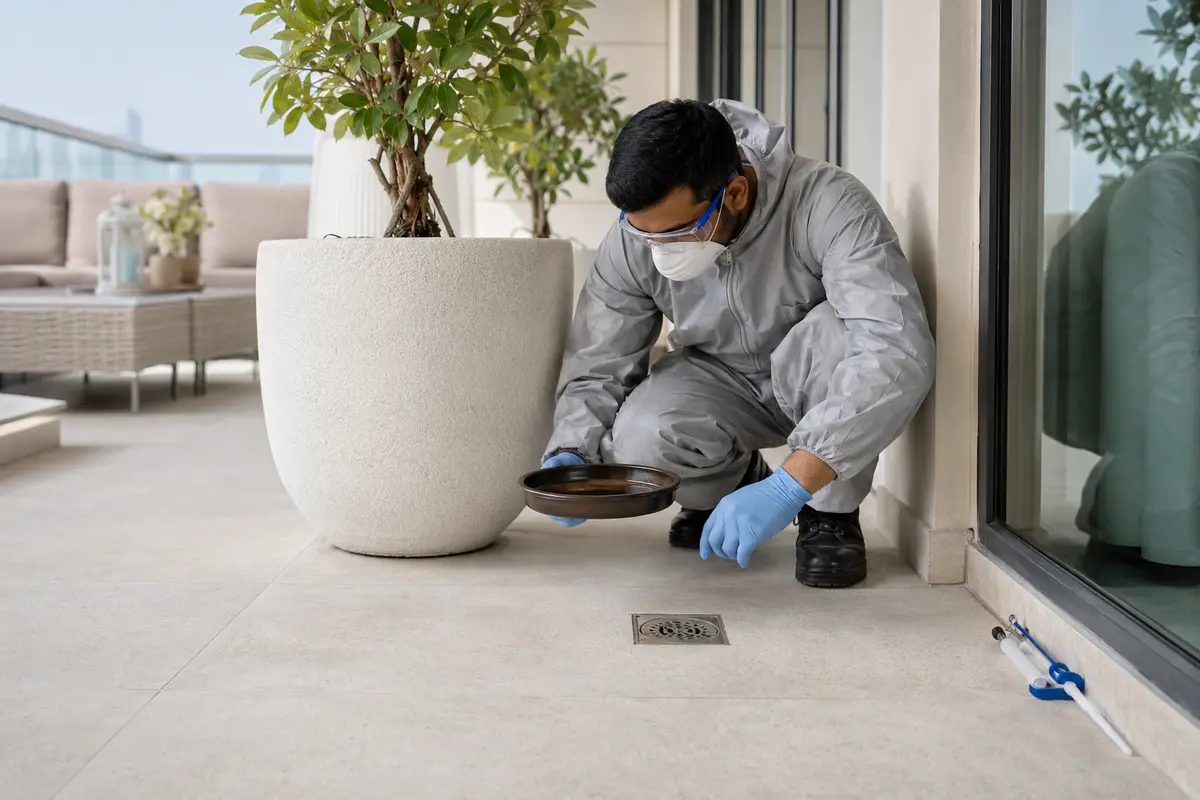
A floor or balcony drain has a U-bend trap that should hold a little water to block odours and insects. The problem in summer cuts both ways: a trap that dries out becomes an open pipe pests crawl up through, while a blocked balcony drain leaves a stagnant pool that breeds mosquitoes.
Run water down any rarely-used floor drain weekly to refill the trap, and clear leaves or grit from balcony drains so rain or AC runoff cannot pool. Standing water in a sluggish drain is a classic breeding source, the same one covered in this guide to dealing with blocked, smelly apartment drains.
3. Store food and bin waste so ants find nothing (15 minutes)
Ants forage on scent trails, and a single reachable food source recruits a column within hours. Move sugar, honey, cereal, and pet food into airtight containers, wipe down counters after cooking, and rinse recyclables before they sit in the kitchen.
Keep the bin sealed and emptied often through the warm months. Removing the reward is more durable than killing the ants you can see, because it stops the trail re-forming the next day.
4. Fix door sweeps and check window and balcony screens (30 minutes)
Daytime-biting mosquitoes come in through the gaps you stop noticing. Check that window and balcony-door screens are intact with no torn corners, and that the mesh sits flush in its frame.
Fit or replace a door sweep on the main door and any balcony door. The strip of light under a poorly-sealed door is also the gap an insect uses. This is a screwdriver-and-self-adhesive-strip job for most tenants, no contractor needed.
5. Seal gaps around pipework and skirting (45 minutes)
Ants and mosquitoes both exploit the gaps where a sink or washing-machine pipe passes through a wall, and the open seams along skirting boards. These are the highways an ant trail follows from a wall void into your kitchen.
Fill obvious gaps around pipework with a flexible sealant and press skirting back where it has lifted. You are narrowing the entry points, not sterilising the building — but every sealed gap is one fewer trail route.
6. Manage balcony plants and overflow (15 minutes)
Overwatered pots, saucers that never dry, and a water tank or AC line that overflows onto a balcony all create the still water mosquitoes want. Tip saucers after watering, and report any persistent overflow from a shared water tank or feed line to your building's maintenance team.
If a balcony tap or AC drain line drips steadily into a corner, that slow puddle is a breeding site in its own right, and fixing the drip removes it for good.
Why baiting beats spraying for ants
The instinct when you see an ant trail is to reach for an over-the-counter spray. It feels decisive, and it does kill the foragers in front of you — but it leaves the nest untouched and can make a stubborn problem worse.
Some ant colonies respond to a spray by budding: stressed workers split off and start new sub-nests elsewhere in the wall void, so one trail becomes three. A gel bait works the opposite way. Foragers carry the bait back and feed it to the colony, including the queen, which is the only part of the nest that actually matters for long-term control.
Professionals add an insect growth regulator (IGR), a compound that stops the colony reproducing rather than just killing adults. It is slower to look dramatic but far more thorough, which is why a persistent or structural ant problem is a job for a licensed technician rather than another can of spray.
The shared-building problem one flat cannot fix
This is where an apartment differs from a standalone villa. Pests do not respect your front door. They move between units through the building riser, shared drains, and common walls. Treating only your flat has a built-in ceiling, because the source may sit in a neighbour's kitchen or a common-area void.
That is why serious prevention in a tower is coordinated. The building's facilities management (FM) arranges common-area treatment, and under a typical Dubai tenancy contract (registered through Ejari) the landlord generally carries responsibility for structural and common-area pest control while the tenant handles day-to-day hygiene inside the unit. Treat that as a general rule rather than a legal absolute: your specific agreement and what it says about pest control governs, so read it before assuming who pays.
If you are seeing pests despite a clean, well-sealed flat, the practical move is to raise it with the building's management so treatment is coordinated across the affected units. A diagnosis-led look at how persistent pests keep returning is covered in this piece on why apartment pests keep coming back.
What needs a licensed pro
The checklist above handles prevention. Some situations need a contractor licensed by Dubai Municipality, which regulates pest control companies, issues their permits, tests pesticide effectiveness, and runs vector-monitoring programmes under International Best Practices, per the municipality's Public Health Pest Control Section. Outside Dubai, your local municipality plays the same licensing role.
Call a licensed pest professional when you hit any of these:
- A mosquito problem that persists after you have cleared every standing-water source. Adult control may need ULV (ultra-low volume) fogging, which is not a tenant task.
- Recurring ant trails from inside the wall structure. Targeting the nest with gel bait and an IGR is far more reliable done professionally.
- Any breeding site you cannot reach — a shared water tank, a common service shaft, or a void behind fixed cabinetry.
- Signs of more than one pest type at once, which usually points to a building-wide source the FM team should treat.
Booking a licensed pest-control treatment through a vetted contractor also gives you the municipality-format paperwork that some buildings and inspections require.
When to do this next
The trigger is seasonal. Run the full checklist as a pre-summer reset in February or March, before the humidity climbs, then repeat the weekly standing-water sweep through the warm months to October.
Tie it to a habit you already keep. Many tenants fold the water-source check into the same weekend they run their pre-summer AC walkthrough, since a clogged AC condensate tray is itself a breeding site worth catching early. After a heavy rain, add an extra sweep: storms leave pooled water that mosquitoes colonise within days.
Frequently asked questions
Why are there suddenly so many ants in my apartment in summer?
Ants march indoors in summer mainly to find water and food when conditions outside turn hot and dry. They follow scent trails along skirting and through gaps around pipework. The fix is to remove the reward — store food airtight, wipe surfaces, and seal the gaps — not to spray the foragers you can see.
Is the landlord or tenant responsible for pest control in a Dubai apartment?
As a general rule, the landlord covers structural and common-area pest issues while the tenant handles day-to-day hygiene inside the unit, but your tenancy contract is what actually governs. Check what your agreement (registered via Ejari in Dubai) says about pest control, and raise building-wide problems with your building management.
How quickly do mosquitoes breed in standing water?
In warm weather an Aedes mosquito egg develops into a biting adult in roughly 7 to 10 days, and it needs only a teaspoon of still water. That short cycle is why clearing standing water weekly works: you break the cycle before a new generation can mature on your balcony or in a blocked drain.
Do over-the-counter ant sprays work?
Sprays kill the foragers you see but usually leave the nest intact, and they can prompt some colonies to bud into several smaller nests. Gel baits work better because foragers carry the bait back to the queen. For a persistent or structural infestation, a licensed technician using bait plus an insect growth regulator is more reliable.
Do I need professional pest control if I keep the apartment clean?
A clean, sealed flat prevents most problems, but in a shared tower pests travel between units through risers and common walls, so one tenant's effort has limits. If pests persist despite good hygiene, the source is likely a common area, and coordinated treatment through the building's management and a licensed contractor is the right next step.
Booking pest control on Everlook
Quotes for pest control vary widely across Dubai — apartment size, the pest involved, and whether treatment needs to be coordinated across a building all push the number. Everlook lets you compare offers from licensed UAE pest-control contractors side-by-side before you commit, with no obligation.
Find your next pro on Everlook
Describe your job once, get quotes from verified UAE contractors. Free, no commitment.
Find your next pro on Everlook
Post a job in minutes and get offers from trusted local contractors. Free to start.
Get started