Bed Bugs in a Dubai Apartment: How to Be Sure, and What Actually Gets Rid of Them
What to look for tonight, before you buy anything
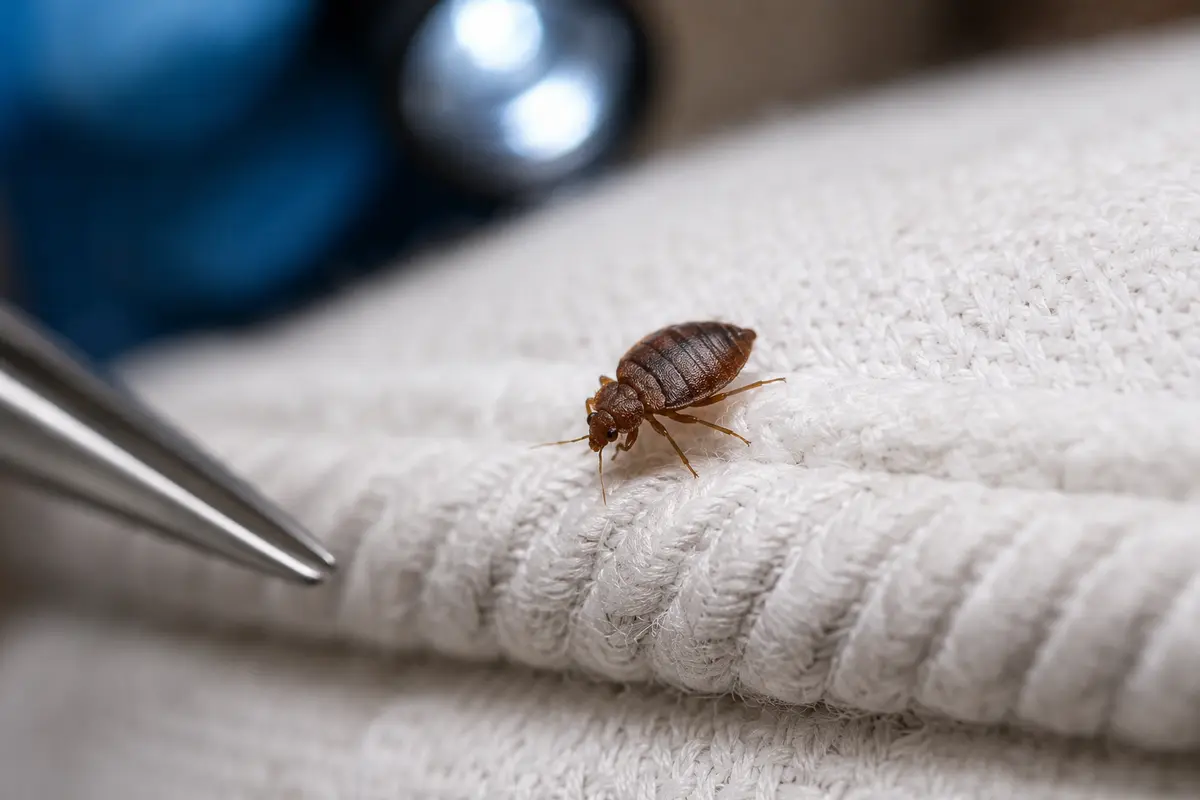
Bed bugs are confirmed by physical evidence, not by skin. The adult insect is roughly 4 to 5 mm long, flat, oval and reddish-brown before it feeds, and it spends the day pressed into a seam or a joint within a couple of metres of where you sleep.
You need a torch, something thin and stiff to run along seams, and about 10 minutes. Strip the bed, pull it away from the wall, and work outwards from the mattress.
Start with the mattress piping and seams
Run the torch along the piping that edges the mattress, then the seams, the label tags and the folds of any pillow-top layer. Four things confirm an infestation: live insects, shed skins, eggs and faecal spotting.
Faecal spotting is the most useful of the four, because the insects hide and their waste does not. It shows up as dark brown or black dots roughly 1 to 2 mm across, like ink from a fine-tip pen, and since it is digested blood it bleeds slightly into fabric rather than sitting on the surface. Shed skins look like hollow, translucent copies of the insect. Eggs are pearly white, about 1 mm long, and glued in place, not loose.
Then the frame joints, the headboard and the screw voids
The insects favour tight, dark, dry gaps with a rough surface to grip: the bolt holes and screw voids of a headboard, the joints where side rails meet the frame, the underside of slats, and the cavity between a fabric headboard and its backing board.
Unbolt the headboard from the wall if the fixing allows it. Speckling on the wall behind it, or along the top edge of the skirting board behind the bed, means the harbourage has outgrown the bed and has been established for a while.
Widen the search only after the bed is clear
If the bed shows nothing, check the bedside drawer runners, the hems of floor-length curtains, the carpet edge where it grips at the skirting, and any sofa or armchair someone has been sleeping on. A heavy infestation carries a sweetish, musty smell, but that arrives late and its absence proves nothing.
What actually counts as confirmation
One live insect, or a shed skin alongside fresh spotting on a seam. That is the standard a technician works to, and it is worth holding yourself to before you commit to treatment.
Trap the specimen in a clear zip bag instead of crushing it. Species and life stage both change the plan, and a nymph in a seam means something is breeding in the room rather than a single insect hitching a ride home.
Why bites are the weakest evidence in the flat
Bites feel like proof. They are not: clinical reviews of bed bug exposure put the share of people who never develop any visible skin reaction at roughly a fifth to a third, with lower reaction rates reported in adults over 65 and in young children.
Timing distorts the picture further. Someone bitten for the first time may show nothing for 8 to 10 days, then react within minutes once sensitised — so the person who "started reacting first" is not necessarily the one being bitten most. Even the textbook pattern of three or more bites in a line turns up in fewer than half of documented cases.
Plenty of other things produce the same marks: mosquito bites, ant bites, flea bites, heat rash in the humid months, contact dermatitis and ordinary allergic reactions. When bites are the only evidence you have, the ordinary explanations are the likelier ones, and the summer mosquito and ant problem accounts for a large share of misread mornings.
Bed bug, carpet beetle or cockroach nymph?
Most misidentifications come down to two insects, and both mistakes send you down a treatment path that cannot work.
Carpet beetles: rounder, hairier, and not in the bed
Adult carpet beetles are small and rounded with mottled patterning, nothing like the flat uniform oval of a bed bug. The larvae are the ones people photograph: elongated, tan to brown, and covered in bristly hairs that a bed bug nymph never has.
Location settles it. Carpet beetles feed on natural fibres, so they turn up in wardrobes, under rugs and in stored textiles, not in a mattress seam. They do not bite at all, though those bristles can raise itchy welts that pass for bites, and their damage shows as irregular holes in wool with shed larval skins nearby.
Cockroach nymphs: fast, glossy and never in a mattress seam
A young German cockroach is dark, glossy, quick on its feet and carries two parallel stripes on the shield behind its head. A bed bug is slow, matte and flat as a card, and does not bolt for cover when a light goes on.
Habitat separates them again: cockroach nymphs stay near warmth, moisture and food, which puts them in cabinet voids, behind the fridge and around bathroom pipework, not in bedding. If that is what you are finding, bait and exclusion is the fix, and the reasons cockroach populations keep returning are structural rather than hygienic.
Why the spray can turns one room into the whole flat
The supermarket aerosol is the most damaging thing a resident can reach for, for two separate reasons.
The first is chemistry. Most consumer products are pyrethroids, and pyrethroid resistance in bed bugs is now the rule rather than the exception. Regional evidence is blunt about it: a 2021 study in Parasites and Vectors found high permethrin resistance and super-kdr mutations in every tropical bed bug population it sampled, with under 40 per cent mortality at 24 hours, and concluded that pyrethroid-led control needs rethinking. A controlled test of over-the-counter foggers in the Journal of Economic Entomology found field-collected bed bugs largely unaffected by direct two-hour exposure, with no useful residual afterwards.
The second is mechanical, and it is the part that actually costs you. Aerosols do not penetrate the cracks where the insects sit, but they do irritate — pyrethroids raise activity levels, and a treated harbourage empties outwards into skirting boards, wall voids, the next room and, in a tower, the unit next door. Jones and Bryant, who ran that fogger test, flagged the dispersal it causes as a grave concern in multi-unit housing.
The bites often stop for a week after a spraying. That is not the treatment working; that is the population relocating, and it comes back wider than it started.
Two related instincts are worth resisting. Do not throw out the mattress: carrying an infested item through the corridor seeds the building, and a new mattress in an untreated room is infested within weeks. Do not move to the sofa or the spare room either, because the insects follow carbon dioxide and body heat, and you have just founded a second colony.
What professional treatment actually involves
It is not one visit, and a company that promises a single-visit cure is either using heat or overselling.
A conventional treatment starts with an inspection to map the harbourage, then combines targeted crack-and-crevice application of non-repellent products with an insect growth regulator (IGR) that stops nymphs reaching breeding age, plus steam on seams and joints a residual product cannot reach. Vacuuming and encasements do the mechanical half.
Eggs are the reason for the second visit. They survive most residual products, and at ordinary indoor temperatures they hatch in about 9 to 12 days — which is why a follow-up roughly 10 to 21 days after the first treatment is standard practice, not a sign that something went wrong. Expect the job to run over several weeks, with monitors left in place between visits.
Only companies permitted by Dubai Municipality's Public Health Pest Control Section may carry out this work, and the professional-grade actives they hold are not sold to residents. Ask for the permit number, the product list and a written service report before anyone starts, and arrange a licensed treatment for the whole flat, not one bedroom.
The preparation the crew needs from you
Wash all bedding, curtains and clothing from the affected rooms at the highest temperature the fabric tolerates, tumble-dry on high for at least 20 minutes, then bag it and keep it sealed until treatment is finished. Heat drying is what kills every life stage, not the wash itself.
Declutter the floor, empty the bedside units, and pull furniture away from the walls so the technician can reach the skirting line. Keep encasements on the mattress and base for at least a year once they go on.
One instruction matters more than the rest: do not move infested items into another room, into storage or onto a balcony before the crew arrives. Shifting the mattress, the headboard or a bag of clothes is the most common way residents turn a bedroom problem into a flat-wide one in the 48 hours before treatment.
Whether you have to move out
It depends on the method, so ask before you book. Targeted crack-and-crevice work with steam usually does not require you to vacate beyond a few hours of drying time, and normal use of the bedroom resumes the same evening.
Whole-room heat treatment and fogging are different. Heat work holds the room in the region of 49 to 52°C for 20 to 30 minutes, which means everyone leaves, and heat-sensitive items (aerosol cans, candles, medication, some electronics) come out beforehand. Fogging carries its own re-entry interval. Neither is a reason to avoid the method; both are a reason to plan the day.
In a tower, your flat is not the unit of treatment
This is the part that catches Dubai tenants out. Bed bugs travel along shared walls, through the wall penetrations around a building riser, and under doors into adjoining units, and genetic work on multi-unit infestations has repeatedly traced a whole building back to a single introduction.
The consequence is uncomfortable. If a neighbouring unit is infested and untreated, your flat can be cleared properly and recolonised within a month, which reads to a resident as a failed treatment and to the contractor as a finished job. One badly handled treatment in a shared accommodation block has been documented spreading an infestation from a single room to dozens.
So report it in writing to the building's FM team or the owners association on the same day you book your own treatment, and ask them two specific questions: whether other units have reported the same thing, and whether adjacent flats will be inspected. Written notice also creates the record you will want if the building sits on it.
Who pays, in one paragraph
Under Dubai's tenancy law the default sits with the owner. Article 16 of Law No. 26 of 2007 makes the landlord responsible for maintenance and for repairing defects that affect the tenant's use of the property, unless the parties agree otherwise, and in practice many tenancy contracts do exactly that, assigning routine pest control to the tenant. Read what your own contract, registered via Ejari, says before arguing the principle. Then act anyway: an infestation does not pause while an email thread runs, and the delay lands on whoever is sleeping there.
How they got in, and what to change
Bed bugs do not walk in from outside. Something carried them, and in this market the leading candidate is second-hand furniture. The used-furniture trade moves a lot of beds, sofas and headboards, and flat clear-outs cluster around lease turnover through summer (Mar-Oct), when exit-clean expectations push people to hand a unit over fast without inspecting what is leaving it.
Two other routes matter. Movers' blankets and shared trucks carry insects between jobs when the crew does not launder the wraps, which is worth raising when you compare moving companies. And luggage after travel is the classic vector: hotel rooms are treated frequently, but a suitcase left open on a luggage rack collects what a mattress seam releases at night.
Most of that closes off with three habits. Inspect the seams and staple lines of any used upholstered item outdoors before it comes through the door, unpack suitcases away from the bedroom and run travel clothing straight through a hot dryer, and keep bedroom textiles on the sort of schedule a sensible mattress and sofa cleaning routine already sets.
There is a myth worth retiring here. Bed bugs are not a summer pest here, and they are not a hygiene problem. An air-conditioned flat holds a steady indoor temperature all year, so the insects have no off-season; what is seasonal in this city is human behaviour — leases turning over, furniture changing hands, and people flying in and out.
Frequently asked questions
Do I have to throw away my mattress?
No, and doing so usually makes things worse. Carrying an infested mattress through corridors and lifts spreads insects through the building, and a replacement bought while the room is still infested is colonised within weeks. Professional treatment, steam and a zipped encasement left on for at least 12 months save the mattress in almost every case.
How long does it take to get rid of them completely?
Weeks rather than days. A conventional programme is typically two visits spaced 10 to 21 days apart, occasionally three where the infestation has spread beyond the bedroom, because eggs hatch after the first application and need a second one to catch. Judge success by monitors and by the absence of fresh spotting, not by whether bites have stopped.
Can bed bugs survive in an apartment that has been empty?
Yes, which is why an empty period is not a cure. At ordinary indoor temperatures an adult that has fed can survive several months without another blood meal, and cooler conditions extend that considerably. A flat left vacant between tenancies can deliver a live population to the next occupant on the first night they sleep there.
Do bed bugs transmit disease?
There is no definitive evidence that they transmit disease to humans, despite more than 40 pathogens having been detected in the insects themselves. The real harms are different: persistent itching, secondary skin infection from scratching, disrupted sleep and genuine anxiety. Those are reason enough to treat quickly, but not a reason to panic about infection risk.
Booking bed bug treatment on Everlook
Bed bug problems compound faster than almost anything else in a flat. Left for six months, what began in one mattress seam is in the sofa, the second bedroom, and — because service risers and shared walls do not respect your front door — quite possibly the unit next to yours. Everlook connects you with licensed UAE pest-control contractors: verified credentials, transparent quotes, and reviews from real Dubai customers.
Find your next pro on Everlook
Compare licensed contractors in your area in under a minute. Free to post, no signup needed to browse.
Find your next pro on Everlook
Post a job in minutes and get offers from trusted local contractors. Free to start.
Get started