Pigeons on Your Balcony and AC Unit in Dubai: What to Do (and What's Allowed)
Why this matters in the UAE specifically
Dubai's high-rise towers give pigeons exactly what they want: shaded ledges, sheltered balcony corners, and a flat, warm perch on the outdoor AC condenser unit that most apartments mount on the balcony or in a service recess. Once a pair settles in, droppings build up fast, and the mess sits on surfaces you breathe near every day.
There is a regulatory layer here that catches a lot of tenants out. Bird control in the UAE has to be humane — under Federal Law No. 16 of 2007 concerning the protection of animals, acts that cause animals harm, pain or suffering are prohibited. Poisoning pigeons, gluing them, or trapping them in ways that injure them is not an option, and it is not how a licensed contractor works either.
There is also a building layer. You share a facade with every other unit in the tower, so what you bolt to your balcony is rarely just your decision. The good news is that the methods that genuinely work in this climate are also the humane, building-friendly ones.
The pigeon-proofing checklist for a Dubai balcony
Work through these in order. The early steps remove what attracts pigeons in the first place; the later ones physically block access where they are already roosting.
1. Remove every source of standing water (15 minutes)
Pigeons need to drink, and a balcony in summer often gives them a supply you did not notice. The biggest culprit is your own AC: the outdoor unit sheds condensate, and a clogged or badly routed drain leaves a shallow puddle that birds return to daily.
Empty plant saucers, tip out anything that collects rain or hose water, and check where your condensate drains. Make the balcony a place with nothing to drink, and you have removed half the appeal before you spend on anything.
2. Cut the food supply and stop feeding (10 minutes)
Open food, crumbs from balcony dining, and pet bowls left outside all keep pigeons circling. So does a neighbour scattering bread. Feeding birds in public is discouraged across Dubai. Dubai Municipality has warned residents that feeding crows and pigeons can breed parasites that spread disease, with droppings flagged as a health risk and a fine attached.
You cannot control the whole building, but you can keep your own balcony clean and raise persistent communal feeding with your facilities management (FM) team.
3. Close off the nesting nooks (20 minutes)
Pigeons favour sheltered, hidden spots: the gap behind the condenser, the void under a raised AC platform, the corner where a partition meets the railing. Walk the balcony and find every recess a bird could tuck a nest into.
Clear out any early nesting material before it becomes an established nest with eggs. Once there are eggs, humane rules mean you have to wait, and the problem entrenches. Block small gaps with mesh offcuts so the sheltered corners stop being inviting.
4. Fit bird spikes on narrow ledges (30 minutes to a half-day)
For railings, the top of the AC unit casing, window sills and other narrow perches, stainless or UV-stabilised polycarbonate spikes stop a bird landing without harming it. They are one of the methods Dubai pest contractors install routinely because they survive the sun, unlike the temporary tricks below.
Spikes are surface-mounted and usually removable, which makes them tenant-friendlier than anything that needs drilling into the structure. They handle ledges well but do not enclose an open balcony, and for that you need netting.
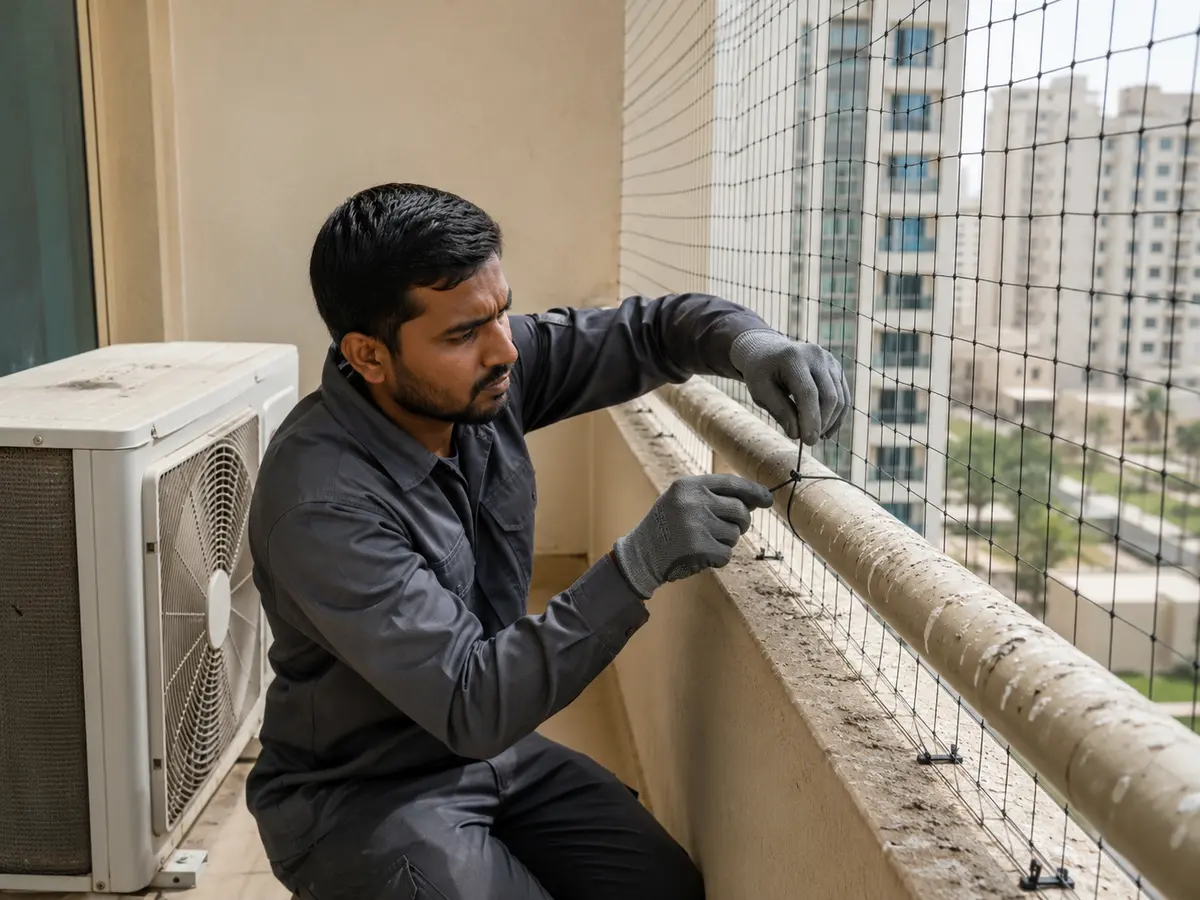
5. Install balcony netting, with approval first (half-day, pro job)
UV-stabilised bird netting is the only thing that fully encloses an open balcony and keeps pigeons out for good. In Dubai's sun, wind and dust the netting has to be the stabilised kind, professionally tensioned. Cheap garden netting goes brittle and sags within a season.
This is the step you do not start without permission. Most towers require a No Objection Certificate from building management and your landlord before anything is fixed to the balcony, and many specify a net colour and mounting spec so the facade stays uniform across the skyline. A tension-mounted system that leaves no permanent damage is far easier to get signed off, and you can remove it cleanly when you move out.
6. Skip the deterrents that fail in this climate (0 minutes, just don't)
Foil strips, hanging CDs, plastic owls, and chilli or vinegar sprays all get recommended online and all stop working fast on a Dubai balcony. The sun degrades them, the shamal winds tear them down, and pigeons habituate to a fake predator that never moves within days. Spend the effort on water removal, spikes and netting instead.
Why the outdoor AC unit is the part that really bites
A fouled balcony is unpleasant. A fouled condenser is expensive, and this is where pigeons do their quiet damage. Bird droppings are acidic, and the uric acid corrodes the thin aluminium fins on the condenser coil. Once those fins pit and rust, the unit sheds heat far less efficiently.
Nesting is worse. Twigs, feathers and droppings packed around the coil block the airflow the unit needs to dump heat, and the same debris can clog the condensate drain. A blocked, fouled outdoor unit runs hotter and works harder for the same cooling, which through the long Dubai summer (Mar-Oct) means a compressor under constant strain and a higher electricity bill for no extra comfort.
If your split-AC compressor is already labouring, droppings on the coil are one more load it does not need. Keeping the unit clear is part of the same routine as the rest of your seasonal AC maintenance schedule, and birds just add a reason not to skip it.
The health risk, the honest and non-alarmist version
The risk from pigeon droppings is real but proportionate, and it is mostly about dust, not the droppings themselves. Dried droppings and the soil they enrich can harbour the fungus that causes histoplasmosis; the related organisms behind cryptococcosis and psittacosis are also associated with bird droppings.
The mechanism is inhalation. Histoplasmosis is, in the words of the United States CDC, "a lung infection caused by breathing in spores of the fungus Histoplasma in the environment", and the danger spikes when dried droppings are disturbed and the spores go airborne. Most healthy people who breathe in spores do not get sick; the people most at risk are those with weakened immune systems.
The practical takeaway is simple: do not let droppings dry and accumulate near where you sit, and never dry-sweep them. Damp, contained cleaning keeps the dust down. Damp mould near an AC unit raises similar questions, and if you are dealing with both, this guide on damp and mould around the AC in summer covers the cleanup logic.
How to clean droppings safely
The wrong way is a dry broom, which aerosolises exactly the spores you want to avoid. The right way keeps everything wet and contained.
Wear disposable gloves and a well-fitting mask. Lightly mist the droppings with water (a little detergent helps) and let them soften rather than scraping them dry. Wipe or scoop the softened waste into a sealed bag, then disinfect the surface. Wash your hands and launder clothing afterwards.
For a light, fresh mess on your own balcony, that is enough. Stop and call a professional when droppings have built up into a thick crust, when there is an established nest, or when the fouling is on or inside the AC unit where dislodged debris and dust become hard to control. The CDC advises that large amounts of bird droppings should be cleaned up by a company that specialises in handling hazardous waste, which in Dubai means a licensed pest and bird-control contractor.
What needs a pro and what you can do yourself
You can handle the cheap, reversible groundwork: emptying standing water, keeping food away, clearing early nesting material, and a careful damp clean of a light mess.
Bring in a contractor for the rest. Professionally installed netting and spikes need the right UV-stabilised materials, secure tensioning, and tidy fixings that satisfy your building's facade rules, a job a vetted pest-control crew does in a few hours. They also remove established nests and heavy droppings safely, including off the condenser, without aerosolising spores or damaging the coil fins. Persistent pests rarely stay solved by half-measures, which is the same lesson behind why cockroaches keep coming back in Dubai apartments. If you want options, browse pest and bird-control services on Everlook.
When to handle this
Act at the first signs — a bird or two testing the railing, the first scattered droppings, twigs appearing in a corner. Pigeon-proofing an empty ledge is quick; evicting an established colony with eggs is slow, because humane rules mean you wait for chicks to fledge before you can clear the nest.
If you are moving into a new apartment, fold a balcony check into your handover snagging walk-through: look for old droppings, dormant nests behind the AC unit, and gaps that need closing before pigeons find them. For a tower-wide infestation across many balconies, raise it with the owners association or FM team. At that scale it is a building issue, not a single tenant's to solve alone.
Frequently asked questions
Can I legally remove a pigeon nest from my balcony in Dubai?
You can clear early nesting material before eggs are laid. Once there are eggs or chicks, humane-treatment rules under UAE animal-protection law mean you should not destroy the nest. Wait for the chicks to fledge, then remove the empty nest and block the spot. Poisoning, gluing or injuring pigeons is prohibited at any stage. A licensed bird-control contractor can advise on timing.
Do I need permission to install balcony netting as a tenant?
Almost always, yes. Most Dubai buildings require a No Objection Certificate from building management plus your landlord's approval before anything is fixed to the balcony, and many specify a net colour and spec to keep the facade uniform. Choose a tension-mounted, no-drill system where possible — it is easier to approve and removable when you move out, protecting your deposit.
Are pigeons really damaging my outdoor AC unit?
Yes. Their droppings are acidic and corrode the aluminium condenser fins, while nesting debris blocks airflow and can clog the condensate drain. A fouled outdoor unit runs hotter and less efficiently, straining the compressor and pushing up your cooling bill through the Dubai summer. Keeping the unit clear protects both its lifespan and your energy use.
Is it safe to clean pigeon droppings myself?
A small, fresh mess on your own balcony is fine if you wet it down first, wear gloves and a mask, and never dry-sweep it. Dry sweeping sends fungal spores airborne, which is the main health risk. Call a professional for thick built-up droppings, an established nest, or any fouling on or inside the AC unit.
What deterrents actually work against pigeons in Dubai?
Removing standing water and food, professionally installed bird spikes on ledges, and UV-stabilised balcony netting are what hold up in this climate. Plastic owls, foil strips, hanging CDs and chilli sprays fail quickly: the sun degrades them, the wind tears them down, and pigeons stop reacting within days once they learn the threat is fake.
Booking pigeon and bird control on Everlook
Pigeon problems on a Dubai balcony rarely solve themselves and always get worse the longer the nest sits there. Everlook lists vetted pest and bird-control contractors across the UAE with verified licences, transparent pricing, and reviews from your neighbours, so you can get netting, spikes or a safe clean-up sorted by someone who knows the building rules.
Find your next pro on Everlook
Describe your job once, get quotes from verified UAE contractors. Free, no commitment.
Find your next pro on Everlook
Post a job in minutes and get offers from trusted local contractors. Free to start.
Get started