Why Is Your AC Blowing Warm Air? What to Check First in Dubai
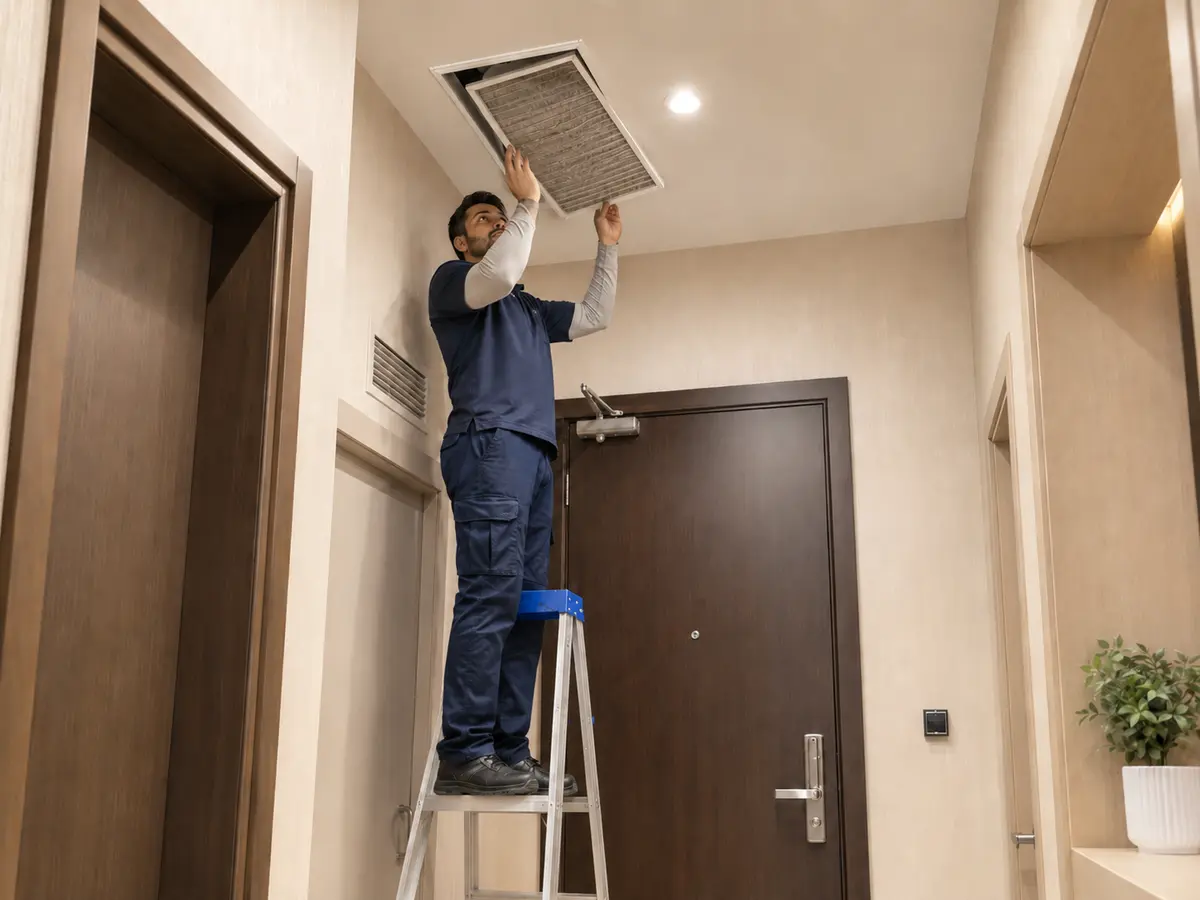
First, check these in 60 seconds
An AC that runs but blows warm air is usually a settings problem before it is a hardware problem. Spend a minute here before assuming the worst.
Check the mode first. A thermostat set to "fan only" will push air around the room without ever engaging the cooling cycle, so the air feels warm because it is just recirculated room air. Switch it to "cool".
Then check the setpoint. If the dial says 26°C and the room is already 25°C, the unit has no reason to cool. Drop the setpoint well below the current room temperature, 18°C is a fair test, and listen for the compressor or the chilled-water valve to engage.
Watch for a silent override. Many newer Dubai buildings ship with smart-home panels or a building app that can change AC mode or schedule without anyone touching the wall thermostat. A timer that flipped the unit to "eco" or "fan" overnight is a common false alarm. Check the app, not just the wall.
Finally, the breaker. If the AC is genuinely dead rather than warm, a tripped breaker in the consumer-unit panel may be the cause. Reset it once. If it trips again, stop — a breaker that trips a second time is protecting you from a fault downstream, and repeatedly resetting it is the fast route to overheated wiring. That is a licensed technician's job, not a reset-and-pray job.
First work out which system you have
This is the step most guides skip, and in Dubai it changes everything. The checks that follow depend entirely on whether you have a split AC or a central chilled-water setup.
A split AC with an outdoor unit
If there is a condenser box mounted on a balcony, an external wall, or a rooftop, and a refrigerant pipe running to the indoor unit, you have a split system. You own the airflow and filter side of the problem, and the outdoor unit is yours to inspect. The decision tree below applies to you in full.
District cooling or a chilled-water fan-coil unit
Many Dubai apartments run on district cooling (Empower, Emicool) or a central chilled-water system feeding a fan-coil unit (FCU) in the ceiling void. There is no outdoor condenser to check, because the cold is generated at a central plant and piped to your flat as chilled water.
For these homes, "check the outdoor unit" is meaningless. Warm air can mean the building's chilled-water supply is down, a control valve on your FCU has closed, or the chiller account has a billing or supply cutoff. Those are facilities management (FM) matters routed through the building, not a private contractor job. Before booking anyone, ask the building management whether chilled water is flowing to your riser. If the whole floor is warm, it is almost certainly upstream of your flat.
Cause one: a dust-loaded filter starving airflow
The single most common preventable cause is a clogged filter. When the return filter is packed with dust, it chokes the air the coil needs to do its job, and the room never reaches setpoint even though everything is "on".
Dubai's dust load makes this worse than most climates. Sandstorm and shamal-wind dust ingress means filters foul faster here, so the monthly cleaning cadence that is optional elsewhere is closer to mandatory through the dustier months. Slide the filter out, hold it to the light, and if you cannot see through it, rinse or replace it. If you want a calendar to work from, this maintenance schedule for UAE homes sets sensible intervals.
Cause two: a blocked outdoor condenser (split systems only)
If you have a split system and the filter is clean, look at the outdoor unit. The condenser rejects heat to the outside air, and in 40 to 50°C summer ambient it is already working at the edge of its envelope. Pack its fins with dust, sand, or lint and it cannot dump heat — so the refrigerant returns warm and the indoor air never gets cold.
Look for debris matted across the coil fins, a fan that is not spinning, or anything leaning against the box that blocks airflow. Clear obstructions you can reach safely. Bent fins, a stalled fan motor, or anything needing the casing opened is a service call, not a tenant task.
Cause three: a frozen evaporator coil
Starve a coil of airflow long enough and it ices over. A frozen evaporator coil is a downstream symptom of a dirty filter or low refrigerant, and once it is iced, the unit blows warm air past a block of ice instead of cooling.
If you see frost or ice on the indoor coil or the pipe, switch the thermostat from cool to off and let it thaw. Manufacturer guidance on frozen coils is blunt on the next part: do not chip at the ice, which damages the coil. Give it a few hours, and running the fan alone can speed the thaw. If the ice returns after a full thaw, the underlying cause has not been fixed and you need a technician.
Cause four: low refrigerant or a leak
If airflow is fine, nothing is iced, and the air is still warm, refrigerant is the next suspect. The system is sealed and should never need topping up, so low refrigerant almost always means a leak somewhere in the pipework or coil.
This is a hard cutoff. Refrigerant is handled under pressure, requires recovery equipment, and is regulated, so topping up or chasing a leak is strictly a licensed technician's job. Signs include hissing near the indoor coil, an oily residue around the pipework, or cooling that fades over weeks. Do not buy a top-up kit — book a pro.
Cause five: a fouled coil, or a failing compressor
Two deeper faults sit at the bottom of the tree. A fouled evaporator coil, grimed over even when the filter is clean, loses the surface area it needs for heat exchange, so the air cools weakly rather than not at all. This is what a chemical wash addresses, and it is why a deep AC cleaning and maintenance service restores cooling that has slowly faded.
The last suspect is the compressor. It pressurises the refrigerant and drives the whole cycle, and a failing one draws excessive current, struggles to start, or stops engaging entirely. On the local DEWA supply, nominal low-voltage variation is held to roughly ±6% of 230V, so a compressor that keeps tripping the breaker is rarely a supply problem and far more often a sign the motor itself is on its way out. Either way, a compressor that will not start is the end of the DIY road.
What needs a licensed technician
Some signs mean you stop diagnosing and call someone licensed. Booking early beats waiting through a summer week with no cooling.
Call a technician if any of these are true: the breaker trips a second time after one reset; refrigerant needs topping up or a leak is suspected; ice returns after the coil has fully thawed; there is a burning or electrical smell from the unit; or the compressor will not start at all. None of these are settings problems, and most carry a safety or property-damage risk if ignored — a burning smell in particular is a stop-now signal.
If the trouble looks electrical rather than mechanical, the warning signs overlap with wider wiring problems, and these signs your home needs an electrical inspection are worth a read. Across recent AC callouts booked through Everlook, the typical scheduling window for a non-emergency technician visit lands inside the next working day, so an early booking rarely means a long wait.
Frequently asked questions
Why does my AC run but not blow cold air?
The unit is moving air but not cooling it, which points to a settings or airflow fault before a hardware one. Check the thermostat is set to cool with the setpoint below room temperature, then check for a clogged filter or, on a split system, a dust-packed outdoor condenser. If those are clean and it is still warm, a frozen coil or low refrigerant is likely.
How long does a frozen AC coil take to thaw?
Allow a few hours with the system switched off, though heavy icing can take much longer. Running the fan alone helps move room air across the coil and speeds it up. Never chip at the ice, as that damages the coil. If ice forms again after a full thaw, the root cause is unresolved and needs a technician.
My apartment uses central chilled-water cooling and the air is warm. What do I check?
Start with the building, not your flat. Central chilled-water systems get their cold from a remote plant, so there is no outdoor unit to inspect. Ask the building whether chilled water is reaching your riser and whether the chiller account is active. A closed valve, a supply outage, or a billing cutoff is an FM matter, not a private contractor one.
My AC breaker keeps tripping. Can I just keep resetting it?
No. Reset it once. If it trips again, stop and call a licensed technician. The breaker is detecting a fault downstream, and repeatedly forcing it back on risks overheating the wiring in the consumer-unit panel. A compressor drawing excessive current or a short in the unit are common causes, and both need professional diagnosis rather than another reset.
How often should I clean the AC filter in Dubai?
Through the dustier months, check the filter monthly and clean or replace it when light no longer passes through. Dubai's dust and shamal-wind ingress foul filters faster than in milder climates, and a starved filter is the leading cause of warm air and frozen coils. A clean filter is the cheapest insurance against a needless callout.
Booking an AC technician on Everlook
An AC blowing warm air in a Dubai apartment rarely fixes itself and always gets worse the longer the flat bakes through summer. Everlook lists vetted AC technicians across the UAE with verified licences, transparent pricing, and reviews from your neighbours, so you can match a refrigerant leak or a failing compressor to someone who actually handles it.
Find your next pro on Everlook
Describe your job once, get quotes from verified UAE contractors. Free, no commitment.
Find your next pro on Everlook
Post a job in minutes and get offers from trusted local contractors. Free to start.
Get started