Choose a Villa Pergola by Its Wind Rating, Coating and Community Rules
·
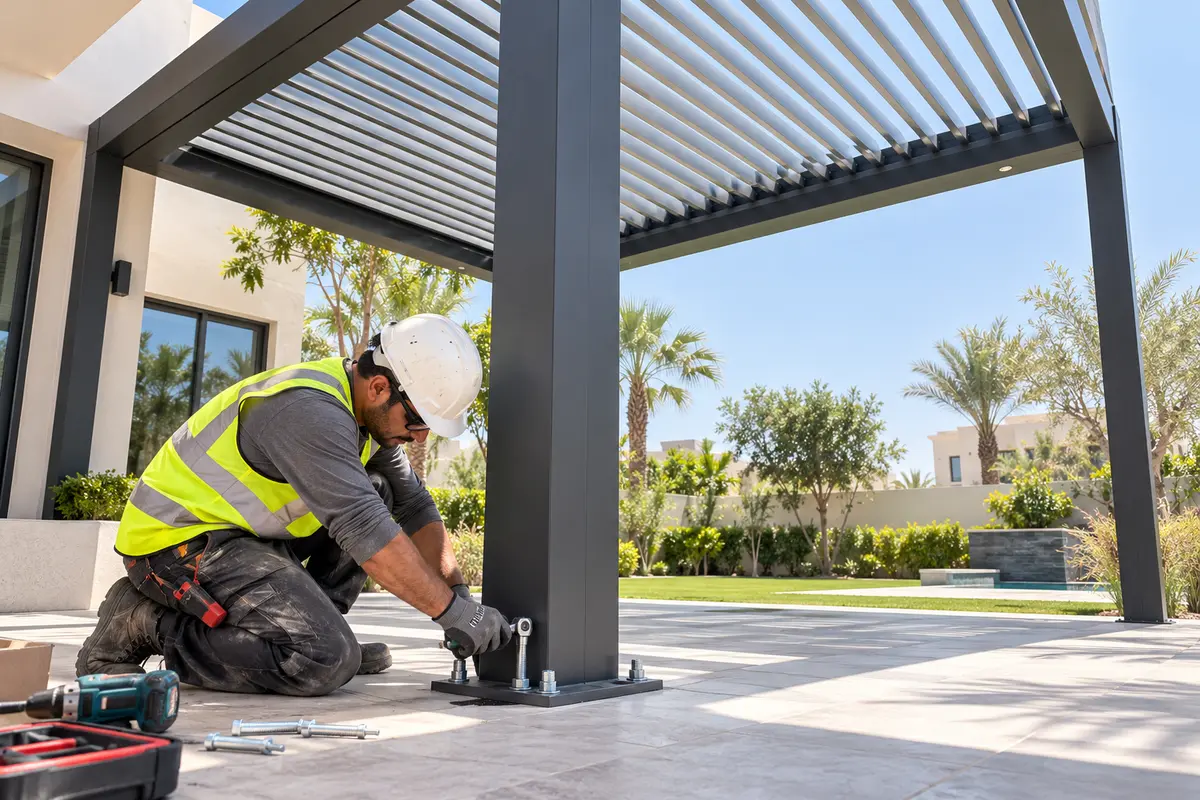
Four kinds of shade, and the spot each one suits
If the spot is open to the north-westerly shamal and you want cover from the winter rain as well as the sun, you need a closed roof with a wind rating behind it: a solid aluminium roof the supplier has rated, or a motorised louvred roof rated with its blades closed, which can also be opened for air and angled for shade. If the spot is sheltered and you want shade only, a fixed aluminium frame with open slats is the low-upkeep choice. Timber suits an owner who will re-oil it on a schedule. A fabric sail is the quickest shade to put up and the only one you can take down before a storm.
- Fixed aluminium: powder-coated posts and beams, with open slats or a solid roof panel on top. It does not rot, and the coating is what you are really buying.
- Timber: posts and rafters in pressure-treated softwood or a hardwood, usually open on top or carrying a climber or a cloth.
- Motorised louvred (bioclimatic): an aluminium frame with blades that rotate, open for air, closed for rain, with gutters and a drain in the posts.
- Fabric: a tensioned sail on posts and wall brackets, or a cloth stretched over a frame. Knitted HDPE (high-density polyethylene) shade cloth lets air and water through; PVC-coated and PVDF-coated cloths shed rain.
Wind: read which position the rating is for
The National Centre of Meteorology's forecasts for these winds have put gusts at 40 to 50 km/h, and stronger episodes have been reported at 55 to 65 km/h. A pergola in an open garden or on a roof terrace takes those gusts side-on and from below.
Louvred systems publish very different numbers. Renson lists its Camargue louvred roof at 160 km/h with the blades closed and its Algarve at 120 km/h. The installation sheet for a flat-pack louvred pergola sold through a European DIY chain tells owners to set the slats open once the wind passes Beaufort force 3, which it defines as more than 19 km/h. Force 3 is a gentle breeze, so one product can stay shut through a forecast blow while the other must be opened in an ordinary afternoon wind.
For scale, Dubai's building bylaw, as amended by Administrative Resolution No. 37 of 2021, designs temporary buildings for a 32 m/s three-second gust, about 115 km/h. Pergolas sit outside that rule, but it puts the 19 km/h kit in proportion.
- Fixed aluminium with open slats: wind passes through, so the load is mostly on the post fixings. A solid roof panel turns the top into a sail and needs a wind figure from the supplier.
- Timber: open rafters catch little wind. A cloth or reed mat tied on top changes that.
- Louvred: ask for the rating with the blades closed and with them open, in writing, and ask whether a wind sensor opens or closes the blades automatically. An optional sensor that acts on its own matters most when the villa is empty for the summer.
- Fabric: one sail maker's installation sheet tells owners to consider taking the sail down temporarily in extraordinarily harsh weather, and not to over-tension it. A sail on stainless shackles comes down in minutes; one laced on does not.
What the posts stand on decides whether any rating applies. One louvred-kit manual requires the pergola to be anchored in solid ground or on load-bearing foundations, and a shade-sail guide recommends new posts concreted at least 800 mm deep. Pavers laid on sand, or an artificial lawn over a compacted base, are no footing: the installer has to lift them and pour one, or bolt to an existing slab whose thickness someone has checked. The comparison of artificial grass and a real lawn describes what sits under a synthetic one.
A roof terrace adds a further problem. Bolting base plates through the roof slab opens holes in the waterproofing, so the fixing method there is a decision for an engineer and the waterproofing contractor together. Do not let an installer drill a roof on their own judgement.
Sun on the frame: what the coating, oil and fabric warranties ask of you
Aluminium: the powder coat class
Qualicoat, the European certification scheme for coatings on architectural aluminium, grades powders by outdoor exposure in Florida: Class 1 holds up through one year of testing, Class 2 three years, Class 3 ten. Its Seaside class adds a deeper pretreatment etch of at least 2 g/m² of aluminium removed, for sites with salt in the air, which coaters commonly define as within about 5 km of the coast. For a villa near the Gulf or a lagoon, ask for a Class 2 powder on a Seaside-certified line. Renson gives 10 years on structure and paint, conditional on registering the pergola online after installation. Put the registration on the handover checklist.
Timber: the oil schedule is part of the deal
Osmo's data sheet for its UV-Protection Oil Extra says to apply a fresh coat after about three to four years, and to expect substantially shorter intervals on surfaces highly exposed to weather, naming post caps. Pergola rafter tops, in the full Dubai midday sun, are exactly that surface. The stated UV protection needs two coats.
Pressure-treated pergola kits are often sold with a guarantee against rot and fungal decay, 15 years on several retailers' listings for one UK brand. A rot guarantee says nothing about the surface checking, splitting, warping or greying in the sun, which is how timber usually ages in a dry climate. Ask the installer which finish they use, how often it needs renewing on a south- or west-facing pergola, and whether they will quote a maintenance visit.
Fabric: what a UV warranty covers
Knitted HDPE shade cloths commonly carry a 10-year warranty against UV degradation, and some makers make it pro-rata, so the cover shrinks year by year. PVDF-coated polyester awning cloths are also sold with 10-year warranties. Both cover the cloth. Neither covers a sail torn at a corner by a gust, so stitching, corner hardware and fixings need their own line in the quote.
Heat underneath, and what lowers it
Field measurements in Arizona found air temperature barely differs from one kind of shade to another. What you feel is radiant heat from the roof and the ground. A 2025 field study in Dhahran, published in Building and Environment, found that a cotton canvas shade cut mean radiant temperature by more than 16°C, and that a double roof with a 25 cm air gap took off a further 1.9°C. Lower shades, at 4 m, worked better than taller ones.
- Solid aluminium roof: a single metal sheet in full sun gets hot and you feel it from below. An insulated sandwich panel, or a second layer with an air gap, is the fix the study points to.
- Louvred: with blades angled open, hot air can escape through the gaps while the blades still block the high sun. Closed, it behaves like a solid roof.
- Timber, open: shade only where the rafters fall, so it needs a cloth or a climber to be a shade structure in summer.
- Fabric: HDPE mesh breathes and lets hot air out, but leaks in rain. A waterproof cloth traps more heat under it unless there is a gap at the edges.
Sand, rain and the moving parts of a louvred roof
A louvred roof is the only one of the four with a drainage system. Renson's carries rainwater along the frame and down a drain inside the columns you choose. After a dusty shamal, sand settles in the blade channels and gutters, and the first heavy rain washes it towards that downpipe. Ask where the drain discharges, how to reach it to clear it, and how often the maker wants the gutters cleaned. A blocked column drain overflows onto the terrace in the rain.
Ask too what the motor and sensor warranties are. One maker of motorised pergolas lists 10 years on the structure and two on the electrical parts, so the parts that move are the ones with short cover.
Lights, fans, heaters and the motor make the pergola an outdoor electrical installation. The fittings need an ingress-protection (IP) rating suited to rain and dust, the circuit needs residual-current protection, and the connection is a job for a licensed electrician. Stop at the point where a cable meets the villa's distribution board. Community rules may also govern where the cable runs: Nakheel's community rules (section 6.1.5) bar wiring visible on the exterior of a property, so the route belongs in the application.
Who signs off: the community desk, and sometimes an authority
Community rules usually catch all four types, the sail included. Nakheel's 2013 community rules (section 6.1.4) list awnings, canopies, sun shades and "enclosures of any kind such as gazebos, pergolas, sheds" among the exterior changes that need the managing agent's prior written approval, with documents approved by the agent and the relevant authority before works start. Emaar's master community rules for Arabian Ranches, as published excerpts quote them, require the community manager's written approval for pergolas and shade structures whether they are temporary or permanent, and allow unapproved work to be removed at the owner's expense.
The authority question turns on what is being built. Dubai's Local Order No. 3 of 1999 bars construction works without a permit and allows demolition and fines for works built without one. A free-standing open frame on a few base plates may stay a community matter, while posts on new footings, a solid roof, or a frame fixed to the villa wall is where the developer's desk is more likely to ask for an authority file. No authority publishes a single size or height threshold for pergolas, so ask the community desk directly. The authority is Trakhees in the master communities it covers, such as Palm Jumeirah, Jumeirah Islands, Jumeirah Park and Al Furjan, the Dubai Development Authority in the communities it regulates, and Dubai Municipality elsewhere; the community desk will tell you which. An authority file goes in through a registered consultant or contractor, so ask pergola installers up front whether they prepare it or work with a consultant who does. The sequence is set out in the guide to villa extension approvals.
Take these to the community desk: the supplier's drawing with height and footprint, the colour (RAL code), a plot sketch with distances to the boundary walls, the fixing method, and any lights or motor. If the pergola sits by the pool, check its posts against the barrier rules in the villa pool fence guide: a post or beam near the fence can become a foothold for a child to climb.
What to ask for in the quote and the warranty
The same questions, in the same order, for every installer:
- Wind: the rated speed, and with the louvres closed or open; for a sail, how it is taken down.
- Footings: what each post is fixed to, the anchor type, the depth of any new footing, and who checked the slab.
- Finish: the Qualicoat class and Seaside certification of the coater, or the timber species, treatment and oil with its renewal interval, or the cloth and its UV warranty terms.
- Warranty conditions: registration steps, the coastal clause, the cleaning the maker requires, and separate periods for structure, finish, motor and electrics.
- Drainage and power: where the gutters discharge, the IP rating of every fitting, and the name of the licensed electrician doing the connection.
- Approvals: who prepares the community application, and who files with the authority if one is needed.
Pergola quotes vary widely in Dubai, and two that both say "aluminium pergola" can describe different products. Everlook lets you put the same six questions to several licensed pergola and shade installers and compare their offers side by side before you commit, with no obligation.
Find your next pro on Everlook
Post a job in minutes and get offers from trusted local contractors. Free to start.
Find your next pro on Everlook
Post a job in minutes and get offers from trusted local contractors. Free to start.
Get started
