Is It Termites? Reading the Signs in a Villa, Then the Treatment Proposal
·
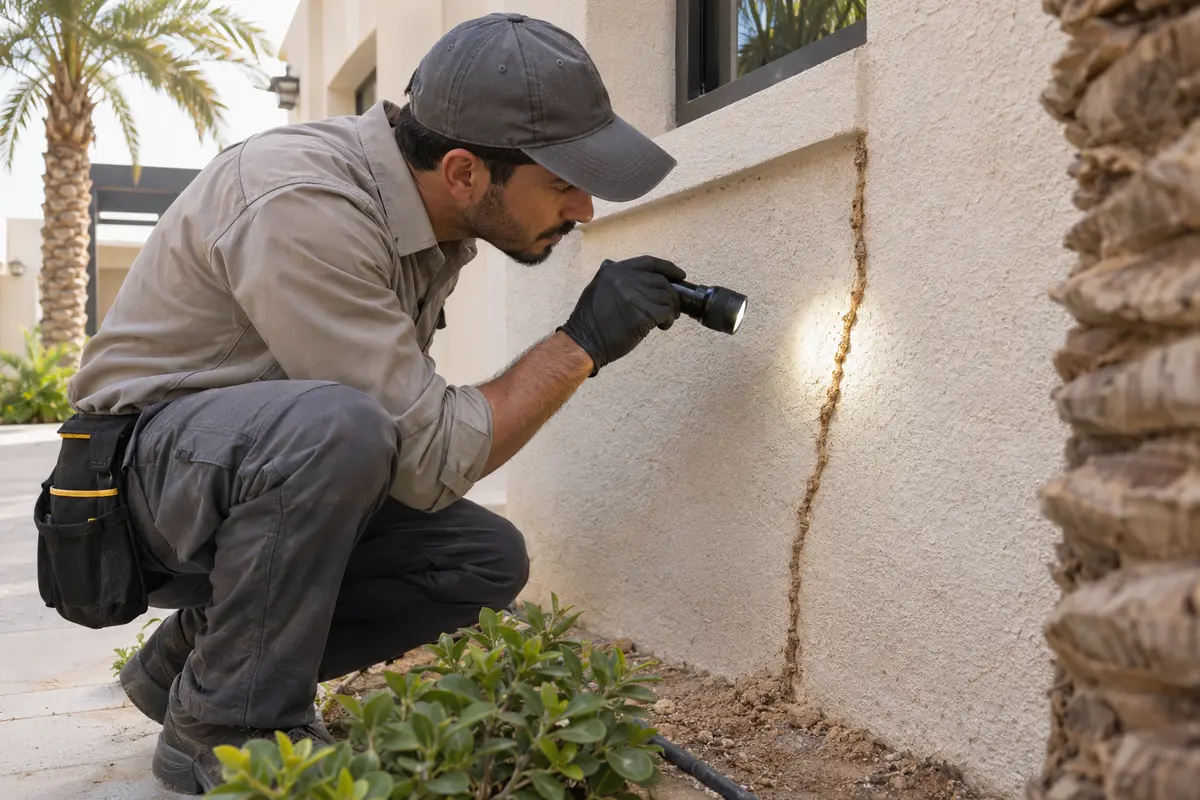
Every termite recorded in the UAE comes up from the soil
The fullest survey of the country's termites, published in 2005 by an entomologist at UAE University, found six species. All six are subterranean, all six were present in Dubai, and each one reaches wood through tunnels of earth from a nest in the ground. So the most reliable sign in a villa is soil where soil has no business being: on a wall, inside a door frame, in the hollow behind a skirting board.
Locally the same insects are called "white ants". Dubai Municipality's list of companies licensed for termite control carries the Arabic for that name, al-naml al-abyad, next to the English heading. Two species, Anacanthotermes ochraceus and Psammotermes hypostoma, made up over 70% of the termites the survey recorded in Abu Dhabi and Dubai, and both were found damaging construction timber and furniture. Stored wood, paper, and in some sites carpet and leather were eaten too.
Until someone qualified has looked, leave the find as it is. A household spray kills the termites in view and leaves the inspector less to go on, so photograph the spot with the date showing, note where it is, and break nothing open.
What each find points to, and what it can be confused with
Jump to: mud lines on a wall · hollow or soft timber · wings after a humid night · a palm or garden timber · dry pellets, no mud
Mud lines on a wall, a skirting or a planter
Shelter tubes, often called mud tubes, are the most commonly seen evidence of subterranean termites, according to the University of California's pest note on subterranean termites. Workers build them from soil, saliva and bits of chewed wood, and a University of Kentucky extension sheet describes them as about pencil width, running up foundations and onto timber.
Look for a raised, rounded line with a crust you could lift with a fingernail, usually rising from the floor, a slab joint or the soil line outside. A dust streak or a dried splash wipes off flat and leaves nothing behind it. A tube that ends at a door frame, a skirting board or a built-in wardrobe tells you where the inspector should look first.
A door frame or skirting that sounds hollow or gives under a thumb
Subterranean termites eat along the grain and leave a thin outer skin. In damaged areas the surface can be punctured easily with a screwdriver, and the Kentucky sheet notes that the hollowed wood is lined with bits of mud or soil. That lining is the observation that separates termite damage from the look-alike.
The look-alike is rot. Timber that has stayed wet beside a shower tray, an AC condensate line or a leaking planter can go soft and crumble, with no soil in it. The two also overlap: termites prefer decayed wood, which they eat faster than sound wood, so a soft frame near a leak may have both. Do not lever off the skirting or open up the frame to check. Tap along it, note where the sound changes, and leave the opening-up to the inspection.
Wings on the windowsill after a humid night
Termites leave the nest to mate in swarms. The UAE survey collected winged adults after their swarming periods, "during a humid day or at night at the beginning of the spring", and Californian species swarm on warm days after rain. A cloud of winged insects at a light on a damp spring night fits that pattern, and so do flying ants.
The difference shows under a phone's zoom. Mississippi State University's extension service lists three features: termites have straight, beadlike antennae, no pinched waist, and front and hind wings of equal length. Ants have elbowed antennae, a narrow waist, and front wings noticeably longer than the hind pair. Both shed their wings soon after swarming, so look at the bodies as well as the wings. If they turn out to be ants, the guide to ant trails and baits indoors covers what to do next.
Swarmers or piles of shed wings inside the house, on windowsills and along the edges of floors, are one of the signs the Kentucky sheet lists for an infested building. A few at an outside light can come from a nest anywhere nearby. Sweep a sample into a sealed bag or jar for the inspector.
A date palm, a pergola post or a raised bed
The UAE survey found all six species attacking date palms, alive or dead. Live palms were affected by A. ochraceus and Microtermes najdensis in Dubai, and the most common attack was hollowing out of the roots, which may be followed by yellowing and death, especially in young palms and offshoots. Dead palm stumps, timber edging, sleepers and wooden planters touching irrigated soil are all food.
Activity in the garden shows a colony foraging on your plot. Whether it has reached the house is a separate question, so the inspection should cover the building's perimeter as well as the palm. A timber shed or pergola on a slab should be checked at the base for tubes at the same visit.
Small, hard pellets and no mud anywhere
Tiny hard pellets collecting under a piece of furniture or below a frame, with no tubes and no soil, point away from the species in the UAE survey. Six-sided pellets are diagnostic for drywood termites, which nest inside dry wood and need no soil contact, according to the University of California. Wood-boring beetles are the other candidate the University of California lists.
Drywood termites were not among the species the survey recorded, so a sample is worth bringing to the inspection. The answer changes the treatment: a soil barrier or a ring of bait stations in the ground does nothing for an insect living inside a dresser.
What the inspection should establish before anyone quotes
Termite work in Dubai sits on its own licence list. Dubai Municipality's approved-companies list states that the general pest control companies on it are licensed "excluding fumigation, termite control and bird control", and it publishes a separate list for termite control. Check the company you book against that list, and ask to see the technician's Pest Control ID card: the list tells customers to make sure company staff carry one. The municipality's Public Health Pest Control Section publishes both lists.
The same rules, and the fumigation and smoke treatments to turn away at the door, are set out in the guide to pest control before moving in.
A pest identification visit is the right first booking when you do not yet know what you have. Ask it to establish, and write down:
- whether the insects are termites, and if so which kind: subterranean or drywood, and the species if the technician can name it
- whether the activity is live or old damage, and how that was judged
- a sketch of the villa marking every active site, every damaged timber and every tube
- how far the damage goes into frames, skirting and joinery, as far as can be seen without opening finishes
- conditions that feed termites on your plot: timber touching soil, irrigation wetting the wall, a leak inside a wall, dead palm stumps
If the villa is fairly new, ask the developer or the original contractor whether the ground was treated against termites before the slab was poured, and whether a certificate or warranty came with handover. A live pre-construction warranty may cover re-treatment, and its paperwork tells the new company what is already in the soil.
Barrier, bait or a local treatment, and what each asks of the household
A liquid barrier in the soil
A termiticide is put into the soil under and around the building by trenching along the outside walls and by drilling and injecting through slabs, patios and porches, and a barrier uses many litres of product. The University of California notes that termites can detect repellent products, usually pyrethroids, while fipronil, imidacloprid and chlorantraniliprole are non-repellent and kill at low doses. Kentucky's extension entomologist writes that non-repellent barriers tend to be the most reliable.
In a villa that can mean holes through interlock paving, terrace tiles and the floor along inside walls where tubes came up, so ask where every hole goes and how it is filled and matched. A barrier protects the building from the soil side, and Kentucky's sheet notes that eliminating the colony is not always needed for the house to be protected.
Liquids act faster than baits, according to Kentucky, but neither extension service gives a date by which a barrier is proven. The proof is the follow-up visit: no fresh tubes and no live termites at the sites marked on the inspection sketch. Ask for the re-inspection dates in writing. Winged termites in the garden the next spring do not on their own mean the house is infested, the University of California notes.
Bait stations around the perimeter
Stations go into holes in the ground around the whole building, about 30–60 cm from the wall and 3–4.5 m apart in the Kentucky description, and the bait inside is a slow-acting insecticide that termites carry back and share. Floors are not drilled and furniture is not moved. Paving is a problem only where it blocks stations around most of the building, which on a townhouse with a paved side passage is worth asking about.
Baiting is slow. Weeks or months may pass before termites find the stations, and elimination can take several months or longer, according to Kentucky; the University of California says months or even years, with constant monitoring. Stations are checked monthly, quarterly or less often depending on the product, and protection lasts only while the stations stay in the ground and the monitoring continues.
A local treatment of one piece of timber
Drilling and injecting a product into one infested board or frame is the standard approach for drywood termites confined to a few pieces, and the University of California says it should be done only by licensed applicators because home-use products do not work. For subterranean termites a local treatment kills the insects in that frame, while the colony that sent them lives in the soil, so on its own it is a holding step. The University of California advises breaking shelter tubes to cut the termites' access, so a tube rebuilt at the same frame after the visit is the sign to call the company back.
Which proposal fits which finding
- If tubes come up through the floor or along inside walls and the ground around the house can be reached, a non-repellent barrier or a full bait ring are the two real options. Choose the barrier if you want the soil treated in one visit and can accept drilling, and bait if you would rather avoid drilling and can keep up the monitoring.
- If most of the perimeter is paved or built against, bait loses its advantage, and the proposal should explain how a barrier will reach under the paving.
- If the only activity is in a palm or garden timber, ask for the infested material to be dealt with and the house perimeter inspected and monitored, and compare that with a full treatment before paying for one.
- If the find is pellets with no mud, ask for a local treatment of the identified pieces, and refuse a soil treatment until the identification says subterranean.
What the proposal must state before you sign it
A proposal that names a method and a price is not enough to compare one company with another. Before accepting, ask for each of these in writing:
- the company's name and its place on the municipality's termite control list
- the species or type found, and whether it is active
- the method, and why it suits what was found
- the product's trade name and active ingredient, with the label and safety data sheet
- a plan of where they will drill, trench or place stations, and how holes in tiles and paving are filled and matched
- what you must do before and after: clear items along walls, cover a fish tank, move planters off the wall line, keep children and pets out until surfaces are dry
- the re-inspection or station-check schedule, with dates
- the warranty: its length, whether it covers re-treatment only or also repair of new damage, the yearly renewal terms, and every condition that would cancel it
Pesticides may be imported or circulated in the UAE only once registered with the Ministry of Climate Change and Environment, so ask for the product by trade name and keep the label with your copy of the proposal. Dubai's classification guide for pest control companies requires each service vehicle to carry its pesticide list and safety data sheets, so the sheet for your product should be available on the day.
Read the warranty most closely. North Carolina's regulator describes re-treatment-only agreements as the most common kind, and they do not oblige the company to repair any damage. Ask in writing whether re-paving, new planting beds against the wall or an extension over treated ground cancels the warranty, since each disturbs the soil a barrier sits in or the stations around the house. Damaged frames and skirting go to a carpenter once the follow-up inspection records the activity as dead.
Everlook lists licensed pest control companies for termite treatment and extermination, with verified credentials and reviews. Pick the one that will put species, method, product, drilling plan and warranty terms on the page, and compare proposals on those lines as well as on response time and rating.
Find your next pro on Everlook
Compare licensed contractors in your area in under a minute. Free to post, no signup needed to browse.
Find your next pro on Everlook
Post a job in minutes and get offers from trusted local contractors. Free to start.
Get started
