How to Choose the Repair for a Leaking Flat Roof on a Villa
Three facts about your roof that pick the repair
A ceiling stain that appeared last winter and dried out by May proves that water got through once. It says nothing about where the water went in, how far it travelled before it came out, or how much of it is still sitting above the slab.
Those unknowns are why three contractors can look at one roof and quote a patch, a coating and a full re-roof. Settle them first and the choice mostly makes itself.
Where the water gets in: a detail or the open field
On a flat roof, leaks usually start where the waterproofing changes direction or is cut: the upstand where the membrane turns up the parapet, the collar round an AC condenser stand or a pipe, an expansion joint, the flange of an outlet. A failure at one of these details is local and can be repaired locally.
A membrane that has aged, split or lost its bond across the open area of the roof, the field, is a different problem: fix one split and next winter finds another.
The stain is a poor guide to which you have. Water that gets under a membrane can run along the slab until it meets a crack or a joint to drop through, so the ceiling marks where the water came out, and the entry point may be metres away.
What sits above the slab, and whether it is wet
Many villa roofs in the UAE use an inverted build-up, sold locally as a "combo roof": the membrane bonded to the slab or to a screed laid to falls, polystyrene insulation boards on top of it, then a protective screed and tiles. Henkel Polybit, which makes its membranes in the UAE, specifies its self-adhesive bitumen system to be covered with tiles or polystyrene board in exactly this way. Other roofs leave the membrane or a coating exposed to the sun.
On a buried membrane, a leak soaks the layers above it before it reaches the ceiling. Water can sit in the screed and between the insulation boards long after the rain has stopped, which is how a stain returns in a dry week, and how a slab stays damp enough to grow mould on the ceiling below.
How the roof is finished and used
An exposed membrane can be inspected, patched and coated where it lies. A tiled roof has to be opened before anyone sees the membrane at all. A terrace with furniture and daily foot traffic adds wear most roof coatings are not rated for.
Evidence to ask for before you choose
Each test answers one of the three questions. When you book a roof repair and maintenance contractor for an inspection, ask which of these they plan to run and what each is expected to show.
- A flood test. A section of roof is dammed, filled with a shallow depth of water and watched from below. It confirms that the section leaks. It cannot show where, and it adds water to layers that may already be wet, so keep it to the area under suspicion.
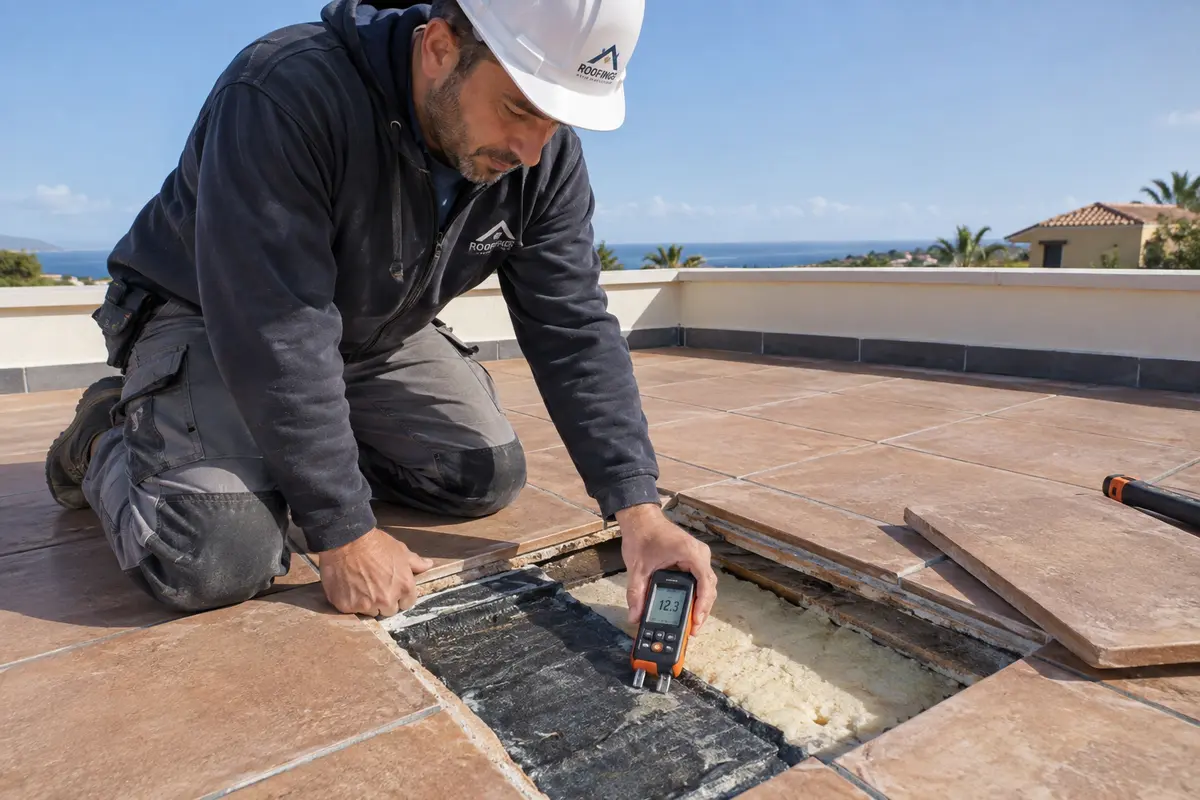
- Opening up. A small cut through the tiles and screed at the suspected entry point, and another near the stain. It is the only test that shows the membrane itself: bonded or loose, brittle or supple, and whether the insulation above it is wet. It must be closed and sealed the same day.
- Moisture meter and thermal imaging. These map where the upper layers are damp. The ASTM practice for locating wet roof insulation with infrared imaging calls for the survey at night and for the readings to be checked by cutting into the roof, so treat a thermal image as an observation to confirm, never as a finding.
- Electronic leak detection. A low current across the membrane pinpoints a breach. The ASTM guide for these methods says they need a conductive surface directly under the membrane, and insulation between the membrane and the deck breaks the circuit, so ask whether it will work on your build-up before paying for it.
Leave the cutting to the contractor. A hole through the membrane is a new leak, and a roof without a proper guarded edge is no place to work.
Ask for the results in writing: photographs of the membrane at each opening, the moisture readings and a sketch of the suspected entry. A quote that names a repair with none of this has chosen before looking.
The three repairs, judged on the same facts
A local repair at the failed detail
Entry point: suits one identified detail, such as a split at a parapet upstand, a failed collar round a condenser stand or an open joint. It is a poor fit when nobody has found the entry.
Layers: right when the opening shows the membrane sound and bonded either side of the defect, and the insulation dry or wet only across a small area that is cut out and replaced.
Finish: simple on an exposed membrane. On a tiled roof the tiles and screed come up around the detail, a new strip of membrane is lapped onto cleaned and primed existing sheet, and the build-up goes back.
A patch is honestly enough when the rest of the roof is sound, and it adds nothing to the life of the rest. The evidence against it is a history of patches: a repair at a new spot each winter means the field is going, whatever the latest quote says. When the work is done, look for the details manufacturers ask for: Polybit's instructions call for an angled cement-sand fillet at internal corners and an extra layer of membrane around pipes and drains.
A liquid coating over the existing roof
Entry point: it covers everything, which makes it tempting when the entry is unknown. It only treats the surface it is painted on, though. On a combo roof that surface is tile and grout, with the wet screed, the wet insulation and the original membrane all underneath.
Layers: manufacturers are specific here. Sika's data sheet for Sikalastic-560 GCC, a water-based roof coating sold across the Gulf, asks for a substrate below 6% moisture with no rising damp, existing bitumen felt firmly adhered and free of badly degraded areas, a primer, adhesion and compatibility tests, and at least three coats. It also says the product is for exposed roofs and not for inverted buried systems. Seal the top of a waterlogged build-up and the water below has no way out; as the sun heats the roof it turns to vapour and pushes up under the new film, which is how coatings over wet roofs blister and lift.
Finish: the same data sheet does not recommend it for pedestrian traffic unless it is covered with paving. A tiled terrace in daily use is outside what a coating like this is made for.
A coating earns its place on an exposed roof whose membrane is still bonded but ageing at the surface, once the entry points have been found and detailed, and once the roof is dry. There it is a genuine way to extend the roof's life; Sika lists exactly that use for failing exposed roofs. Before accepting one, ask for the product data sheet, the number of coats, the adhesion-test result and the moisture readings.
Stripping back and laying a new membrane
Entry point: the answer when there are several entry points, when the field has failed, or when the entry cannot be found after opening up.
Layers: when the membrane is brittle, cracked, blistered across wide areas or lifting from the slab, or the insulation above it is wet, those layers come off together. New insulation is usually part of the job when the old boards are wet.
Finish: on a tiled roof the tiles come up anyway to reach the membrane, so once two or three openings show trouble, stripping the whole roof is often the better use of the disruption.
The job runs in order: strip to the slab or to sound screed, repair the concrete, let it dry, prime, lay the new membrane with reinforced details at every upstand and penetration, water-test it, then reinstate the insulation, protection screed and tiles. Insist on the water test before the insulation goes back, the cheapest moment in the whole job to find a fault. Ask the contractor what depth and duration of flood test their membrane allows.
Four situations that move the choice
One wet bay on an otherwise dry tiled roof. If the openings show wet insulation in one corner and a dry, sound membrane everywhere else, stripping that bay back to a joint or a clean edge sits between a patch and a full re-roof, and is often the right call.
Solar panels on the plan. Shams Dubai, DEWA's rooftop solar scheme, puts panels on the roof, and every bracket fixed through the waterproofing is a new penetration. If panels are coming within a few years, fix their positions before the roof is redone, so the mounting details go in with the membrane.
A villa still inside its defect liability period. If your sale contract carries one, report the leak to the developer in writing, with photographs, before any contractor opens the roof. Third-party work on a defect the developer should repair can complicate the claim.
A coating that has already failed. A second coat over a failing first one inherits every weakness underneath. Sika requires an adhesion test before over-coating its own product after three months of exposure, and the same caution applies to anyone's.
Timing, permits and the warranty before the rain
Annual rainfall across most of the UAE is under 100 mm, and the vast majority of it falls from November to March, according to a peer-reviewed study of the region's major weather events. It tends to come as showers, sometimes intense ones, so a roof that coped in a dry year can still leak in the first real downpour. The heat closes the other end of the window. Sika's coating needs air and roof surface between 8°C and 40°C and humidity below 80%, applied while the temperature is falling to avoid pinholes; Polybit's self-adhesive system gives 5°C to 45°C. A summer roof sits above both ceilings for most of the day.
That leaves a short autumn window. Opening-up tests can happen now; a full strip-out should never leave the roof open with rain in the forecast, because a stripped roof caught by a storm does more damage than the leak it was meant to fix.
Many master communities require your contractor to hold an access permit from the community management company before work starts (Emaar's, for instance, issues digital contractor entry permits), and some restrict hours for noisy work. Ask the community office whether a re-roof counts as maintenance or as a modification in your community before you fix a start date.
Get the warranty in writing before paying, and check who issues it (applicator, manufacturer or both), what it covers (materials, workmanship, reinstating tiles), how long it runs and what voids it. New penetrations by other trades, such as a condenser stand, a satellite dish or solar brackets, are a common exclusion, so any later fixing should be detailed by the original installer or with their written approval. Many also expect the outlets kept clear, which the pre-season drainage check covers.
Once the roof is dry, the stained ceiling below is a separate job, and a water-damaged false ceiling has its own repair.
Everlook lists licensed UAE roofing and waterproofing contractors with verified credentials and reviews. Choose by how each one proposes to find the leak: shortlist the replies that name an opening-up or a moisture survey before they name a product, then compare their quotes against the three facts above.
Find your next pro on Everlook
Compare licensed contractors in your area in under a minute. Free to post, no signup needed to browse.
Find your next pro on Everlook
Post a job in minutes and get offers from trusted local contractors. Free to start.
Get started