Sagging or Stained False Ceiling in a Dubai Apartment: What's Leaking and How It's Fixed
First, check these in 60 seconds
A sagging or stained false ceiling in a Dubai apartment is almost always water sitting on gypsum board, and the most likely source is the air-conditioning unit hidden in the void above it. Make the room safe first, then work out where the water came from — the position of the stain narrows the source down to one of three or four places.
Treat a bulge as something that can fall
Gypsum board soaks up water and gets heavy while losing its strength. A bulging panel can let go at the screws without cracking first, and it brings wet board, compound and water down together. Move people, furniture and electronics out from under it, and keep children and pets out of the room.
If water is anywhere near a downlight, spotlight or ceiling fan, switch that lighting circuit off at the consumer-unit panel (the DB, usually in the entrance hall or a utility cupboard) before you touch anything else. Leave it off until the fitting has dried and been checked.
Relieve a water pocket in a controlled way
A bulge that is visibly holding water will empty itself eventually, and usually all at once. Restoration contractors deal with this by draining it on their terms: a bucket goes directly under the lowest point of the sag, then a single small hole is made there with a screwdriver, with goggles on and the face kept to one side because the water can come out with force. One small puncture gives a controlled stream. A large cut releases the whole pocket.
Skip this step if the bulge sits next to a light fitting, if the board is already cracking open, or if you cannot reach it from a steady stepladder. Close the door on the room and call someone in.
Photograph everything before anything is cut
Take wide shots showing where the stain sits in the room, close-ups of the edge of the stain, and a photo of the nearest AC grille. Date them. Whoever pays for this, whether the landlord, the flat above or the building, will ask for evidence, and once a technician opens the ceiling the original pattern is gone.
Read the stain's position to find the source
A false ceiling in a Dubai apartment hides a crowded space. In most towers the void carries a concealed split or a fan coil unit (FCU), the plastic or metal drain pan beneath its cooling coil, the condensate pipe that carries that water away, supply ducts to each grille, and, in buildings on district cooling (Empower or Tabreed, depending on the area), insulated chilled-water pipes. In some layouts the waste pipes of the flat upstairs cross it too.
Each of those leaves a different kind of mark. If your ceiling is cracked but dry, the question is movement and belongs in the guide to reading cracks in walls and ceilings. If it is stained, sagging or damp to the touch, use position and timing.
A round stain beside an AC grille
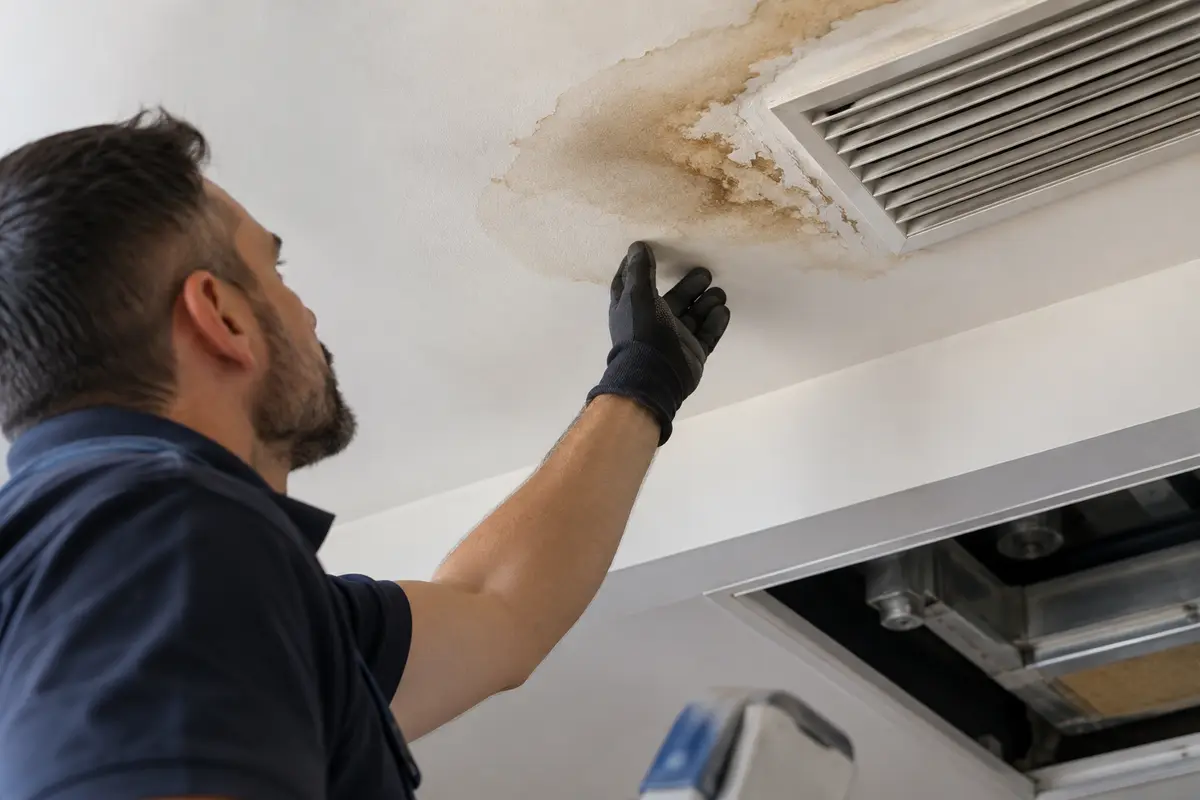
A roughly circular brown ring, a metre or two from a supply or return grille, or directly under the access hatch, points at the AC. The drain pan sits right under the unit, and when it overflows, the water lands on the board below it and spreads out evenly.
Test it by timing. If the stain grows or drips while the AC is running and stops within a few hours of switching that unit off, the condensate system is the source.
A stain under the bathroom or kitchen above
Work out what sits directly over the mark on the floor above. If it is a shower, toilet, bath or kitchen sink, the likely causes are a leaking waste joint, a supply pipe, or tile waterproofing that has failed under the wet area upstairs. These stains tend to be irregular, often show a darker tidemark, and get worse after the upstairs neighbour showers, whatever your own AC is doing.
A line of spots along a pipe or duct run
Spots that follow a straight line, often with small grey patches of mould, suggest condensation. A chilled-water pipe or supply duct whose insulation has split, slipped or lost its vapour barrier sits well below the dew point of humid air in the void, so it sweats and drips all along its length. The same cold-surface physics grows mould on walls near the AC in summer, and the fix is insulation work by an AC or MEP technician.
If it is the AC: the condensate drain has overflowed
An AC coil pulls moisture out of the air as it cools it. That water drips into the drain pan and runs away through a small pipe laid at a slight fall, usually to a floor drain, a bathroom waste or a shared drain riser. When any part of that path blocks, the pan fills and spills over its edge onto the ceiling board.
The usual blockage is biological. Dust drawn through a dirty filter settles in the wet pan, and the warm standing water grows a gel of algae and bacterial slime that plugs the outlet. Less often the pipe has sagged between its supports, lost its fall, or cracked at a joint, or the pan itself has rusted through or been knocked out of level.
Why September is the peak
An AC produces the most condensate when the air it treats is at its wettest. Through summer on the Gulf coast the air grows steadily more humid, and late August and September bring the stickiest weeks, so a drain that coped in May can be overflowing by the end of the season. Units that ran hard all season without a service are the ones that spill first.
Switch that AC unit off until it has been looked at, and book an AC cleaning and drain service. The technician clears and flushes the drain line, cleans the pan and coil, checks the fall of the pipe and replaces the filter. If the pan is cracked or rusted, it gets replaced at the same visit, since clearing the pipe does nothing for a pan that leaks through its base.
If it comes from upstairs: a pipe or failed waterproofing
A leak from the flat above needs access to that flat, which you cannot arrange yourself. The owner or tenant upstairs has to let a plumber in, and a failed shower tray or floor waterproofing usually means lifting tiles in their bathroom.
Where the pipe is a shared vertical stack that serves several floors, it is building infrastructure. In a jointly owned (freehold) tower, Law No. 6 of 2019 puts common parts under a management company regulated by RERA, and the owners' committee under that law is advisory and does not handle repairs. In a building with a single owner, the landlord's own facilities team looks after them. Either way, the building's FM (facilities management) team is the practical point of contact for a shared-pipe leak.
Who ends up paying depends on where the leak started and what each contract says. The full answer is in the guide on water coming through from the flat above.
Who calls whom
If you rent
Report it to your landlord or their property manager in writing on the same day, with the photos attached, and keep the message. Under Article 16 of Dubai Law No. 26 of 2007, the landlord is responsible during the tenancy for maintenance and for repairing defects that affect your use of the property, unless your contract says otherwise. Check the maintenance clause in the contract registered with Ejari before paying anyone.
A dated written report also protects you at the end of the tenancy. A ceiling repair nobody was told about can turn into a security deposit deduction.
If you own the flat
The AC unit, its drain pan and the pipework serving only your apartment are usually yours to maintain, so book the technician directly. Tell the building FM team as well, because they know where the condensate lines join the shared drain and whether other flats on the same drain line have reported leaks recently. If the building is recently handed over and still inside the developer's defect liability period, report it to the developer first.
How the false ceiling is actually repaired
The order matters more than the method. Fix the source, let the void dry, then repair the board — do it the other way round and the new paint is stained again within weeks.
Fix the source, then dry the void
The Gypsum Association's technical guidance on assessing water damage to gypsum board (GA-231) sets out when wet board can stay. All four conditions have to hold: the source is found and stopped, the water was clean, the board dries completely before mould starts (typically within 24 to 48 hours), and it shows no sagging, rusting screws, peeling paper or other damage. Its summary rule is blunt: if there is ever doubt, replace it.
Drying usually means opening the access hatch or cutting an inspection hole and running a fan or dehumidifier into the void for a day or two.
Board that sagged gets cut out and replaced
When gypsum gets soaked, its core loses bond strength and the board slumps between screws. It stays slumped after it dries. A contractor cuts the damaged area back to the nearest ceiling framing, screws in new 12.5 mm board, tapes and fills the joints, skims the patch and paints the whole ceiling so the repair disappears.
This is ordinary work for a false ceiling repair contractor and normally takes one visit to cut and board, then a second visit for finishing once the compound has dried.
A dry, firm stain gets sealed before painting
If the board stayed flat and firm and the stain is old and dry, it can stay. The mark still has to be sealed first with a stain-blocking primer, usually shellac- or solvent-based. Water stains carry dissolved salts and tannins that migrate through ordinary water-based emulsion, so a ceiling painted straight over shows the same brown ring again within weeks.
Two upgrades worth asking for
Under a bathroom or in a humid kitchen ceiling void, ask for moisture-resistant board, the type with green paper facings. Gyproc and USG both sell it in the region. It resists humidity and splashes, but it will still fail under a steady leak.
The second is an access panel next to the AC unit, typically a hinged square about 600 mm across. A lot of developer-installed ceilings were closed up with no way to reach the drain pan, so every future drain clean means cutting the ceiling again. With a panel in place, the twice-yearly AC service reaches the pan without anyone cutting the ceiling.
What needs a professional
Call someone the same day if any of these apply:
- The ceiling is bulging, cracking open at the joints, or has already dropped a section.
- Water is near a light fitting or fan, or the lights flicker or trip when the room is in use — an electrician checks the circuit before the power goes back on.
- The stain is still growing with the AC switched off, which points at a supply pipe, a leak from upstairs or a sweating chilled-water line.
- The water is grey, smells of drains, or comes from under a toilet upstairs. Board wetted by waste water always gets replaced.
- There is visible mould on the ceiling or around the grille, or a musty smell when the AC starts.
A small, dry, old stain under a unit that has just been serviced is the only case where waiting a week costs nothing.
Frequently asked questions
Can a water-damaged false ceiling collapse?
Yes, a false ceiling holding water can collapse without warning. Gypsum loses strength when saturated and the board tears away around its screws, bringing water, board and compound down together. Collapse is most likely where a bulge has formed or where joints have opened. Clear the space underneath, isolate any nearby lighting at the DB, and have the damaged section cut out once the source is fixed.
Can I just paint over a water stain on the ceiling?
Only after the leak is fixed, the board is dry and firm, and the stain has been sealed. Ordinary emulsion alone lets the brown mark bleed back through, often within a few weeks. Apply a stain-blocking primer over the mark and a little beyond it, then repaint the whole ceiling. If the board is soft, sagging or crumbly when pressed, it needs replacing instead.
How long does a false ceiling repair take?
Most small repairs take two to three days once the leak is fixed. The void is opened and dried first, usually for a day or two, then the damaged board is cut out and replaced. A second visit, after the jointing compound has dried, covers sanding, priming and painting. A large area, a stain that needs drying time first, or a leak upstairs that someone else has to fix first can stretch this to a week or more.
Who pays for a false ceiling damaged by an AC leak in a rented flat?
In Dubai the landlord usually pays, because Law No. 26 of 2007 makes the landlord responsible for maintenance and defects during the tenancy unless the contract says otherwise. Some contracts pass minor AC maintenance to the tenant, and a leak caused by the tenant's own negligence can shift the cost. Report in writing with photos, then check your contract's maintenance clause.
Booking false ceiling repair on Everlook
Quotes for a water-damaged false ceiling in Dubai vary more than the size of the stain suggests — whether the board can be sealed or has to be cut out, how much of the ceiling needs repainting to hide the patch, and whether an access panel goes in beside the AC unit all change the scope. Everlook lets you compare offers from licensed UAE wall and ceiling repair contractors side-by-side before you commit, with no obligation.
Find your next pro on Everlook
Post a job in minutes and get offers from trusted local contractors. Free to start.
Find your next pro on Everlook
Post a job in minutes and get offers from trusted local contractors. Free to start.
Get started