Peeling Wallpaper: Is It the Paste, the Wall or Mould Behind It?
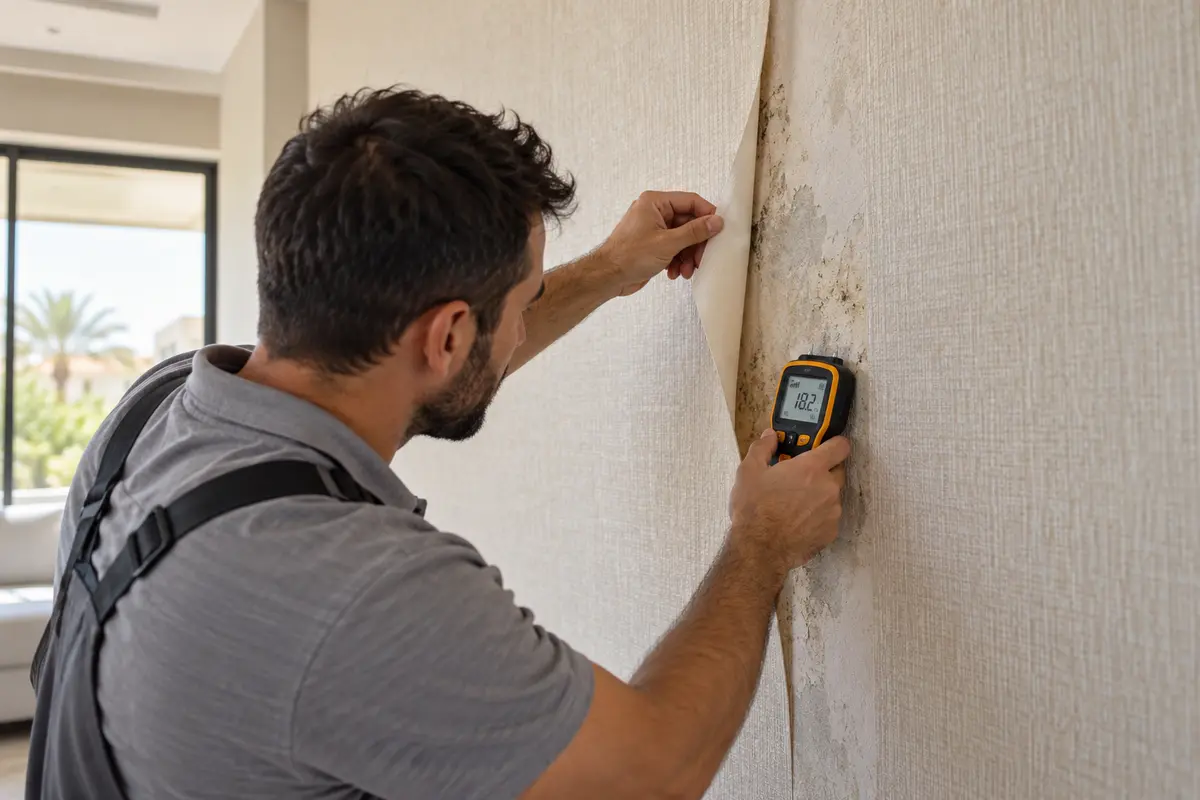
Peel back a loose edge and look at both faces
Pick the loosest edge and lift it two or three centimetres, no further. Then look at the back of the paper and at the patch of wall it came off. The bond split at its weakest layer, and which surface the paste stayed on tells you which layer that was.
- Paste on the wall, back of the paper clean. The paper let go of its own paste, usually because it dried and shrank before it had gripped. A hanging fault.
- Paste on the paper, wall bare and dusty or chalky. The paste never gripped the wall. It went on without size or primer, or over powdery or glossy paint.
- Flakes of paint stuck to the back. The paint let go of the plaster or board beneath it. The paste held; the paint underneath is the question.
- Grey, black or green specks on the back or on the wall. Mould. Stop lifting and press the edge back down (see the section on outside walls).
- A brown tide line, or plaster that crumbles under a fingernail. Water has been in the wall.
Do not trust your hand on the rest. Through a Dubai summer the AC keeps every wall cool to the touch, and Protimeter, the moisture-meter maker, notes in its survey guidance that building materials do not feel damp to the touch until they are already very wet. A wall that feels dry rules nothing out.
Seams that opened within weeks of hanging
Wet paste swells a paper strip, and it shrinks back as it dries. Marburg, the German wallpaper maker, puts the swelling of a pasted paper at about 2.5% across its width. If the paste dries before it has gripped, the strip shrinks on the wall and the seams open into thin lines of bare wall.
Air conditioning is one way to dry it too fast. Installation instructions from Materialised, an Australian wallpaper producer, warn that air conditioning can make the paper shrink while it dries and say never to heat or force-dry it. Harris, the decorating-brush maker, lists heat, sunlight and air conditioning among the things that dry paper unevenly and open seams, and advises at least 48 hours of natural drying at a steady room temperature.
In a Dubai summer that leaves a problem the instructions do not solve: a closed room with the AC off gets very hot, and one with it on dries the paste fast. Ask the installer how they will handle the room for the first two days, and check what the maker of your particular paper says about cooled rooms.
A thirsty wall does the same from behind. Fresh gypsum board and bare plaster draw water out of the paste. Graham & Brown tells hangers to size plaster and plasterboard first so the wall does not suck the moisture out of the paste, and Roman's wallcovering primer data sheet names new drywall and cured plaster as the surfaces it is made for.
What this means for the repair: a seam that has lifted with its edges intact and a clean, dry back can go back down with seam adhesive, applied thinly and rolled lightly. A seam that has gapped because the paper shrank cannot be glued shut, since the strip is now narrower than the space it was cut for. On a pale paper over a dark wall the gap stays visible, and the lasting fix is a re-hang on a primed wall by a wallpaper installer who preps the wall.
Edges lifting along the ceiling and above the skirting
The top and bottom few centimetres are where paste is easiest to miss. Graham & Brown's hanging guide tells hangers to brush extra paste at the top of the wall and above the skirting so the paper does not lift once dry. When the top or bottom of strip after strip curls back, and every back is clean, the paste never reached those edges.
Check what sits next to the edge before blaming the paste. If the top edge lifts only on the strips under an AC outlet, the cold air blowing along them is a likely contributor. If it lifts under a brown ring or a bulge in the ceiling, the water is coming from above, and reading the stain on a false ceiling comes before anything is done to the paper.
Low edges take water from the floor. Paper that lifts and softens along the skirting near a bathroom door, a kitchen sink or where the floor gets mopped is taking up that water. Inside a bathroom, edges that lift beside the basin or the shower with clean backs are splash water. A re-hang there calls for a paper sold as washable for wet areas.
Bubbles in the middle of a strip
Bubbles that show up while the paper is going on and shrink over a day or two are trapped air, or paper that had not finished soaking. Most flatten as the paste dries. Bubbles that appear weeks later, or keep growing, have a different cause.
Press one with a fingertip. If it crackles and the paper lifts with flakes of paint on its back, water from the paste has softened a paint that was not well bonded. Roman's data sheet tells installers to check surfaces for paint bonding first, and rules out sealed or glossy surfaces for its primer. Gloss or loose paint under paper is a preparation fault, and the strip has to come off so the wall can be sanded and sealed.
A single small, dry bubble on a sound wall can be slit along the pattern with a sharp blade, given a little adhesive and pressed flat. A bubble that feels cool and soft, or a cluster low on an outside wall, belongs to the next two sections.
A patch that spreads outward from one spot
Lifting that starts at one point and widens over weeks, with a tide line, a stain showing through or a wall that gives under the thumb, points to water entering at that point. In a flat the usual candidates are inside or behind the wall: a pipe in a chase, the wet room on the other side, the AC drain line run down the wall, or the shared riser. Those are possibilities to check one by one. The paper cannot tell you which.
Knock the wall first. Gypsum board sounds hollow, blockwork with cement plaster sounds solid, and the knock test in the wall-cracks guide matters here because a wet board loses strength and often has to be cut out, while wet plaster on block can usually be dried in place.
A cheap pin moisture meter maps the patch, within limits. On anything except wood the reading is relative (Protimeter calls it wood moisture equivalent), so compare the patch with the same wall a metre away and with a wall you know is dry. Salts left by an old leak make readings high, and Protimeter notes that the black ink in some wallpapers conducts and reads as moisture. Readings that fall away with distance from one spot fit a leak. High readings everywhere usually mean the meter is picking up something else.
Stop at that point. Do not glue the paper back over a wet patch, and do not strip it to look: the source has to be found and stopped, and in a tower a leak from the riser or the flat next door goes to the building's FM (facilities management) team first. Once the water has stopped, book wall and ceiling repair to dry the wall and replace damaged board or plaster before any paper goes back.
Dark spots behind vinyl on an outside wall
UK-written guides explain mould under wallpaper as warm, damp room air reaching a cold outside wall in winter. In an air-conditioned Dubai home the summer moisture moves the other way. Outdoors, the average dew point in July and August sits above 26°C. Indoors, the inner face of an outside wall sits near the temperature the AC holds the room at, so water vapour moves from the humid air outside, through the block and plaster, towards that cooler inner face.
Emulsion paint lets that vapour through into the room, where the AC takes it out of the air. A vinyl face stops it at the back of the paper. The US Department of Energy's Building America guidance on inward vapour drive names vinyl wallpaper as a vapour retarder that, in a warm, humid climate, traps moisture against the cool inner surface and grows mould. Joseph Lstiburek of Building Science Corporation puts it as a rule: "If you air-condition and you have humid summers there should be no interior vapor barrier."
How strongly this applies depends on the wall. The documented cases are mostly buildings with gypsum board on the inside face. A solid block wall rendered outside and plastered inside, a common outside wall in a Dubai villa or tower, holds and moves moisture differently, and vinyl on an outside wall does not guarantee mould. Treat it as a risk pattern that fits one particular picture: spots or a musty smell on outside walls only, worst where a wardrobe or bed head covers the wall, and the internal walls of the same room clean.
If the internal walls are spotted too, or the AC smells musty when it starts, the moisture is coming from the room, and mould from the AC and room air is the place to start.
On a villa, look at the outside of the same wall as well: rain or irrigation water getting through cracked render reaches the paper the same way, and a properly specified exterior repaint covers that side.
Do not strip the paper yourself to see how far it goes. The US EPA's guide to mould at home warns that removing wallpaper over mould "can lead to a massive release of spores", says not to paint or caulk over mouldy surfaces, and suggests an experienced professional when you suspect mould is hidden. Its do-it-yourself limit, about 10 square feet or roughly one square metre, is for mould you can see and measure. Growth behind a vinyl usually cannot be sized until the paper is off. Spraying cleaner on the face of the vinyl does nothing for growth behind it.
So suspected mould behind the paper is a job for wall and ceiling repair contractors, before any wallpaper installer. Mouldy gypsum board is often cut out and replaced, since the EPA's remediation guidance lists only HEPA vacuuming or discarding for wallboard. Dubai Municipality has its own Technical Guideline for Mold Remediation and Control, issued in May 2025.
When the wall is dry and repaired, choose what goes back with the vapour in mind. Paint, or a paper without a vinyl face, gives an outside wall room to dry. Read the label carefully: "vinyl" describes the surface and "non-woven" describes the backing, so a non-woven paper can still carry a vinyl face.
When seam adhesive is enough, and when the paper has to come off
Seam adhesive holds where three things are true: the edge came up cleanly, its back is clean and dry, and the wall under it is sound and dry. That covers seams and edges the paste never reached. It does not cover shrink gaps, paint coming away with the paper, or anything damp or spotted.
Everything else means stripping and re-hanging on a prepared wall. Hanging new paper over old is a poor shortcut: the old paper's bond becomes the new paper's weak point, and Roman's data sheet warns that hanging wallpaper over existing wallpaper with its products is unlikely to meet fire-rating standards.
Stripping can damage the wall. The Painting Contractors Association's standard for wallcovering removal says surfaces "are often damaged during the removal process" and that the extent is usually not foreseeable until the paper is off. On gypsum board papered without a primer, the paste can take the board's paper face with it. Before agreeing a re-hang, ask the installer three things in writing: whether patching and skimming the wall after stripping is included, which primer goes on before the new paper, and how the room will be kept while the paste dries.
Finding a wallpaper installer in Dubai who asks what is behind an outside wall before suggesting a vinyl, and who plans the drying around the AC, is harder than it sounds. Everlook lists wallpaper installers and wall repair contractors with verified UAE experience and reviews from your neighbours, and you can compare quotes for the stripping, any wall repair and the re-hang before you commit.
Find your next pro on Everlook
Compare licensed contractors in your area in under a minute. Free to post, no signup needed to browse.
Find your next pro on Everlook
Post a job in minutes and get offers from trusted local contractors. Free to start.
Get started
