Roof and Balcony Drainage Checklist for Dubai Villas: What to Do Before the Rain
Why September, and why a UAE roof specifically
Rain here is a winter event. Research by the National Center of Meteorology (NCM), published in Scientific Reports, puts the country's annual mean rainfall under 110 mm, carried mostly by thunderstorms as upper-air troughs cross the region in the cooler months. In practice, showers from November through March and very little either side.
How that total arrives matters more. Extreme single-day events account for between 20 and 70 per cent of annual UAE rainfall, so a roof sits dry for eight months and then handles much of its yearly load in a few hours. On 16 April 2024 the NCM recorded 254.8 mm in under 24 hours at a station in the Al Ain watershed — more than twice what the country averages in a year, and a reminder that the heaviest falls can land just outside the usual window.
So the useful time to look is now. The blockage that overflows in December was laid down in July: the summer shamal season runs from late May into mid-August and loads every horizontal surface with fine sand. Dubai's Local Order No. 8 of 2002 makes the owner responsible for draining rainwater from the building and its parking area, and nobody checks it between storms.
Know which roof you have
Villa roofs in Dubai are not one thing, and the drainage detail changes between them.
The flat roof behind a parapet
The common arrangement is a concrete slab, a waterproofing membrane, a screed laid to falls and a parapet round the edge. Water leaves through outlets that drop through the slab into concealed downpipes, and through scuppers, openings cut low in the parapet as an overflow. The minimum finished fall is around 1:80, and plenty of roofs in service are flatter.
The parapet is what makes it unforgiving. A flat roof with a raised edge is a shallow tank with holes in the bottom, and blocking the holes fills the tank. Standing water is heavy: 25 mm across a 100 m² roof weighs 2.5 tonnes.
The pitched tiled section
Plenty of villas carry a pitched roof clad in clay or concrete tiles, over the whole upper floor in Mediterranean and Spanish-styled communities or as a feature above the entrance. These drain through an eaves gutter to a downpipe, or onto a flat area below.
The failure points differ. A gutter loses its fall as brackets sag, a downpipe blocks at the offset bend before the straight run, and where a pitched section meets a flat one the flow off a whole slope arrives through one opening. Where a villa has both, the flat section floods first.
The balcony and terrace
Balconies and roof terraces drain separately, through a floor gully, a weep slot at the slab edge, or a small scupper in the balustrade upstand. All are small, all sit at floor level, and all are where dust ingress settles first.
A terrace outlet is also the one a household walks over daily: furniture feet, planter saucers and a barbecue trolley end up beside the only opening that matters, and an outlet clear at handover spends two years under a plant pot.
The 7-step check, on a dry day, before the season
Work through these in order. Steps 1, 2, 4 and 5 need only a torch and a tape measure and keep you on the ground or on a balcony, with one exception: where a condensate line ends on the roof deck, that half of Step 4 waits for the roof visit in Step 3. Steps 3, 6 and 7 need real roof access, so read the next section first.
Step 1. Walk the ground line first (10 minutes)
Everything the roof did last winter shows up at the bottom of the building. Walk the perimeter and look up at each downpipe and scupper.
A dark fan of staining below a scupper means that opening ran hard, so the outlets above were not coping. Grass in an eaves gutter means silt deep enough to hold moisture through a Dubai summer. At the foot of each downpipe, check the shoe still points into a gully and that the gully is not packed level with sand: drainage pits on a villa plot silt up faster than the fittings were sized for.
Step 2. Read last season's tidemarks (10 minutes)
Water leaves a record of itself. On a parapet, a band of paler render with a silt line under it marks how deep the last pond got; on a balcony it turns up low on the wall or across a door frame.
Inside, look at the ceiling below any roof outlet or parapet corner. A ring stain that has dried out records a single event. A patch that stays cool and darker than the plaster around it is still wet, and damp held in a wall goes on to grow mould behind the paint long after the leak has stopped.
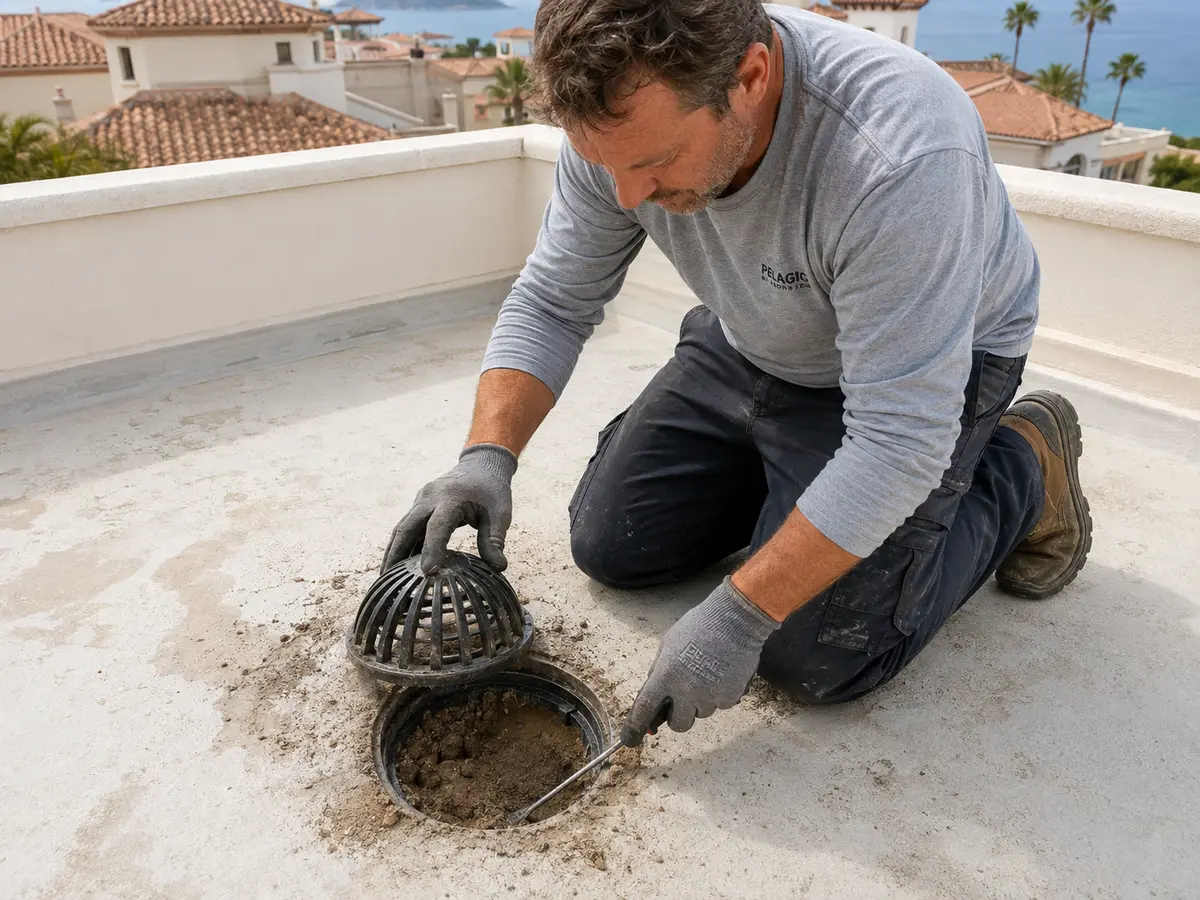
Step 3. Lift the gratings and find where the sand stops (20 minutes)
The domed grating over a roof outlet keeps leaves out. It does nothing about sand, which passes through and settles in the sump and the first bend below, so a clear-looking grating tells you nothing about what is under it.
Lift each one and put a torch down the hole. Dry sand behaves like a liquid and pours aside when you prod it with a length of hose. Sand kept damp sets into a plug with the consistency of soft mortar and will not move for water pressure alone. If more than one outlet comes back like that, the roof needs a gutter and drainage specialist with vacuum extraction and rods; a garden hose only washes more silt into the plug.
Step 4. Follow the condensate lines to where they end (15 minutes)
This is the step that separates a UAE roof from a European one. Every split unit and fan coil in the house drips condensate whenever it runs, and in this climate that is most of the year — a medium-capacity unit can shed 10 litres or more across one humid August day.
A condensate pipe ending on the roof deck or a balcony floor keeps one patch permanently wet through the months when nothing else is. That is what turns loose dry sand into a set plug and grows the slime layer that narrows a gully. It also breaches the rules: Article 33 of Dubai's Local Order No. 8 of 2002 bars water from air conditioning, or from cleaning air-conditioning equipment, from the rainwater drainage network. Developer-installed routing tends to end wherever was quickest at first fix.
Step 5. Measure the balcony threshold (5 minutes)
Waterproofing on a balcony does not stop at floor level. It is carried up the walls and up to the door as an upstand, and the height of that upstand is what keeps water outside: by convention at least 150 mm above the finished floor at a wall, relaxed to around 75 mm at a door opening where a channel across the full width drains it away.
Now measure yours: run a tape from the top of the balcony tile to the top of the door sill. On a balcony re-tiled over its original finish, an upgrade adding 20 to 40 mm of adhesive and tile each time, that often comes back at almost nothing, and on a stubborn few it comes back negative. The upstand that used to hold water back is buried under the new floor.
Rest a spirit level on the tiles too: the surface should run away from the door, and a balcony re-laid dead flat pushes a film of water at the threshold.
Step 6. Run a hose and time the clearance (15 minutes)
Everything above is inspection; this is the functional test. Run a hose at each outlet for two minutes, then watch how fast the surface clears and whether water appears at the discharge point below. Stand off the wetted area while you watch, and give it time to dry before walking back across it. Water going in with nothing coming out puts the obstruction between the two, and a puddle still there after five minutes says the outlet is passing a fraction of what it should. Do the balconies last: a balcony gully often shares a stack with the roof outlet above.
Step 7. Check the overflow and the membrane turn-ups (15 minutes)
The scupper through the parapet is the secondary drainage, the thing that empties the roof when the primary outlet fails. It should be clear, open and set above the outlet but below the top of the parapet. Scuppers get painted shut or rendered over during a repaint.
Then look at the membrane where it stops being flat. Failures start at the turn-ups and penetrations: where the waterproofing runs up the parapet into a chase, where it is dressed into the outlet flange, and where a pipe or fixing passes through. Photograph lifted edges, blisters and any dried-out sealant line along the upstand. Cracking in a parapet rewards the same reading you would give a crack indoors: width, direction, and whether it is still moving.
What needs a pro
The honest line runs at the roof edge, and it is worth drawing before anyone stands on the wrong side.
Steps 3, 6 and 7 are reasonable on a dry day if the roof has proper access — a fixed stair or a guarded hatch — and an edge high enough to stop a stumble. There is a serviceable yardstick for what counts as high enough, though it comes from a free-zone rulebook and carries no authority over a villa in a Dubai Municipality community: a Dubai Development Authority circular for its own developments calls for guarding wherever a level sits more than 760 mm above the ground, sets 1200 mm as the minimum railing height for a balcony, terrace or elevated space, and applies the same requirement to roof hatches and rooftop plant that needs servicing. If the edge of your roof is a 600 mm decorative band, it was never detailed as a place to work.
A wet membrane is slick, and bitumen sheet and liquid coatings both lose grip under a film of water and silt. A ladder leaned against a parapet rests on a wall built to look right, with no duty to hold a person.
Clearing a set plug needs vacuum extraction and rods worked from both ends. Re-dressing a membrane into an outlet flange, forming a new scupper or re-hanging a gutter to a proper fall is trade work, and a botched patch over a waterproofing layer causes more damage than the defect it covered. If the check turns up an active leak or a failed membrane, the booking you want is roof repair and maintenance; a drain clearance will not touch it.
Who owns the roof, and who has to ask
If you own the villa and live in it, the roof and everything draining it are yours, including the parts a builder would call inaccessible: the flat area behind a pitched run, the light well, the gully under an external stair.
If you rent it
Your obligations come from the tenancy contract, registered through Ejari in Dubai or Tawtheeq in Abu Dhabi, and the split between routine upkeep and structural maintenance is whatever that document says. Read it in September, while the ceiling is still clean, and report what you find in writing. Where water arrives from a neighbouring unit or a shared area, who pays follows a different route entirely.
If it sits inside a master community
The roof still belongs to the owner, but common areas and community rules are administered by a management entity, the structure Law No. 6 of 2019 put in place of the old owners associations, regulated by RERA. Those rules can govern anything that changes the outside of the building: clearing an existing outlet needs nobody's permission, while a new external downpipe on a front elevation is worth checking against the community documents first.
When to do this next
Put the full seven steps in the calendar for September or early October each year, once the summer dust season has closed and before the first showers. Then add a short second look after the first real rainfall, the only honest test of the system: 20 minutes with a torch while everything is still wet shows which ceiling corner darkens and which downpipe stays dry.
Four triggers should pull the check forward whatever the date:
- Any work on the roof. Solar panels, a satellite dish, a water tank, a replacement condenser: every fixing is a fresh penetration through the waterproofing.
- A re-tiled balcony or terrace. Measure the threshold the week the tiler leaves.
- A new or relocated air-conditioning drain. Find out where the installer put the end of it.
- A repaint or re-render of the parapet. This is when scuppers get sealed shut.
For a villa still inside its defect liability period after handover, log what you find on the snagging list and send it to the developer while the cover applies.
Frequently asked questions
How often should a villa roof drain be cleared in Dubai?
Once a year as a minimum, timed for the end of summer and ahead of the winter showers. Roofs downwind of open desert or an active construction plot silt up faster and earn a second look mid-season. The trigger for an extra visit is a sandstorm heavy enough to leave visible deposit on parked cars: whatever landed on the car landed on the roof.
Will a garden hose clear a blocked roof outlet?
Only if the blockage is loose sand. A hose moves dry silt and washes surface debris through, which covers most cases caught early. It will not shift a plug kept damp by a condensate line and set in the sump, and pushing more water at it packs the material tighter. If two minutes of flow leaves the surface still standing, call someone with vacuum extraction.
Is it normal for water to sit on a flat roof after rain?
A film that drains within an hour or so is normal on any flat roof. Water still standing a day later is a defect, pointing at one of three causes: a blocked outlet, a screed laid without enough fall, or a low spot where the slab has deflected. Mark the edge of the puddle with chalk and check whether the line has moved by morning.
My air-conditioning drain empties onto the roof. Should I move it?
Yes. Dubai's drainage local order bars air-conditioning water from the rainwater network and points it at the building's private sewerage system instead, so a line ending on the deck is a defect in its own right. It also holds one area of the roof wet for months, which is what sets sand into a solid plug and grows biofilm inside a gully. Rerouting is usually a short job.
Booking roof and gutter drainage work on Everlook
Finding a drainage contractor in Dubai who has actually opened a sand-packed roof outlet is harder than it sounds. The ones worth booking arrive knowing that a summer's silt sets hard in the sump, that a condensate line ending over an outlet is a defect in itself, and that the balcony threshold is where a survey starts. Everlook surfaces contractors with verified UAE experience and reviews from your neighbours.
Find your next pro on Everlook
Describe your job once, get quotes from verified UAE contractors. Free, no commitment.
Find your next pro on Everlook
Post a job in minutes and get offers from trusted local contractors. Free to start.
Get started