Tile, Glass or Stone Slab: Which Kitchen Backsplash Belongs Behind the Hob
·
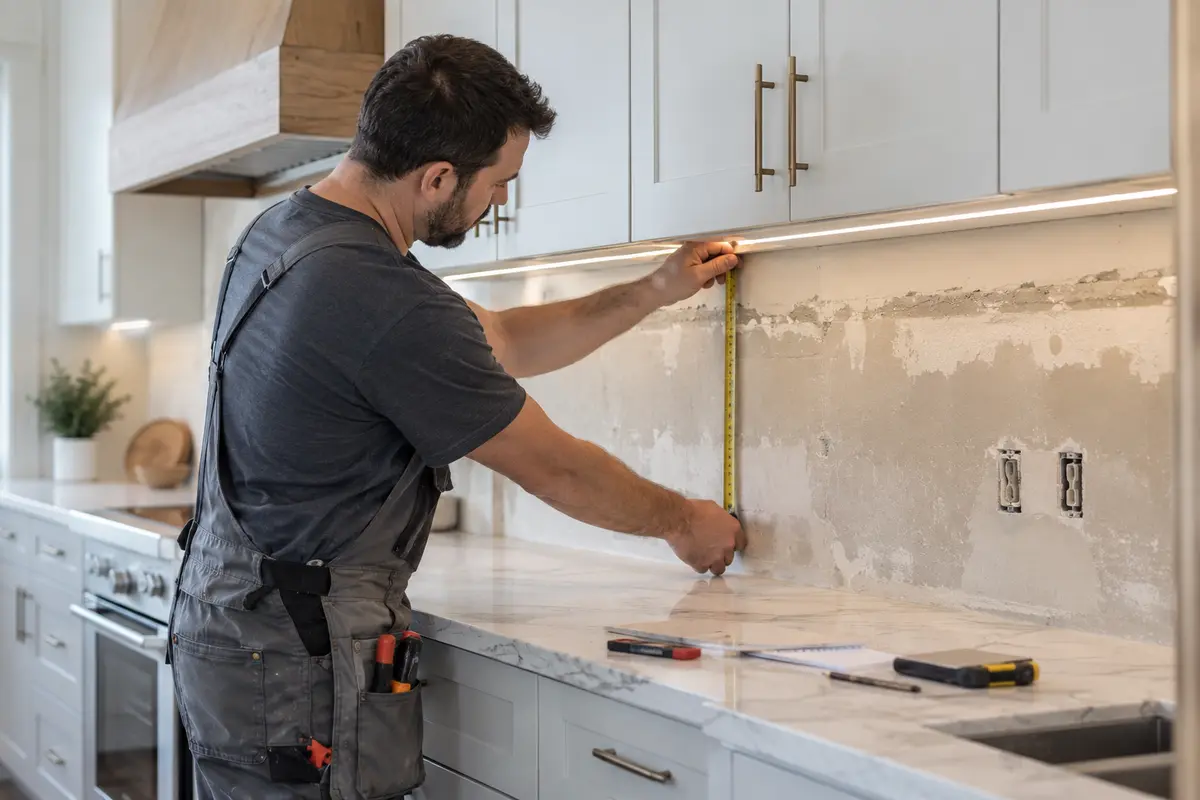
What the hob manual asks of the wall behind it
The hob decides more than the showroom sample does. Many Dubai apartment towers feed the hob from a central gas supply, villas often run on cylinders, and plenty of newer flats were handed over with induction. Find the installation manual for the model you have before choosing a kitchen backsplash, because every splashback maker defers to it.
A Bosch gas hob manual written for Gulf-market models gives the distances it wants: at least 50 mm from the hob to the wall behind it, 100 mm to a wall on its right and 60 to 80 mm to one on its left. It also says the units next to the hob must be non-flammable, with heat-resistant laminate and glue. It names no splashback material at all.
Tile, toughened glass and stone all pass "non-flammable". So the useful question for each material is narrower: what repeated heat does to its finish, the adhesive behind it and the maker's warranty. A gas flame heats the air and the wall behind the pan. An induction hob heats the pan base, and the wall mostly meets steam and splashes.
If the cooker is a freestanding range that has to be pulled out so the wall can be reached, the gas hose is disconnected and leak-tested afterwards by a gas technician. That is outside a tiler's job, and it is not one to do yourself.
Heat near quartz, sintered stone and glass: what the makers commit to
Engineered quartz
Cosentino's warranty for Silestone, its quartz brand, excludes "direct application of heat to the surface" and lists it among the main causes of cracking. Caesarstone's care guide for its quartz says to put hot cookware on trivets every time. Neither document bans quartz from the wall behind a hob. Both leave heat damage with the owner.
An induction hob heats only the pan base, so behind one, set at the manual's clearance, the slab should see far less heat than behind a gas flame. Behind a gas burner close to the wall, the discolouration or crack that heat can cause is a cost you carry yourself.
Sintered stone and porcelain slab
The same Cosentino warranty document covers Dekton, its sintered stone, against "cracking caused by exposure to extreme hot and cold temperatures, as well as thermal shock cracking", and covers surfaces exposed to heat as long as the installation manuals were followed. Caesarstone's porcelain care page says cookware can go straight from the hob onto the surface. On heat, these slabs are the better-documented stone option for the gas zone.
Back-painted toughened glass
Toughening makes glass far more tolerant of heat than ordinary glass, which is why it is sold for this spot. The fitting guides still put the hob first. Belling's toughened splashback guide asks for at least 40 mm from the rear of the hob, or 110 mm to a heat source, depending on the installation. Caple's guide says the clearance must comply with the hob maker's instructions.
The colour is painted on the back. Caple allows only silicone against the glass, because some other adhesives degrade the finish, and both guides specify neutral-cure silicone. Ask the fabricator for the coating's own heat rating if the panel will sit close to a gas burner.
"Glass-look" acrylic and aluminium composite panels are a different product. One cut-to-size supplier rates them at about 80°C before they discolour or warp, and does not sell them for behind an electric or gas hob.
Grease at the hob, scale at the sink: grout or no grout
Ceramic and porcelain tile shrug off heat. Their weak point is the grout. Ordinary cement grout is porous, so behind a hob it soaks up grease, and beside the sink it collects soap and the white scale that dries around a Dubai mixer tap. A sealer slows that down and needs renewing.
Epoxy grout is the alternative for these two zones. Mapei describes its Kerapoxy as stain-resistant with no sealing needed, and Laticrete calls its SpectraLOCK grout stainproof to common household products in homes. It is slower and fussier to lay than cement grout, so ask the tiler whether they use it regularly. Larger tiles help too: fewer joints, less to clean.
Glass and slabs remove the grout lines, but they still meet the worktop at a silicone joint, and both glass guides seal every edge with it. The cleaning problem shrinks to that one bead. When it darkens near the sink, it is usually the same mould that blackens bathroom sealant, and the fix is the one described for black shower grout and silicone: cut it out and reseal.
Can the new backsplash go over the old tiles?
Sometimes, and the tiles have to earn it. Tap every one with a coin or a screwdriver handle. A dull, hollow note means the tile has already lost its bond, and anything stuck to its face will come off with it. The pattern behind hollow and cracked tiles is the same on a wall as on a floor.
New tile over old tile
Mapei's data sheet for Eco Prim Grip Plus, a primer sold for laying tiles on top of tiles, sets the conditions. The old tiles must be well bonded with no cracks, and oil, wax and dust must come off with a cleaner or by abrading the glaze. The primer then dries for 15 to 60 minutes before the adhesive goes on. Kitchen glaze carries years of cooking grease, so the degreasing step is where a rushed job fails.
Mapei says to apply it between 5°C and 35°C. A villa kitchen left without air conditioning in August can run hotter, so in summer the AC stays on during the work. The adhesive should be an improved, deformable cement adhesive (class C2 with S1 in its code). Weber's C2FT-S1 product, for example, is listed as suitable over existing tiles at a 3 to 6 mm bed.
Glass or slab over old tile
Belling's glass guide says its splashback should not go over existing tiling, and wants a wall that is flat, non-porous, dry and free of grease. Some fabricators will bond glass to flat, sound tile. Get that in writing from the one you hire. A stone slab over old tile adds a lot of weight, so the fabricator decides. On a gypsum-board wall, ask whether the board can carry slab and old tile together; stripping is the safer default there.
The extra thickness, and what it hits
An overlay adds the adhesive bed plus the new material. With a 3 to 6 mm bed and a typical wall tile, tile on tile comes out at roughly 10 to 15 mm. Check where that lands before deciding:
- Sockets and switches. The 13A faceplates end up sunk into a hole and need a deeper box or a spacer.
- The window reveal, if a window sits in the splashback zone.
- Cabinet end panels and wall units, where the new face may stand proud of the panel edge.
- The worktop upstand and the hood chimney.
If more than one of these will not take the extra thickness, stripping is usually the tidier job. Stripping is noisy chisel work, so in an apartment, building management will usually want a works permit and set the hours.
Sockets, templates and the order of visits
Tile is cut on site around the socket boxes, so one tiling visit and a grouting visit cover the work. Glass and slabs change the order.
Toughened glass cannot be cut or drilled once it has been toughened, as both IQ Glass and Belling state, so every socket cut-out is made in the factory. That means the template is taken only when the wall is in its final state: old tile stripped and made good, or prepared for overlay, with socket positions settled. Slabs follow the same sequence: template, workshop fabrication of the cut-outs, then fitting. Ask each fabricator for the gap between template and fitting, because the kitchen wall stays unfinished for that long.
The socket and switch plates come off before templating or tiling and go back on at the end, often with longer screws or a deeper back box. That is electrician's work, with the circuit switched off at the consumer unit. When you book a backsplash installer, ask whether the electrician is included or is a separate visit you arrange.
If a stone slab is cut in your kitchen
Engineered quartz contains large amounts of crystalline silica, and OSHA, the US workplace-safety regulator, warns that cutting it can put high levels of that dust into the air. Australia went further and banned engineered stone benchtops, panels and slabs from 1 July 2024, as Safe Work Australia sets out. Porcelain and sintered stone made without resin fall outside the ban, but Safe Work Australia still lists them as crystalline silica substances whose cutting needs dust controls. The exclusion covers the ban, and the dust is still there.
For a flat you are living in, the practical rule is short. Ask for every cut-out and edge on a stone splashback, whether quartz, sintered stone or porcelain slab, to be done in the workshop from the template. Any trim that has to happen on site should be wet-cut or done with a dust-extracting saw, never dry-ground. Keep the kitchen door closed during that work, and switch off the AC unit serving the kitchen so it does not draw the dust round the flat.
Which material goes where
- If you cook on gas, put toughened glass, a sintered stone or porcelain slab, or tile with epoxy grout directly behind the hob, at the clearance the hob manual gives. Quartz there means accepting that its maker excludes heat damage from the warranty.
- If you cook on induction, any of the four works at the manual's clearance, and quartz is a reasonable choice.
- Along the worktop, between the hob and the sink, heat and water are both light. Choose on looks and on how many joints you are willing to clean.
- Behind the sink, a slab or glass panel leaves only one silicone joint. If you prefer tile, use epoxy grout there.
- If you want two materials, say glass behind the hob and tile elsewhere, put the change at a natural break such as the end of the hob unit, and match the thicknesses so the faces line up. A step between them collects grease.
- Keep the old tiles only if every one sounds solid, the wall can carry the extra weight (on gypsum board, check before assuming it can), the extra thickness clears the sockets, window and end panels, and the maker of the new material allows it. Otherwise strip them, and budget the time for making good the wall.
- If you rent, a removable panel is the realistic option, and anything fixed needs the landlord's written consent first. What tenants may change is covered in the rules for renovating a rental.
Quotes for a backsplash vary more than the materials suggest: whether the old tile is stripped, whether an electrician is in the price, who takes the template and where the cut-outs are made all move the number. Everlook lets you compare offers from licensed UAE backsplash installers side by side before you commit, with no obligation. Send the same photos to each: the whole wall with the hob, sockets and any window in frame, the hob type, and whether you want the old tiles kept.
Find your next pro on Everlook
Post a job in minutes and get offers from trusted local contractors. Free to start.
Find your next pro on Everlook
Post a job in minutes and get offers from trusted local contractors. Free to start.
Get started