Wooden Floor Lifting or Gapping in a Dubai Apartment: Humidity, the AC, and What Actually Fixes It
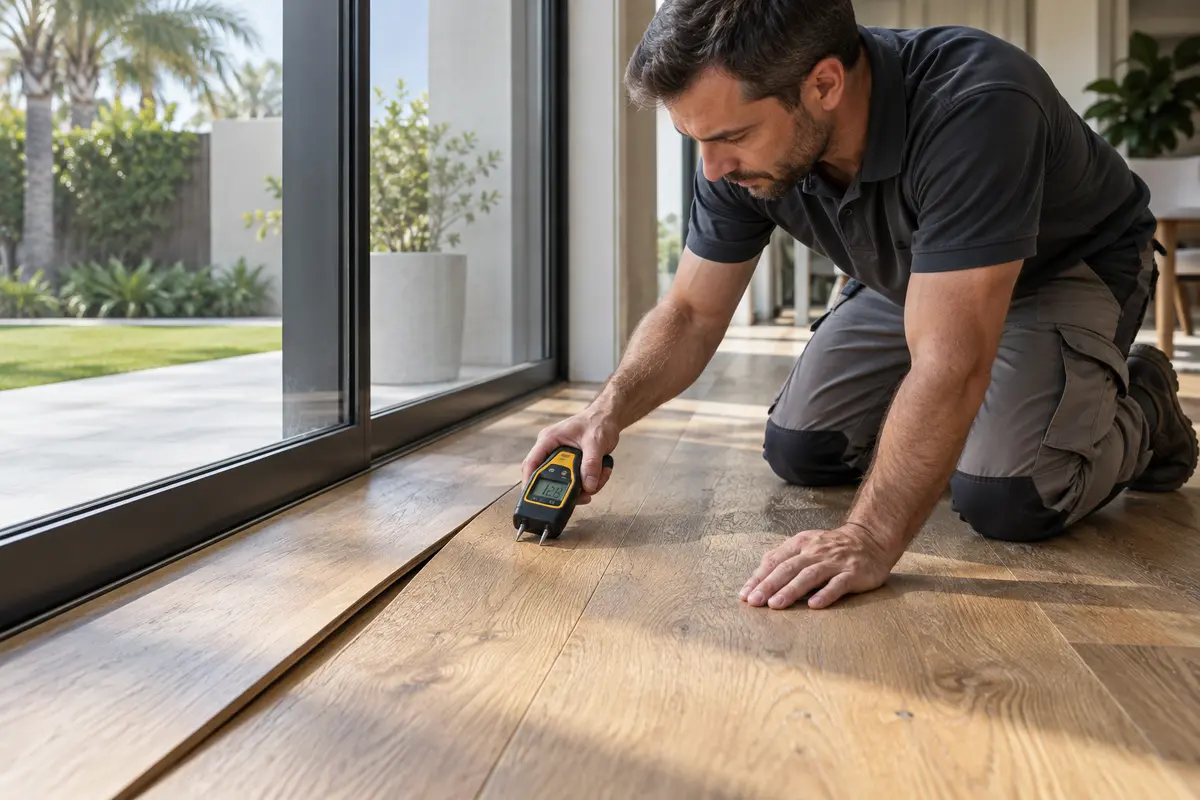
First, check these in 60 seconds
A wooden floor lifting in a Dubai apartment is almost always reacting to one of three things: moisture, heat, or a floating floor that has been pinned in place. The shape of the damage tells you which — and whether it will settle or needs boards out.
Kneel down, look along the floor under a low light, and match what you see to one of these:
- Laminate joints standing up in a ridge, with the board edges swollen, rough or lighter in colour. Water has reached the fibreboard core.
- Laminate peaking in a clean ridge, edges still crisp, often across a doorway or down the middle of a room. The floor has expanded and has nowhere to go.
- Wood boards with raised edges and a dipped centre, like a shallow gutter. That is cupping, and it means the underside is wetter than the top.
- Boards higher in the middle than at the edges. That is crowning, usually the aftermath of an earlier repair.
- Dark lines opening between boards. The wood has dried and shrunk.
- Vinyl or rigid SPC planks lifting along a window wall or opening at the short ends. Heat is the first suspect.
Then answer three questions. Where is it worst: near the AC, a wet-room doorway, or the glass? When did it start: after a trip away, after a mop, or in the first months after you got the keys? And can you slide a fingertip between the floor and the wall under the skirting, or is the board jammed hard against it?
Tiled floors fail in their own ways, and hollow or cracked floor tiles have a separate checklist.
If laminate peaks at the joints: a swollen core or a pinned floor
Laminate is a photographic layer pressed onto a core of high-density fibreboard (HDF). The surface shrugs off water, but the core soaks it up wherever it is exposed, and the click joint is exactly that place.
Swollen, fuzzy edges mean water got in
When water sits in a joint, the HDF fibres absorb it and the board edges thicken. The two boards push each other up into a small tent, and the edge often feels soft or looks slightly paler than the face.
This is the damage that does not reverse. Dried fibreboard stays thicker than it was, so the ridge usually remains even after the room is dry. The usual culprits are a wet mop used daily, a spill left under a rug, a slow drip from a developer-installed kitchen sink trap, or water creeping under the skirting from a bathroom threshold. Pergo's published warranty terms exclude cleaning "involving an excessive amount of water" and water damage from pipes, sinks and dishwashers, so the manufacturer will not replace boards for it either.
Crisp peaks with dry edges mean the floor cannot move
A floating laminate floor is meant to slide as a single sheet on its underlay, growing and shrinking with the air. The Quick-Step laminate installation guide (version 07.2026) asks for an expansion gap of 1 mm per metre of floor width, with a minimum of 8 mm, and "certainly 10mm" in high-humidity regions. It caps a single floating area at 13 x 13 m and requires a profile in every doorway unless specific conditions are met.
Peaking with crisp edges usually traces to one of these installation faults:
- Skirting boards or tile trims pressed down onto the laminate, gluing its edge to the wall.
- Door frames sitting on top of the floor. The guide says the base of a frame must not create a fixed point.
- Fitted wardrobes or a kitchen island screwed through the floor. Quick-Step's rule is blunt: "Never fix/block/permanently load a floating floor."
- One continuous floor running through several rooms with no joint at the doorways.
The good news: this kind of peak often drops once the pinch point is freed, because the boards themselves are undamaged. The bad news: finding the pinch point can mean lifting skirting and trimming boards around a wardrobe.
If wood boards cup, crown or open up: they are tracking the air
Solid and engineered wood are hygroscopic. They take on moisture from humid air and give it back to dry air, swelling and shrinking across their width far more than along their length. The National Wood Flooring Association (NWFA) recommends keeping a wood-floored home between 30% and 50% relative humidity year-round, and treats gaps that appear and close with the seasons as normal.
Doors follow the same physics, which is why bedroom doors that start sticking in the same weeks are a useful second clue that the air in the flat has turned damp.
Cupping: the underside is wetter than the face
A cupped board has absorbed more moisture on its underside than on its finished face, so the bottom grows wider and the edges curl upwards. On an upper floor of a tower, the usual sources are the screed below, a leak spreading under the boards, or humid air reaching the underside through gaps at the perimeter.
Cupping is the most reversible shape in this article. If the moisture source is removed and the air is brought back into range, the boards usually flatten over several weeks, sometimes longer on thick solid parquet.
Crowning: usually a repair done too early
Crowning is cupping's mirror image, and in apartments it usually has a human cause. Someone sanded a cupped floor flat while the boards were still swollen. The raised edges were ground away, the boards then dried and shrank, and the centre ended up as the high point.
That is why a floor that cups in September should be left alone until moisture readings in the boards and the subfloor are back to normal. Sanding is the last step of a cupping repair, done only once the wood has stopped moving.
Gaps: dry air, or boards that were fitted wet
Dark lines between boards that open in cooler months and close again in summer are seasonal movement. Gaps that appear once and stay usually mean the wood was laid before it had acclimatised to the apartment, then dried out under constant air conditioning and never grew back.
If vinyl or SPC lifts by the windows: heat, then movement
Click vinyl and rigid SPC planks barely react to humidity, but they do expand with temperature. Floor-to-ceiling glass on a west or south face can put direct afternoon sun on the same strip of floor for hours.
Quick-Step's rigid click vinyl guide guarantees standard residential floors of up to 13 x 13 m between 15°C and 35°C. For rooms with more extreme temperatures, up to 65°C, it cuts the maximum floating area to 8 x 8 m, and it warns that temperature variations can cause open joints. A long open-plan living room behind a sunlit glass wall, laid as one continuous floor with a tight perimeter gap, is exactly the setup that lifts at the window edge and opens joints at the far end.
Blinds drawn through the hottest hours slow it down. Planks already deformed by heat need replacing, along with a restored perimeter gap or an added expansion joint.
Finding the moisture source before anyone lifts a board
Replacing boards over a live moisture source means paying for the same repair twice. A moisture meter is a modest tool, and readings across the whole room, including a known-dry corner, show where the wet patch actually is.
Under and around the fan coil unit
Most towers on district cooling (Empower, Emicool or a building plant) cool each room with a fan coil unit in the ceiling or a cupboard. It pulls moisture out of the air into a drip tray and a small drain line. When that line blocks with slime or dust, the tray overflows, and the water often finds its way down a wall and under the skirting.
Look for a tidemark on the wall below the unit, a musty smell, or damage that is worst on the side of the room nearest the AC. The same fault causes mould on walls near the AC, and in many buildings the FM (facilities management) team clears blocked condensate drains, so check whether yours covers the AC unit inside your flat.
At bathroom and kitchen thresholds
Where timber or laminate meets a tiled wet room, check the threshold strip and the first board. Swelling that fades out within a metre of the doorway points to water migrating from the wet room: a failed shower seal, a leaking washing machine hose, or floor mopping that pushes water across the joint. In humid kitchens, pull the kickboard off the sink cabinet and look at the floor beneath it.
In a newly handed-over unit
Cement screed holds a large amount of water and dries slowly. Quick-Step's guide sets a limit of below 2.5 CM% (or 75% relative humidity) for an unheated cement subfloor before laminate goes down, and requires a vapour barrier on mineral subfloors. A floor laid on screed that had not dried enough tends to cup or peak within the first few months.
If the unit is inside its first year, record the damage during handover snagging or report it to the developer in writing. Dubai's Law No. 6 of 2019 on jointly owned property sets the developer's defect liability period at one year from handover of the unit for defective installations, and ten years from the completion certificate for structural parts.
After a summer away with the AC off
An empty flat with the AC off or on a long timer through August stops drying its own air. The National Centre of Meteorology put the UAE's maximum relative humidity for August 2026 at between 63% and 80%, well above the NWFA's 30% to 50% band for wood floors. Floors that come back cupped or peaked after a long trip, with no leak anywhere, are usually reacting to that. Leaving the AC running on a moderate setpoint while you travel keeps indoor humidity closer to what the floor was laid in.
What settles by itself, and what needs a flooring repair pro
Give the floor time when the cause was air and the boards are intact:
- Cupped wood boards with no leak, once the AC is running normally.
- Seasonal gaps that open and close with the weather.
- Slight peaking in laminate after a humid spell, where the edges are crisp and the perimeter gap is clear.
Give it a few weeks of normal AC use, longer for thick solid parquet, then check again. Photograph the floor on day one with a coin for scale, so you can compare honestly.
Stop waiting and call a flooring repair and refinishing specialist when you see any of these:
- Laminate edges that are swollen, soft or flaking. Those boards need replacing.
- Buckling, where a section has lifted clear of the subfloor and moves underfoot. It is a trip hazard and can snap click joints nearby.
- Damage that keeps spreading after the room has been dry for a week — a live leak is still feeding it.
- Crowning, or a cupped floor someone now wants to sand.
- Peaking that needs skirting removed or boards trimmed around fixed furniture.
A good contractor takes moisture readings before quoting and replaces only the affected boards where the pattern allows. Keep any spare boards from the original install — batches change colour, and a mismatched board shows for years.
Who arranges the repair in a rented unit
If you rent the apartment out, maintenance of this kind sits with you as landlord by default. Article 16 of Law No. 26 of 2007 makes the landlord responsible for maintenance and for defects affecting the tenant's use, unless the Ejari-registered contract says otherwise, so read the maintenance clause first. Damage caused by the tenant, such as a floor flooded by daily wet mopping, is a different matter under the same law.
If the water came from a common-area pipe, a shared riser or the unit above, report it in writing to building management. Jointly owned buildings in Dubai are run by a RERA-regulated managing agent under Law No. 6 of 2019, and they will need to trace the source before anyone agrees who pays for the floor.
Frequently asked questions
Why is my laminate floor lifting?
Laminate lifts for one of two reasons: water has swollen the fibreboard core at the joints, or the floating floor has expanded against something holding it down. Swollen, soft edges point to water from mopping, a spill or a leak. Crisp ridges point to a missing expansion gap, skirting pressed onto the boards, or a wardrobe fixed through the floor. The first needs new boards; the second often drops once the floor is freed.
Will a buckled wooden floor go back down?
Mild cupping in solid or engineered wood usually flattens once the moisture source is gone and the room is back in a normal humidity range, which can take several weeks. A true buckle, where boards have lifted off the subfloor, rarely settles fully and generally needs the affected boards taken up, the cause fixed, and the boards relaid or replaced. Avoid sanding until moisture readings are normal.
Can you fix swollen laminate?
Swollen laminate cannot be reliably shrunk back. Once the fibreboard core has absorbed water, it stays thicker even after drying, so the joint ridge remains. The practical repair is replacing the damaged boards, which a flooring contractor can often do without lifting the whole room by working in from the nearest wall. Fix the water source first, or the new boards swell too.
Can a landlord deduct a swollen floor from the security deposit?
Yes, if the damage came from the tenant's use and goes beyond ordinary wear and tear. Dubai's tenancy law requires the tenant to return the unit in the condition received, and water damage from heavy mopping or an unreported spill may justify a deduction from the security deposit. Damage from a building leak or a failed AC drain is maintenance, which the landlord generally covers. Photographs and dated messages decide most disputes.
Booking flooring repair on Everlook
Lifting and gapping floors in Dubai apartments rarely fix their own cause, and a hidden drip under the boards gets worse every week it is left. Everlook lists vetted flooring repair and refinishing contractors across the UAE with verified licences, transparent pricing, and reviews from your neighbours.
Find your next pro on Everlook
Post a job in minutes and get offers from trusted local contractors. Free to start.
Find your next pro on Everlook
Post a job in minutes and get offers from trusted local contractors. Free to start.
Get started