What Sand, a Whistle or Water on the Sill Says About an Old Aluminium Sliding Window
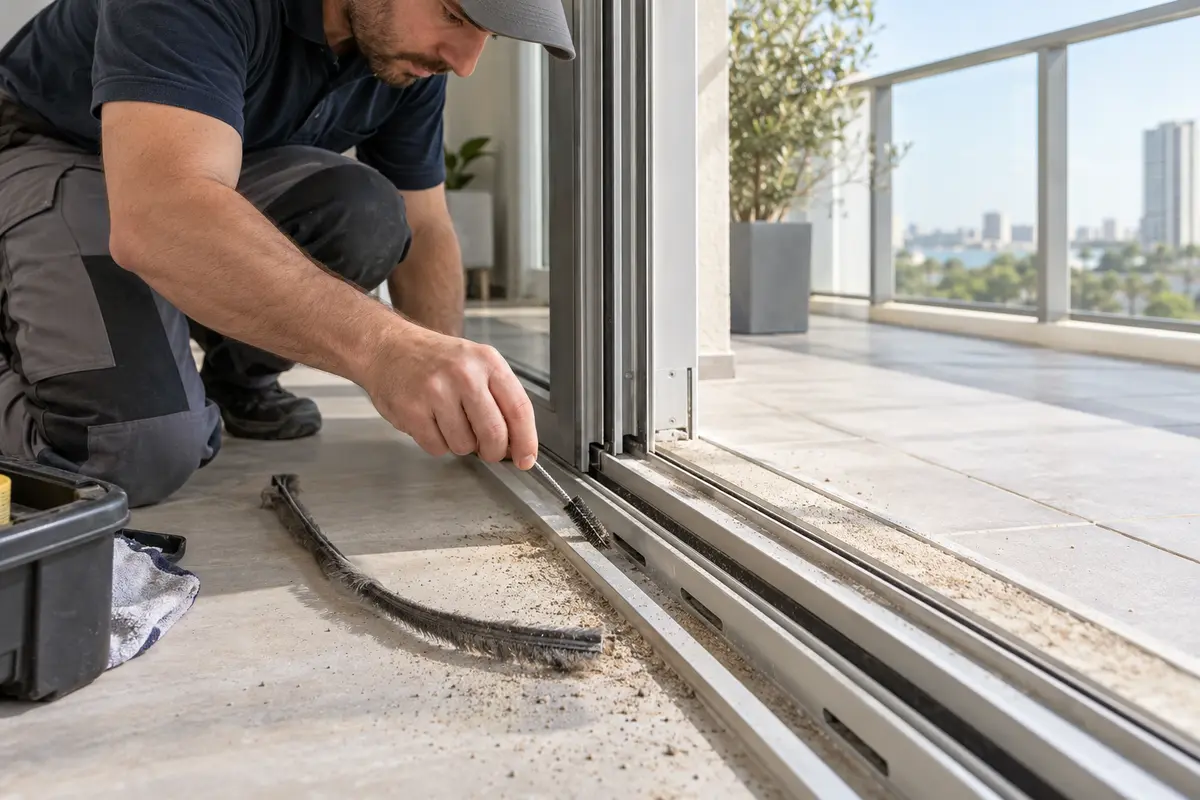
Sand on the sill: where the line of grit stops
Look at the sill after a dusty shamal day, before anyone wipes it. The shape of the sand shows which gap it came through.
On a slider, the gap between each moving panel and the frame is closed by pile weatherstrip: dense polypropylene fibres woven into a backing strip, often with a thin plastic fin down the middle. Schlegel, a major maker of the strip, says those fins give "measurably tighter air sealing". Pile runs along the top and bottom rails of each moving panel and up the interlock, where the two panels overlap when the window is shut.
- A fan of sand where the two panels meet, at the top or bottom of the interlock, is consistent with worn pile on the interlock or a missing end pad, the small block that closes the corner where the interlock meets the track.
- A thin, even line along the whole bottom track points to the pile on the panel's bottom rail.
- Sand in the corners where the frame meets the wall points away from the moving parts altogether, towards the sealant joint between the frame and the wall.
Then slide the panel open and look at the pile itself. Healthy pile stands up and springs back when you run a finger along it. Worn pile lies matted flat, has gaps at the ends, or has a torn or missing fin. The summer shamal, the hot north-westerly that NASA's Earth Observatory says usually blows from about 30 May to mid-August, drives fine sand at those gaps for weeks.
Worn pile is a reseal job. Pile is sold by backing width and pile height, so a technician can usually match it by measuring, even when the original supplier is long gone. On a moving panel, the panel normally has to come out first.
Where you stop: taking a panel out means lifting it up into the head track and swinging the bottom inwards clear of the sill, the sequence a maker's manual lays out for its own sliders. A balcony door panel is a large sheet of glass in a metal frame, often heavier than one person can steady, and on a balcony there is a balustrade behind you. That lift belongs to two people who do it every week.
A whistle in the wind: the interlock, or the edge of the glass
A whistle is air forced through a narrow gap, so the job is to find the gap. On a windy day, hold a strip of tissue close to each joint in turn and watch where it flutters.
At the interlock, with the window locked. Try the lock first. If the whistle fades when you push the moving panel hard towards the fixed one, the lock is not pulling the two together. Many sliding locks have a catch whose reach can be adjusted under a small cap, and the strike plate can be moved to meet it, as one maker's manual describes. That is a small repair. If pushing changes nothing, the pile on the interlock has worn down.
Heavy wind adds a second cause: panels bow under strong gusts and open a gap at the interlock that thicker pile cannot close. A slider that whistles only in the strongest wind, with pile in good condition, may simply be at the limit of its design.
Round the edge of the glass. The glass sits in the panel frame on a wedge-shaped rubber or plastic strip pushed in along each side. Small gaps at the corners of the glass are not, on their own, the leak. A technical memo from Alspec, an Australian aluminium system supplier, found that its plastic wedges can shrink by up to 25 mm per metre on dark, unshaded frames that pass 75°C, and that the grip on the glass tightens as they do, leaving gaps it calls purely cosmetic. If the tissue flutters along the length of a side, the strip on that side may have lifted out of its groove or gone missing, and a technician renewing the seals can check it on the same visit.
Water on the sill after rain: the track, the slots or the wall joint
The bottom track of a slider is meant to collect water. It drains to the outside through slots in the sill, called weep slots, often behind small flaps on the outer face. Graham, an American window maker, puts the test plainly in its owner's manual: if water stands in the sill "long after the rain has stopped" or overflows it during rain, the small passages are blocked.
The National Centre of Meteorology ties winter rain to passing low-pressure systems, so a window can go months without a real test while a summer's dust settles in the track. The first storm of the season then arrives at slots that are already packed. Clearing them in October or November costs nothing.
Where the water appears tells you which branch you are on:
- Water standing in the track after the rain stops, or spilling over its inner edge during the storm: blocked weep slots. Graham's fix is a pipe cleaner or a small soft bottle brush pushed through the slots from inside the track. That part is yours to do.
- Water only at the meeting point of the panels, with the rest of the track draining normally: the interlock end pads or the pile at the bottom of the interlock.
- Water over the whole inner edge in wind-driven rain, while the slots run clear: wind pressure is usually pushing water up and over the track's inner upstand. EN 12208 classifies windows by the wind pressure they hold back under a water spray, and an old slider may simply sit low on that scale. That is a limit of the frame's design, and new seals are unlikely to change it.
- Water at the frame corners, down the plaster beside the frame, or on the floor below it, with the track itself dry: the sealant joint between frame and wall, or the sill's junction with the wall below it. These two cannot be told apart by looking. A technician separates them by wetting one joint at a time from outside, starting low.
Check the outside of the sill too, if you can see it safely from the balcony or the ground. A bead of silicone run across the weep slots by a previous repair will flood the track on its own. The installation practice of AAMA, the American window manufacturers' association, says never to block weep holes with sealant.
Inspect the perimeter sealant in the cooler months. ASTM C1521, the standard for checking installed sealant joints, says its non-destructive checks work best when the joint is stretched in mild weather and least well in high heat. A bead that looks closed in August can show its crack in January.
Where you stop: clear the slots from inside the room only. Do not lean out of a window or over a balustrade to reach the flaps, and do not drill new drain holes. A hole in the wrong chamber of the sill lets water into part of the frame with no way out. Resealing the outside of a frame above the ground floor needs a platform or rope access, and in a tower it is the building's call. If water has already reached a timber or laminate floor below the sill, the guide to floors lifting after a leak covers what to check before anyone lifts a board.
A panel that still drags after the track is clean
Cleaning the track and setting the roller height are covered in the section on sliding balcony doors and their tracks. If the panel still drags after both, three causes remain.
- Worn rollers. A wheel with flats, or one that will not spin freely by hand, needs replacing. In the maker's manual quoted above, changing the roller housing starts with taking the panel out of the frame, so this is a repair visit with the same two-person lift. Rollers are made for a particular profile, and on an old system the hardest part of the job is finding a set that fits.
- A damaged running rail. Run a fingertip along the raised rail the rollers ride on. A dent, a burr or a worn groove drags the panel at the same spot every time. On some systems the rail or its cap snaps in and can be replaced. On others it is part of the frame extrusion.
- A frame that has moved. Close the window and look at the interlock from top to bottom. A gap that tapers, a panel that rubs the head track at one end, or a lock that only engages when you lift the handle are signs the frame is out of square. That is a fabricator's assessment, and often the end of the repair route.
A hot pane, or fog between the panes
Look at the edge of the glass where it enters the frame. A double-glazed unit shows two sheets with a spacer bar between them. A single sheet means single glazing. Single glass in a west-facing window that feels hot by mid-afternoon is working as designed. No reseal changes how much of the sun's heat comes through it.
With double glazing, the question is fog. On a humid morning with the AC holding the room cool, the outer face of the glass can drop below the dew point and mist over. Graham's manual calls that "not a window defect". Wipe both faces. If the haze stays, it is inside the sealed unit. A 2007 paper from a building-envelope conference published by Oak Ridge National Laboratory says that "in almost all cases" moisture between the panes means the sealed unit must be replaced, and names sunlight and UV among the causes of seal failure. A glazier can replace just the unit in a sound frame.
Where new parts stop paying off
Most of the symptoms above end in a repair or a reseal. Replacing the unit makes sense in fewer cases:
- The frame is bent, out of square or corroded through at the sill. New seals sit against the frame, so they cannot close a gap the frame itself has opened.
- The parts no longer exist. Pile can usually be matched by size. Rollers and interlock end pads often cannot, and a panel that will not run properly on substitute parts has reached the end of its repair life.
- The real complaint is the glass. A sash built for single glass has a glazing pocket sized for it. One of Schüco's sliding systems for the Middle East takes glass 24 to 40 mm thick, so a double-glazed upgrade normally means new panels and frame together.
If you do replace, two features change how a slider performs in this heat. A thermally broken frame joins its inner and outer aluminium with a strip of insulating plastic, usually polyamide, so heat from the sun-baked outside face has no continuous metal path into the room. Double glazing with a solar-control coating cuts what the glass lets through. Ask the supplier for the unit's U-value and its solar heat gain coefficient. The Department of Energy's consumer guide to windows explains that a lower coefficient means "less solar heat", and recommends a low one for east, west and south windows in warm climates. Ask for the EN 12208 watertightness class too, since makers such as Schüco test each project against its own specification.
A reseal of pile and wedges, clearing the slots and new rollers can usually be booked as one door and window repair visit. A new unit is a larger job, with an approval step first.
In an apartment, the window may belong to the building
Dubai's jointly owned property law, Law No. 6 of 2019, lists "windows in external walls" among a building's common parts unless the building's site plan says otherwise. Another article lists the windows and glass that form part of a unit's internal windows among the parts of the unit, also subject to the site plan, so each building's documents decide where the line falls. Common parts are run by a RERA-regulated managing agent or, in some projects, the developer.
In practice, message the managing agent before booking anything that touches the frame, the glass or the outer seals. Ask whether the building treats your windows as common property, and if it does, whether the repair is theirs. Clearing weep slots and adjusting a lock catch are rarely questioned. Ask about access for anyone working on the outside face.
Replacement is a different matter. Article 39 of the same law requires approval from the master developer, the Dubai Land Department and the competent authority before an occupant makes substantial changes to the external appearance of a unit. New frames in a different colour or profile, or glass with a different tint, change the facade. In a villa the windows are yours to maintain, but a change visible from the street may also need the master developer's approval under the community rules, so check them before ordering.
Worn seals and blocked slots get worse slowly, and the damage builds up out of sight. A winter of water overflowing the track ends up under the skirting, in the plaster beside the frame and in the floor, and by then the job includes the room as well as the window. Everlook connects you with licensed UAE door and window contractors who can tell a reseal from a replacement on site, with verified credentials, transparent quotes and reviews from Dubai customers.
Find your next pro on Everlook
Post a job in minutes and get offers from trusted local contractors. Free to start.
Find your next pro on Everlook
Post a job in minutes and get offers from trusted local contractors. Free to start.
Get started