Microcement or Tiles in a Bathroom Refit, Zone by Zone
·
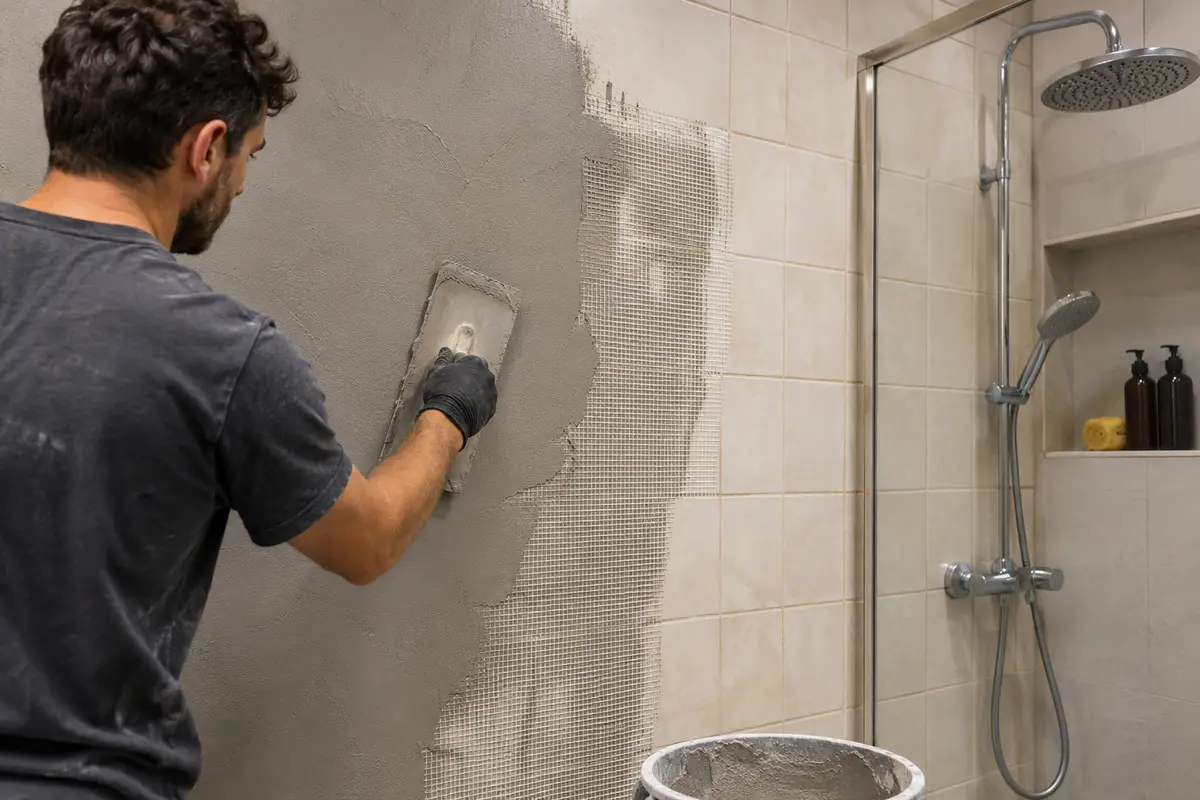
Three millimetres of cement over whatever lies beneath
Topciment's data sheet for its water-based sealer, Topsealer WT All in One, puts the limit in one sentence: it "seals the pore of the microcement against running water (occasional contact)", and it is no waterproofing agent against water in "permanent contact". The anti-slip version of the same sealer carries the same wording. Most of the zone-by-zone answer follows from that line, because a bathroom has both kinds of water, in different places.
Microcement itself is a polymer-modified cement trowelled on in thin coats. Ideal Work's Microtopping data sheet describes a jointless covering "with a maximum thickness of 3 mm", built from two base coats and usually a finer finishing coat, then sealed with a polyurethane. At that thickness the coat follows the surface underneath. Ideal Work warns that shrinkage cracks in the substrate "inevitably tend to be transmitted" to the finish, and tells applicators to respect any control joints already in the floor.
In a wet zone the work is shared between layers. A membrane below keeps water out of the wall and the slab, mesh and primer tie the cement to a sound base, and the sealer on top keeps water and soap out of the cement's pores. Tiles divide the same work differently: the membrane still sits underneath, the glazed tile sheds water, and the grout joints are the part you maintain.
Walls outside the shower, where microcement asks least
The walls behind the basin and the WC, and the splashback above a bath, get running water now and then and dry between uses. That is the occasional contact the sealer is rated for. Nobody stands on them, so neither grip nor foot traffic comes into it.
Over old wall tiles, Ideal Work's sequence is to sand the glaze with a diamond disc, smooth the grout joints with its filler, IW-Blocker, and roll on a primer. Where the wall has cracks or gaps it adds a sheet of fibreglass mesh.
The floor outside the shower
A bathroom floor is walked on wet and barefoot, and it sits over the joints in the slab and the old screed. Ideal Work's floor preparation over ceramic is heavier than its wall preparation: diamond sanding, an 80–100 g/m² fibreglass mesh fixed with IW-Blocker, then an epoxy coat broadcast with quartz sand, applied twice where grout joints remain. The floor underneath has to reach a pull-off strength of at least 1.5 MPa, which a loose tile cannot.
The substrate guide from CEMHER, an Australian microcement maker, says movement along the join between two subfloors can crack the coat, because "microcement is an overlay system and does not hold during significant substrate movement". At an existing joint it recommends a threshold, with microcement laid up to it on each side.
For grip, tile makers print ratings on the box. Porcelain sheets such as Vives's give the Spanish building code's class (class 2 for interior wet areas, showers and bathroom floors, class 3 for wet areas sloping more than 6%), the barefoot DIN 51097 class and the R value.
Shower walls and the floor-to-wall corner
Inside the shower the walls are wet every day and steam keeps them damp afterwards. The water runs off and does not stand, which keeps them within what the sealer covers, provided a membrane sits behind the cement.
None of the microcement data sheets read for this article treats the cement or its sealer as the waterproofing. Ideal Work's Microtopping sheet names no membrane at all. The shower detail published by Duraamen, an American maker, draws the waterproofing as its own layer under the microcement, with fibreglass mesh lapped at least 12 inches (about 300 mm) up the wall and across the floor at the junction. That corner is where wall and floor move separately, and where a crack in a 3 mm coat lets water through to whatever is behind it.
Tiles on shower walls need the same membrane and differ in upkeep: grout joints darken and need cleaning, sealing or regrouting, as the guide to black shower grout sets out, while a microcement wall has no joints and depends on a sealer that has to stay unbroken.
The shower floor, where tiles are the safer default
The shower floor collects water around the drain, is stood on barefoot with soap underfoot, and takes the hardest cleaning. Water that sits at the drain is the permanent contact both Topciment sealer sheets exclude. In that spot the cement relies wholly on the membrane underneath and on the drain flange being bonded into it.
Grip is the second test. Topciment's anti-slip sealer, Topsealer WT Anti Slip, reports class 3 under UNE-ENV 12633:2003 in tests by the AIDIMME laboratory. The All in One sheet publishes no slip class. If an applicator proposes a smooth, glossy shower floor, ask for the sealer's test result in writing, and compare it with the class 2 the Spanish code assigns to showers.
Tiles keep this zone simpler: a box of porcelain carries its rating, and small tiles follow the falls to a drain more easily than large ones. A ready-made shower tray is the other option. Ideal Work separates two microcement pours with a cut joint sealed with neutral silicone; ask for the same detail where tiles meet microcement.
Old tiles underneath: what has to hold first
Laying microcement over existing tiles saves the strip-out, and the makers read for this article allow it on conditions. CEMHER's guide asks for tiles that are "sound", with "any loose or drummy tiles" removed and relaid or filled, the grout lines filled level 24 hours before the system starts, and the tile face ground for a key.
Before the applicator visits, tap every floor and wall tile with the handle of a screwdriver: a hollow note marks a tile that has lost its bond. Why tiles go hollow, and which patterns point to the screed underneath, is covered in the guide to cracked and hollow floor tiles.
The same soundness checks apply to any overlay, and the ones for doors, drains and shower membranes are in tiling over existing tiles. Height is less of a problem here than for a second layer of tiles: CEMHER allows 3–4 mm for its full microcement system.
The membrane is the harder question. A finish laid over an old shower keeps whatever waterproofing lies under the tiles, and ARDEX's tile-over-tile bulletin says a new layer "will not remedy waterproofing problems, unless the leak itself is addressed". If there is a stain on the ceiling of the flat below, or the neighbour has complained of damp, stop there. That is a leak investigation for a plumber or waterproofing contractor before any finish is chosen. Otherwise the choice is an overlay membrane on the old tiles inside the shower, or stripping the shower back to the slab.
The layers to see named on the applicator's quote
Ideal Work "declines all responsibility" for work not installed to its tested cycles, so product names on the quote are how you check which system you are getting. A line that reads "microcement, sealed" leaves every layer open, so ask for these, by product name and zone:
- the preparation: diamond sanding, what happens to drummy tiles, and what fills the grout lines;
- the primer and the mesh, with the mesh weight and where it runs (whole floor, walls, corners);
- in the shower, the membrane by name, how far it runs beyond the shower, the drain detail, and a flood test before any cement goes on;
- the system name, the number of coats and the finished thickness;
- where the cut joints go: doorways, floor-to-wall corners, any joint in the slab, and the line between microcement and tiles;
- the sealer by name and its number of coats (Topciment calls for four coats of its All in One sealer in wet areas), plus, for floors, the slip class and the test standard;
- the temperature and humidity the room is held at during application and curing, and the date the shower can first be used.
The last line is where a Dubai summer comes in. Ideal Work says to avoid applying above 30°C or in relative humidity above 70%, and Topciment's anti-slip sealer is not to go on below 15°C or above 30°C. In those months that means the air conditioning running and the window shut for the whole job. Topciment then asks for at least a week before the sealed surface gets wet, and two weeks before any detergent.
For a whole refit, send the list with the job as a bathroom renovation, so every contractor prices the same layers.
Cleaners, limescale and repairs once it is in use
After handover the sealer is the part you look after. Topciment's All in One sheet scores resistance on a scale where water gets 5 at every contact time: bleach drops to 1 after eight hours, and salfumán, the Spanish name for hydrochloric acid cleaner, scores 3. Its anti-slip sealer sheet says not to use "bleach, acetone or salfumán" at all, and both sheets say to rinse off soap and detergent residue at once because it can leave marks or grooves. Ideal Work recommends neutral detergents.
Limescale removers work by dissolving scale with acid. If the white scale that hard tap water leaves on the shower glass already has you reaching for a descaler, keep it off a microcement floor and walls, or put tiles in the shower. The glaze on a tile is not the weak point, though Mapei's grout data sheets warn against acid on coloured cement grout, so the joints need the same care.
No sheet read for this article gives a resealing interval. Ask the applicator to write one into the handover note, with the sealer's product name so a later contractor can match it.
A chipped tile can be cut out and replaced from spares, so keep a box back from the job. A damaged patch of microcement is sanded and recoated, and since Ideal Work ties the finished look to site conditions, timing and sanding, a patch made months later may not match. The repair can end up running to the nearest corner or cut joint.
Microcement, tiles or a split, matched to your bathroom
If the old tiles are sound, the shower membrane is known to be intact or is being replaced, and you will clean with neutral products, microcement can run across the walls, the dry floor and the shower walls, with an anti-slip sealer on any floor that gets wet.
If the shower floor is the doubt, whether for grip, your cleaning habits or the drain, split the room: microcement on the walls and the floor outside the shower, tiles or a tray inside it, with a cut joint between them. For a microcement-only job, applicators are listed under specialty finishes.
If tiles drum across the floor, cracks follow joints in the slab, or the shower has leaked, the finish waits until that is fixed. After a strip-out, new tiles may be the simpler result.
If you want to keep using a descaler, bleach and a stiff brush, tiles throughout are the lower-upkeep choice, and a tiler can quote them through floor and wall tiling.
In a tower, ask the building's managing agent, the RERA-regulated company that runs the common parts under Dubai's Law No. 6 of 2019, what it needs before work starts. Rules vary by building, and a strip-out brings more chiselling noise and debris through the service lift than an overlay does.
An applicator who works in Dubai should know how to hold a bathroom under 30°C and 70% humidity through an August job, and should name the shower membrane without being asked. Everlook surfaces bathroom renovation contractors and microcement applicators with verified UAE experience and reviews from your neighbours, so the list above can go to several at once.
Find your next pro on Everlook
Post a job in minutes and get offers from trusted local contractors. Free to start.
Find your next pro on Everlook
Post a job in minutes and get offers from trusted local contractors. Free to start.
Get started