Home CCTV Installation in Dubai: Where You Can Legally Point a Camera
The short answer, before the branches
A camera you own may look at what you own. Your own front door, your own balcony, the inside of your own rooms — that is the boundary, and everything past it belongs to somebody else's privacy.
For the hardware, Dubai splits the question in two. Selling and installing security equipment is a licensed activity, so the company you pay must hold a licence from the Security Industry Regulatory Agency. The detailed CCTV rulebook (camera counts, storage, signage, sign-off) applies to establishments and to residential complexes as whole buildings, and in an apartment block the party carrying that obligation is the management company.
What falls out of that for an owner-occupier is a clean cutoff. A self-contained indoor camera you plug into a 13A outlet is yours to fit. A system that is cabled through walls, drilled into a facade, or wired back to the consumer-unit panel is a licensed contractor's job, and the compliance travels with the contractor.
What SIRA regulates, and what it does not
SIRA exists under Law No. (12) of 2016, which regulates the security industry across the emirate including the free zones. Article 17 is the sentence a homeowner should know: no person may provide security services in the emirate without first obtaining a licence. The law's own definition of a security service covers selling and installing security equipment and systems, so an unlicensed installer is trading outside the law and leaving you with a system nobody official will stand behind.
The second half of SIRA's mandate is where installer marketing overreaches. Article 20 sets technical requirements for vital sectors and major compounds — banks, hotels, malls, hospitals, and compounds of residential or office units. Those requirements now sit in the Preventive Systems Manual, approved by Administrative Resolution No. (13) of 2025, whose Article 2 applies the manual to establishments as defined by reference to vital sectors and important complexes.
Read the manual's own chapters and the picture holds. Its residential chapter covers multi-storey residential buildings, villa complexes and mixed complexes, and it specifies camera coverage at building entrances, lift lobbies, corridors, swimming pools, car park pathways and the building perimeter. It stops at the door of the unit.
Where the primary sources are silent, the honest answer is to say so. Neither the law nor the 2025 resolution states that a private villa or a single apartment must register a domestic camera with the regulator or the police, and neither makes an offence of plugging in a wireless indoor camera in your own home. Several installer blogs assert both. Treat those assertions as sales copy until an official page carries them, and if your situation is unusual (a home business, a plot with its own guard post, a unit inside a Trakhees-administered free zone), put the question to the authority before you buy.
Where a camera may legally look
The binding instrument here is federal. Federal Decree-Law No. 34 of 2021 on Combatting Rumours and Cybercrimes, listed among the country's cyber laws on the UAE government's official portal, criminalises using an electronic system to invade the privacy of a person or the sanctity of private and family life without consent, including capturing and publishing images of people. Penalties run to imprisonment and a substantial fine. The precise article and range are worth verifying against the current text before you repeat them to anyone.
Translated into mounting positions, the line is easy to hold. Yours: your entrance, your balcony, your garden inside its own boundary, the rooms inside your unit. Never yours: a neighbour's door, window, garden or parking bay; a shared corridor, lift lobby, roof terrace or pool deck; the public street. A camera aimed at any of those is recording people who never agreed to it.
Three placements stay wrong in every property, whatever consent exists elsewhere. Bathrooms and changing areas. A prayer room. Any space where a guest or a domestic worker reasonably expects to be unobserved, which includes a live-in helper's own room.
Audio deserves a separate decision. Many doorbells and indoor cameras record sound by default, and capturing a conversation you are not part of is treated more seriously than a silent video frame. Leave the microphone switched off unless there is a reason to run it.
SIRA's rulebook for regulated premises shows the same instinct. It prohibits hidden cameras and pan-and-zoom cameras covering private areas without the agency's approval, and it prohibits roof-mounted external cameras whose field of view extends past the boundaries of the facility. That last prohibition is the neighbour problem, written down by the regulator.
Branch one: villa boundary or building common part
The first branch is whether the surface your camera fixes to belongs to you outright.
On a standalone villa plot, the front elevation, the boundary wall and the gate are within your title, and a camera on any of them is a decision you make. Community rules still apply in a managed development, and a master developer's design controls can govern anything visible from the street, so check the community handbook before you drill.
In an apartment, the wall your bracket bites into is often shared property. Corridors, lobbies, risers and the facade of a jointly owned building fall under Law No. (6) of 2019 concerning ownership of jointly owned real property, and written consent for anything fixed to them comes from the building's management company. That law repealed the 2007 regime and ended the owners' associations that used to sign these approvals; the body you now write to is the RERA-recognised management company, with an owners committee alongside it that does not control the budget.
In practice the split is sharp. A camera inside your flat covering your own hallway needs nobody's signature. A camera on the outside face of your door, in the corridor, or bolted to the facade needs written consent first, and a facilities-management team that finds an unapproved fixture on a common wall is entitled to have it taken down. If you are renting the unit, the permission chain also runs through your landlord and your tenancy contract registered on Ejari, which is covered in what a tenant may install in a Dubai rental.
Branch two: plug-in indoor, or cabled and external
The second branch decides whether you need a contractor at all.
Fair to do yourself: a self-contained indoor camera that stands on a shelf or takes two screws into a plasterboard wall, runs over Wi-Fi, and draws power from an existing socket through its factory-terminated BS 1363 plug. Nothing about it touches the building's fixed wiring. Change the default password, enable two-factor sign-in on the account, and keep the firmware current — an unpatched camera sitting on your home network becomes a way in for somebody else.
Where it stops being a do-it-yourself job:
- Any cable run back to the consumer-unit panel, or a new fused spur for a recorder. That is fixed-wiring work.
- Power-over-Ethernet runs pulled through walls, ceiling voids or a building riser.
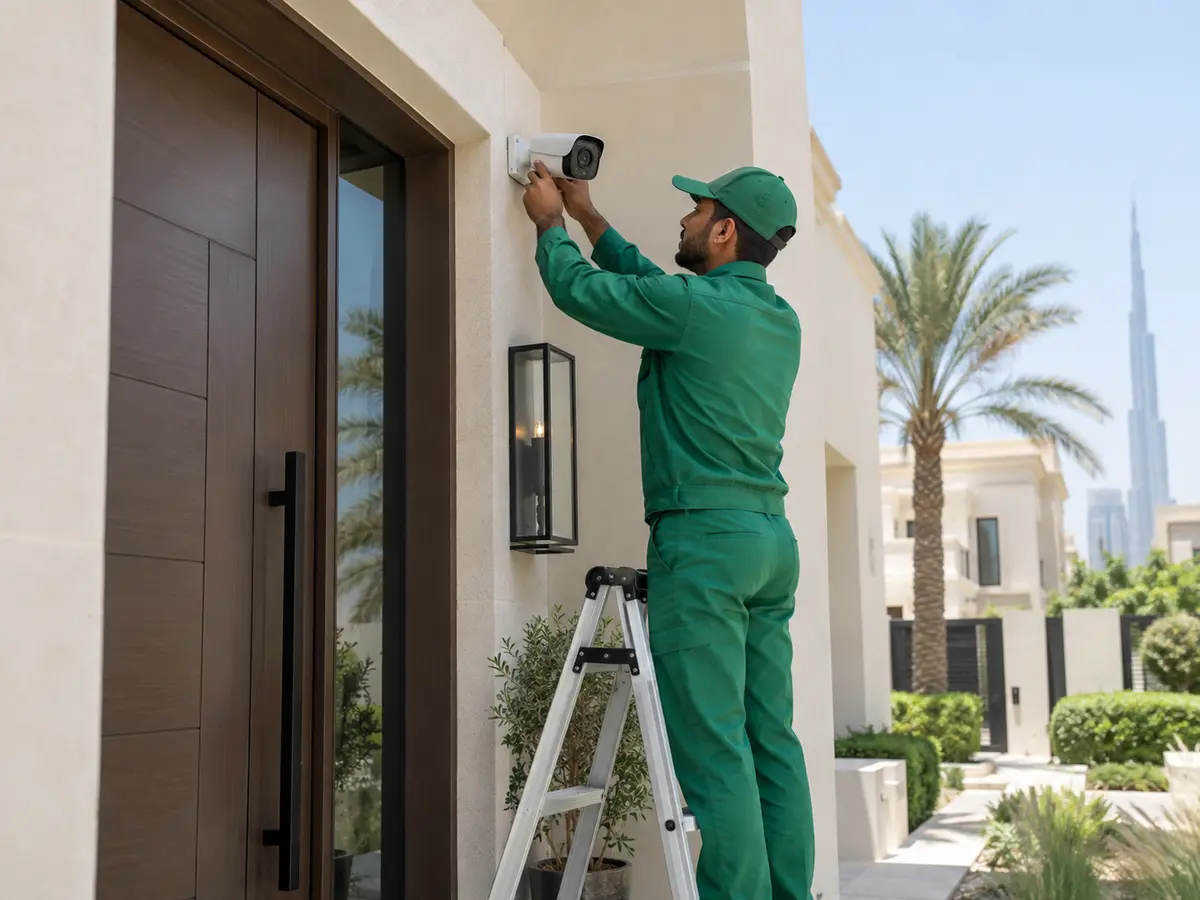
- Drilling a facade, a boundary wall or an external soffit. External fixings here take direct summer sun and shamal-driven dust ingress, and a poorly sealed penetration becomes a water path into the wall.
- Anything above step-ladder height, on a roof, or over a stairwell.
- Any recorder that has to be certified, connected to a monitoring service, or handed over with documentation.
Once fixed wiring is in scope, the work stops being a camera job and becomes electrical work in a Dubai property, with the same threshold that governs any other addition to a distribution board. The warning signs that a circuit is already at its limit are the same ones described in the signs a UAE home needs an electrical inspection.
What needs a licensed installer, and how to check one
Two credentials matter, and they are separate documents. The SIRA licence covers the security work itself. Ask for the licence number and the exact company name it was issued to, then put both to the agency directly before you sign. A licence belongs to a company, and the crew at your door may be trading on somebody else's. The trade licence covers the company's right to trade at all, and the free lookup for that is set out in how to verify a contractor's trade licence. A firm that clears one check and fails the other is not a firm to hand your floor plan to.
Five questions separate a quoting installer who carries the risk from one who leaves it with you.
- Which security-industry licence do you hold, and in what company name? The name on the licence should match the trade licence and the invoice.
- Will your own technicians install it, or a subcontracted crew? The Preventive Systems Manual requires the technical crew on a regulated installation to be licensed, and a subcontractor breaks that chain quietly.
- Who obtains the building's written consent for anything outside my unit, and what happens if it is refused after you have drilled?
- Where does my footage live, who else can log in, and is any cloud account registered in your name? An installer who wants to keep a login for support is asking for a standing view inside your home.
- What paperwork do I receive at handover — device list, as-built cable route, warranty, and the admin credentials in my name?
Screening a security contractor uses the same muscles as screening any trade, and the general pattern is worth reading first in how to hire a trustworthy electrician or plumber. When the answers hold up, book the job through licensed smart-home and security installers and keep the quotes comparable on scope as well as on camera count.
Retention and signage: whose duty is it
Two requirements circulate on installer pages as though they applied to your flat. Both are real, and both have a scope.
The 31-day retention minimum is genuine. The Preventive Systems Manual requires recordings to be kept for at least 31 days at high quality and at a minimum of 10 frames per second, with longer windows for higher-risk premises such as banks and large malls. Signage is genuine too: standard approved warning signs and labels must be placed at all main entrances and inside lifts, alerting people that surveillance is running.
Both duties sit on the establishment or the complex. In an apartment building that means the management company and whoever operates its security systems. No official source reviewed for this article extends either duty to a resident recording their own hallway on a domestic camera, and any installer telling you otherwise should be asked to name the clause.
Adopting both anyway is a reasonable choice. A month of stored footage roughly matches the window in which a resident notices a missing parcel, a scratched car or a disputed delivery and thinks to look. A small visible notice at your own door does something similar for the argument that follows: it removes the claim that anyone was filmed secretly.
Frequently asked questions
Do I need SIRA approval to put a camera in my own villa?
No official source states that a private villa needs SIRA approval for its own domestic cameras. The licensing duty in Law No. (12) of 2016 falls on the company providing the installation service, and the Preventive Systems Manual applies to establishments and residential complexes. If a contractor tells you that your house itself needs registering, ask which article says so.
Can I point a camera at the corridor outside my apartment door?
Not without the building's written consent, and usually not even then. The corridor is common property under Law No. (6) of 2019, so the management company controls what is fixed there, and the people walking past have not consented to being recorded. A doorbell camera framed tightly on your own threshold is the workable version of this idea.
Is a video doorbell treated differently from a CCTV camera?
Legally it is the same thing: a device capturing images of people. The federal privacy rules apply to it identically, which makes framing and audio the two settings that matter. Keep the field of view on your own entrance, switch the microphone off unless you need it, and if the unit fixes to a shared corridor wall, get the building's consent in writing first.
Do the police need access to my home cameras?
There is no general requirement for a private home system to be linked to police. Dubai Police does operate a voluntary smart home-security service that residents can register for through the force's own channels, which is separate from any installation approval. Footage you keep yourself can still be handed over on request when you report an incident.
Booking security-system work on Everlook
Finding an installer in Dubai who understands where the building's consent ends and the federal privacy line begins is harder than it sounds — most quotes price the cameras and stay silent on the facade, the licence and the corridor. Everlook surfaces contractors with verified UAE experience and reviews from your neighbours.
Find your next pro on Everlook
Describe your job once, get quotes from verified UAE contractors. Free, no commitment.
Find your next pro on Everlook
Post a job in minutes and get offers from trusted local contractors. Free to start.
Get started