Why a Sliding Gate Stops, Hums or Reverses, and Which Faults You Can Reset
Count the beeps and flashes before you press the remote again
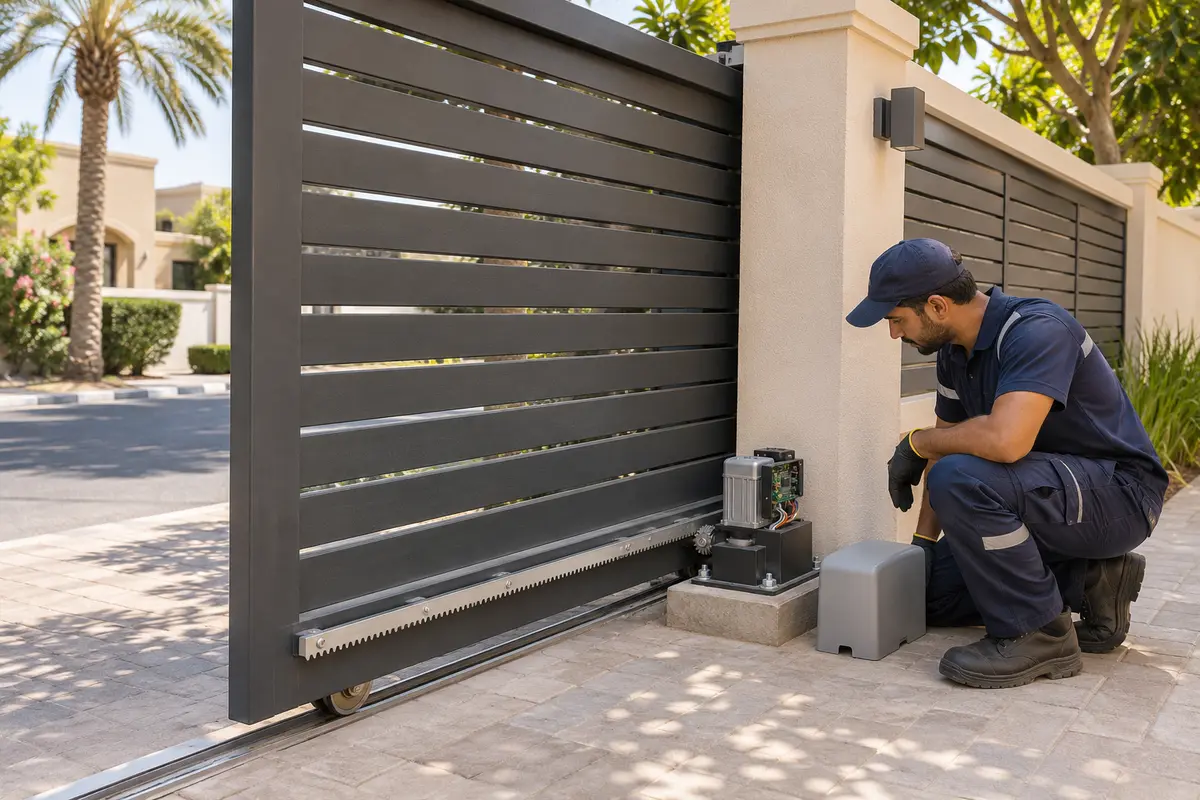
Stand by the motor box, press the remote once, and count. On a Centurion D5-Evo, one of the operators found on Dubai villas, the four-flash collision warning clears as soon as the controller receives the next valid command, so a second press can wipe the clue you came to read.
These patterns come from Centurion's D5-Evo installation manual. The status light repeats its pattern every two seconds, and the buzzer in the motor box gives the matching beeps:
- Two flashes, or two beeps: no mains power is reaching the operator.
- Three flashes, or three beeps: the battery voltage is low. The gate closes fully, then shuts down for two minutes.
- Four flashes, with "Max Collisions" on the display: the gate met resistance more times than the collision counter allows.
- One beep at intervals: a safety beam is broken, or the holiday lockout or emergency stop is on.
- Four or five beeps: the gate stalled, or a hardware fault such as a blown fuse or a disconnected motor. These are a technician's job.
On Nice control units a fault shows as groups of fast flashes on the warning light with a one-second pause, and two flashes means a photocell is blocking the movement. The brand and model are usually printed on the motor cover, and the manual for that model is the reference.
The status LED itself sits on the controller board beside the mains terminals. Do not lift the motor cover to read it while the power is on; Centurion warns that the inside "contains high voltages". Some installers wire a repeat status light to the pillar or the house.
No movement at all: find out which controls still work
Try every way the gate can be opened: a second remote, the keypad on the pillar, the intercom button in the house, the app.
- One remote fails and the others work: that remote. Nice's user instructions say a weak battery shows as a faint or missing light on the transmitter. Borrow the battery from a working remote to confirm.
- No remote works, but the keypad or intercom does: the receiver. Centurion's fault guide lists remotes dropped from its memory, a locked receiver or a faulty one. Re-learning remotes can mean working at the controller under the cover, which makes it a technician's visit.
- The remote works and the app does not: the gate's Wi-Fi controller has lost the network. The boundary wall is often the edge of the house's coverage; see the guide to villa Wi-Fi dead zones.
- Nothing works from anywhere: power, a lockout or the battery first, then a blown fuse or the controller, which are the technician's.
For power, check the gate's breaker on the distribution board, then the isolator switch near the motor; both Centurion and FAAC require one. DEWA reported 0.94 customer minutes lost per customer in 2024, so suspect these before the grid. If the breaker trips again at once, leave it off and call an electrician or the gate technician: the fault is somewhere in the cable, the charger or the operator.
With the power on, look for a lockout. On the D5-Evo an activated holiday-lockout input stops the gate completely and gives one beep at intervals; it is set from a keyswitch or button wired to the controller, and switching that back clears it.
The battery can stop a gate even with the mains on. The D5-Evo's 12 V motor runs from its battery all the time, and the charger only keeps that battery topped up, so a worn one shows as three flashes and a gate that will not move.
If you can hear the motor run or hum and the leaf stays put, look at the manual release first. Centurion's re-engagement step ends with sliding the gate until the drive engages; a release turned back without that slide, or left half-turned after someone moved the gate by hand, leaves the motor turning with nothing to push against. Engage it as described in the release section below. If the release is fully engaged and the motor still runs without moving the gate, the drive between the motor and the rack has failed, and that is a technician's repair.
The gate starts, then stops or reverses
Watch one cycle from the side, clear of the leaf.
It reopens while closing, or will not start to close
Opening works and closing does not: start with the closing photocells, the pair of sensors facing each other across the driveway. Centurion's guide says a broken closing beam leaves the gate unable to close once open, and FAAC's user notes say the safety devices stop it closing while anything is in the area they protect.
Look along the beam for a bin, a pot plant or a parked car's bumper. Wipe both lenses with a soft dry cloth, then check that each sensor still faces the other squarely; a car door or a gardener's trimmer can knock one out of line.
If the beams are clear and lined up and the gate still starts closing, stops and reopens, Centurion's fault guide files that symptom under false collision detection: the gate is meeting resistance, and the push test below finds where. A beam broken only now and then is the other possibility, and a camera covering the gate shows whether a cat or a passer-by crossed it at the moment the gate turned back.
FAAC states that an opening command during closing always reverses the gate, so a remote pressed inside a bag looks like a sensor fault.
It moves a short way in either direction and stops
This is collision sensing: when the gate meets more resistance than the set force allows, the controller stops or reverses it. After a run of these, the D5-Evo shuts down and shows four flashes until the next valid command.
Centurion's own list of causes for a false collision reading is almost all mechanical: something in the track, the rack pressing down on the motor's drive gear, bad rack joints, seized wheels, top guide rollers pinching the leaf, dirt or damage on the rail, and the gate hitting its end stop. The push test below finds which.
Leave the force setting alone. The D5-Evo menu can switch collision sensing off altogether, and Centurion says that level is only for installations with added safety devices such as beams.
A gate that slows and stops part-way, worse in the afternoon or after several trips, points to the battery or to heat; Centurion's fault guide lists a low battery as a cause of a gate that moves a short distance and stops.
It stops short of the end, or runs into the stop
The controller stores the open and closed positions, the limits. The D5-Evo reads them from a magnet bolted to the rack, and the FAAC 740 from steel plates on the rack that trip a switch. If the marker or a plate is knocked or slips, the stopping point moves with it.
Check that they are still where they were, with no fresh scrape or loose bolt. Setting the limits again is done through the controller's setup menu, so leave that to the technician. A gate that stops at the same spot every time while the motor strains has a mechanical problem at that spot.
Release the gate and push it by hand
The manual release takes the motor out of the gate, so you can feel what the motor is fighting. Before you use it:
- Wait until the gate has stopped and nobody, and no car, is in its path. Nice's manual allows the release only on a stationary leaf.
- Switch off the isolator. FAAC's instructions say to cut the power first, so a stray command cannot start the gate during the release.
- If the drive slopes, hold the leaf as you release it. Centurion's installation conditions require a gate that does not move on its own when left in any position; one that rolls away has a track or level fault, so keep your feet clear and stop there.
- Unlock the release with its key and turn or pull it as your operator's manual shows: a thumbwheel on the D5-Evo, a lever on the FAAC 740, a handle on a Nice Robus. Keep your fingers away from the toothed rack and the drive gear.
- Push the gate slowly through its full travel, both ways.
A healthy gate rolls the whole way under a steady push with no tight spot. If it rolls freely, the fault is in the motor, gearbox, board, battery or settings, and the next call is to gate automation technicians who carry parts for your brand.
If it binds at one spot, look there. After a shamal or a dusty week, check first for sand or a stone in the track, where the wind drifts sand against the boundary wall. Then look for a wheel that wobbles or grinds, top rollers squeezing the leaf, a rack joint sitting on the drive gear (Centurion sets 2 to 3 mm of clearance), or a leaf bent by a car. If the post or pillar the gate runs against has moved, the guide to cracks in a villa boundary wall covers the stepped cracks a gate pillar opens.
You can sweep the track and pick stones out. Do not grease the rack: FAAC says no grease or lubricant between rack and drive gear, and grease holds sand. Worn wheels, a damaged track, a sagging rack or a bent leaf are metalwork, and a new motor on a gate that binds trips the same collision sensing.
To re-engage, keep the power off, turn the release back and slide the gate until the gearbox clicks into mesh, then switch the power back on.
Summer heat and the battery inside the box
The D5-Evo is rated for −15°C to +50°C, with its duty cycle quoted at 25°C out of direct sun. FAAC rates the 740 to +55°C and states that direct sun can cut its use frequency, the share of time it may run, to 20%. The National Centre of Meteorology recorded 49°C at Saih Al Salam in Dubai on a July afternoon in 2025, and a motor box in the sun can run hotter than the air around it.
A gate that stops after several trips on a hot afternoon and works again in the evening fits heat: the motor's duty limit or its thermal protection. Put that to the technician, who can check the controller's trip counter.
Heat also ages the battery. Nice's manual for its PS124 backup battery estimates a life of four to six years and warns that at 40°C it could fall to two. How a worn battery shows depends on the operator:
- A 12 V motor that runs from its battery all the time, like the D5-Evo, slows down, stops part-way and signals low battery while the mains is still on. Centurion's test is a technician's meter check: a battery that drops below 11.5 V under motor load needs replacing.
- A mains-powered motor with an optional backup battery works normally every day and fails only in a power cut. Nice warns that on backup the gate may move slowly even when set to high speed.
With so few outages in Dubai, a backup battery can sit dead for years unnoticed. To test it, close the gate with the car on the side you need, switch off the isolator and press the remote. If the gate has a backup and does not move, the battery is the first suspect; a failed charger or loose battery lead gives the same result, so ask the technician to measure it. Switch the isolator back on afterwards.
Test the safety stop before the gate goes back into daily use
Centurion's handover notes ask owners to check the obstruction detection and safety devices every month, and FAAC asks for a technician's check at least every six months. After any reset, run two tests with nobody in the gate's path.
For the beam, start the gate closing and pass a cardboard tube through it close to each sensor; Nice's commissioning test uses a cylinder 5 cm across and 30 cm long. The gate should stop or reverse, as it was set up to do.
For the obstruction, stand an empty cardboard box in the closing path. The gate should stop on contact and back off; the UK Health and Safety Executive says a gate should reverse a short distance, because a gate that only stops can leave someone pinned. Never test with a hand, a foot or a person.
If the gate keeps pushing the box, or ignores the tube, take it out of automatic use: switch off the isolator, release it, close it by hand and keep it on manual. Nice's user instructions say a system with failed safety devices must be repaired as soon as possible, and measuring the impact force to EN 12453 is part of the installer's commissioning. Until then, keep remotes away from children, as FAAC's user rules ask.
Repair the operator or replace it: what the technician should write down
A diagnosis you can compare with a second opinion names:
- the signal pattern the controller was showing, and what was tested;
- the push-test result, and any fix made to the gate itself;
- the battery voltage under load and the charger's output;
- which part failed, its model number, and whether the brand's UAE distributor still supplies it and how soon;
- that the collision force and limits were set again after the repair, and the obstruction test done with you watching.
A battery, a pair of beams, a receiver or a single board on a model the distributor still supports are repairs. A replacement quote is worth asking for when the failed part is no longer made for your operator, when the board and gearbox have both failed, or when the gate is heavier than the operator is rated for; the D5-Evo, for example, is rated for gates up to 500 kg.
A gate jammed open leaves the villa open all night, and one that keeps locking out on collisions wears its gearbox and wheels with every trip. Everlook lists vetted gate automation technicians for the motor, board, battery and sensors, and fence installation and repair crews for worn wheels, a damaged track or a bent leaf, with licences checked and reviews from other villa owners. Post the signal pattern and push-test result with the job, and compare smart home and security pros.
Find your next pro on Everlook
Describe your job once, get quotes from verified UAE contractors. Free, no commitment.
Find your next pro on Everlook
Post a job in minutes and get offers from trusted local contractors. Free to start.
Get started