Nest, Ecobee or Neither? Matching a Smart Thermostat to Your Dubai AC
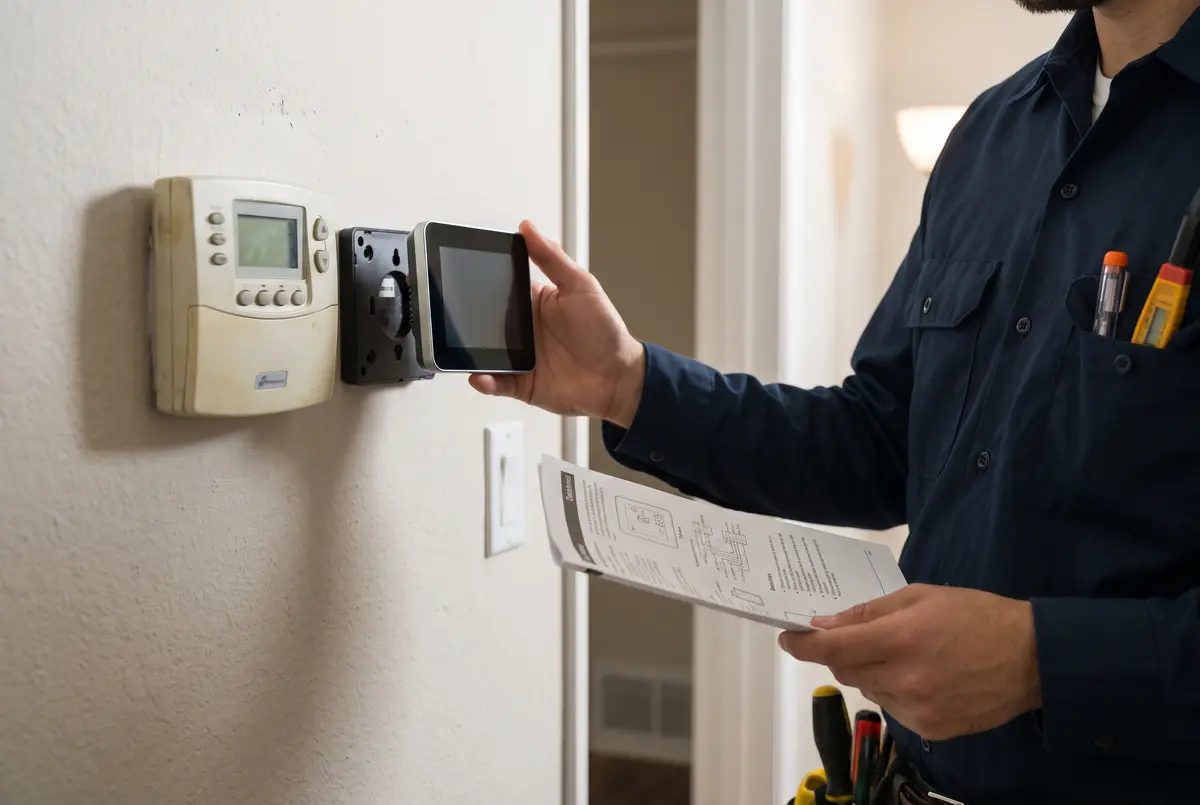
The wiring a Nest, ecobee or T9 is built for
All three can run the AC in a Dubai home in one situation: the controller on the wall is a conventional low-voltage thermostat, with its wires landing on terminals marked R, C, G and Y. Google says Nest thermostats are "designed to work with most 24 V systems". Honeywell's installation guide for the T9 rates its control terminals at 20 to 30 V AC, and ecobee's manual for the ecobee3 lite says it "is not designed for use with line voltage or millivolt heating and cooling systems".
The documents exclude two kinds of system. One is line voltage. Google describes high-voltage thermostats as usually labelled 110, 115, 120 or 240 VAC, and the T9 guide's verdict on a line-voltage system is "Your system is not compatible." The other is proprietary wiring. On Google's compatibility page, terminals labelled 1, 2, 3 or A, B, C, or a system that cools on only two wires, mark a proprietary system, and those "aren't compatible with Google Nest thermostats" unless the maker sells an adapter.
A Nest ordered from a European shop does less again. Google's comparison of its third-generation Learning Thermostats says the European model "controls heating and domestic hot water" through a separate Heat Link box; only the North American model works with 24 V cooling. None of these documents lists a 230 V fan coil among supported systems, and Google's workaround for high voltage, a step-down transformer fitted by a professional, makes the swap a bespoke rewiring job.
Reading your system without taking the controller off the wall
Leave the controller where it is. Thermostats made for chilled-water fan coils are commonly mains-powered: Honeywell's TF228WN, a fan-coil thermostat that fits a standard 86 mm wall box, takes 220 V AC on terminals marked L and N. Google's own advice is that high-voltage thermostats "should only be installed or uninstalled by a professional".
- The bills. A separate cooling invoice from a district cooling provider (Empower, Emicool or the building's billing agent) means chilled water arrives from a central plant. The unit in your ceiling is then a fan coil: a fan blowing across a coil, with a valve that opens when the thermostat calls for cooling. No cooling invoice does not settle it: a chiller-free building puts the cooling in the service charge, and the flat still has a chilled-water fan coil. A DEWA bill that climbs every summer, with no cooling line anywhere, points to a compressor of your own outside: a split, ducted or VRF system. The controller decides.
- The face of the controller. A fan symbol with low, medium and high settings, a temperature and very little else is what fan-coil thermostats look like. A controller carrying an AC maker's name (Daikin, Mitsubishi Electric, LG) is that maker's wired controller. No controller on the wall, only a handheld remote, means a wall-mounted split or a ceiling cassette that listens for infrared.
- The model number. It is often printed on the front or the edge of the controller, or in the handover manual. Search it with the word "datasheet" and read the power supply line: 220 or 230 V AC, or 24 V. If the number is only on the back, leave that for the installer.
- The ceiling and the outdoor units. Long slot grilles and one larger return grille mean a ducted unit above the false ceiling. Ducted tells you only where the unit sits; the bill tells you what cools it. In a villa, one outdoor unit serving indoor units in several rooms, each with the maker's own controller, is a multi-split or VRF system, and here both get the same answer.
Chilled-water fan coils: a Wi-Fi thermostat built for 230 V
What fits a fan coil is a Wi-Fi fan-coil thermostat that does the old one's job at the old one's voltage: one output for the valve and three for the fan speeds. ENGO's EFAN-230 is one documented example: a 230 V AC supply, two- or four-pipe fan coils, 230 V outputs for three fan speeds and the valve, and app control over Wi-Fi. The same maker sells 24 V versions under a similar name, so the voltage on the order has to match the datasheet of the thermostat it replaces.
Two more lines on the old datasheet decide the order: two-pipe or four-pipe, which sets how many valves there are, and on/off or 0–10 V, which sets how the valve is driven.
Fitting it is mains wiring in a wall box, with the circuit isolated at the consumer unit first, so it is a job for an electrician or a smart-home installer who wires fan coils. Have them confirm it fits the existing wall box, and keep the old thermostat in case it has to go back.
The thermostat stays wherever the developer put the old one, and ENGO's, like many, runs on 2.4 GHz. Check the signal at that spot with your phone before buying: a thermostat in a weak patch drops offline, and the fixes for Wi-Fi dead zones in a villa apply to it too.
What a chilled-water building may ask before the old thermostat comes off
Start with whose thermostat it is. Law No. 6 of 2019 on jointly owned property counts the building's main cooling systems among the common parts and excludes from your unit any utility service that serves another unit. On a plain reading, the thermostat and fan coil serving only your flat are yours, and the chilled-water pipes feeding them are not. The building's management regulation, part of your title deed under the same law, can still set rules for what connects to that system, so ask the building's management before ordering.
Ask too whether the room thermostats report to a building management system. Wired, communicating fan-coil thermostats exist for that (Honeywell sells a Modbus version of the TF228WN), and a Wi-Fi swap would cut the building's link to your flat. Where they are linked, the building may refuse the swap or offer remote control of its own.
Buildings have a reason to care how your valve is controlled. Executive Council Resolution No. 6 of 2021, which regulates district cooling in Dubai, lists a surcharge on a low chilled-water temperature difference among the charges a provider can have approved. A valve left open with the fan off sends water back without picking up much heat, which is what that surcharge targets.
The same resolution limits what any thermostat can do for your cooling bill. It requires the bill to show the contracted cooling capacity and its rate separately from the volume consumed and its rate. A schedule can lower the consumption line; the capacity line is fixed by the contract.
If you rent, the swap needs the landlord's written consent first, and the guide to what tenants can install covers the request.
Ducted, multi-split and VRF systems: the maker's own interface
A maker's wired controller talks to its indoor unit over the maker's own control line, often two wires: the proprietary case in Google's list. What fits is the maker's Wi-Fi interface for that indoor unit. Daikin's Onecta app connects through Wi-Fi adapters sold for particular indoor-unit ranges, and Mitsubishi Electric's MELCloud uses its own MAC-series Wi-Fi interfaces. Daikin's Middle East page warns that the features available in the app "can vary depending on the type of system and indoor unit you have".
So the indoor unit's model number, on its nameplate behind the false-ceiling access panel for a ducted unit, chooses the interface. A multi-split or VRF system may take one interface per indoor unit or a central gateway, and the maker's dealer can say which.
The interface plugs into the indoor unit's control board, up a ladder in the ceiling void beside live terminals: an installer's job, with the unit isolated first.
Some ducted units, often those built to North American conventions, are the exception: an ordinary thermostat on 24 V terminals marked R, C, G and Y runs them, the case the Nest, ecobee and T9 are designed for. If the controller's datasheet says 24 V, run the thermostat maker's online compatibility checker and confirm there is a C (common) wire. The T9 requires one, and some Nest installations need one or Google's power connector.
Wall-mounted splits: an infrared controller or the maker's adapter
A wall split with a handheld remote has no wall thermostat to replace. The smart control here is an infrared controller, a small box that learns the remote's signals and sends them across the room. Sensibo's one requirement is that the AC "must have a working infrared remote control". Tado's Smart AC Control asks for more, a remote "that displays the air conditioner's current settings". Without a display, a remote sends one step at a time, and the controller loses track once someone uses the original. Radio-frequency remotes are out too.
This is the one genuine self-install. It runs from a small power adapter, needs a clear line of sight to the indoor unit, and comes away without a mark.
Some wall splits also take the maker's own Wi-Fi adapter, which Daikin, for one, offers for some of its wall-unit ranges; the unit's model number tells the dealer whether yours is one. An adapter connected to the unit reads its state directly, so it cannot drift out of step with the remote. Fitting it means opening the indoor unit with the power off, which puts it with an installer.
A schedule that keeps the humidity down
The obvious schedule switches the AC off whenever the home is empty. In a Dubai summer that also stops the only thing taking moisture out of the air. The Environmental Protection Agency in the United States advises keeping indoor relative humidity below 60%, ideally between 30% and 50%.
A raised setpoint keeps the AC drying the air. Daikin's Middle East guidance, which cites DEWA, suggests around 27°C in place of switching off when you are out for a few hours, and leaving a unit running at around 26 to 27°C for humidity when you are away for days. The utility's everyday recommendation is 24°C, and the other habits that bring a summer bill down are in the guide to a lower summer electricity bill.
All three kinds of smart control can hold a setback for the hours you are out, and those that show humidity tell you whether the room stays under 60%.
Which smart control your AC gets
- A fan-speed thermostat whose datasheet says 220 or 230 V, usually with a cooling bill or a chiller-free service charge: a Wi-Fi fan-coil thermostat at the same voltage, with the same pipe and valve type, fitted by an electrician once the building's management has agreed.
- The same, but the building says the thermostats report to its management system: leave yours on the wall and ask what remote control the building offers.
- An AC maker's name on the controller: that maker's Wi-Fi interface, chosen by the indoor unit's model number and fitted by an installer.
- A conventional thermostat whose datasheet says 24 V: the Nest, ecobee or T9 may fit, once the maker's compatibility checker agrees and the C wire is there.
- Only a handheld remote, with a display: an infrared controller you fit yourself, or the maker's adapter if you want the app to read the unit's state.
- A remote without a display: check the controller maker's compatibility list first; tado's will not work with it.
For a thermostat already in a basket, the deadline is the shop's return window, so find out what is on the wall before the box is opened. Everlook lists vetted smart-home automation installers across the UAE with verified licences and reviews from your neighbours, who can read the datasheet, check with the building and fit the control that matches your system.
Find your next pro on Everlook
Post a job in minutes and get offers from trusted local contractors. Free to start.
Find your next pro on Everlook
Post a job in minutes and get offers from trusted local contractors. Free to start.
Get started
