Soundproofing a Dubai Apartment Starts With Where the Noise Gets In
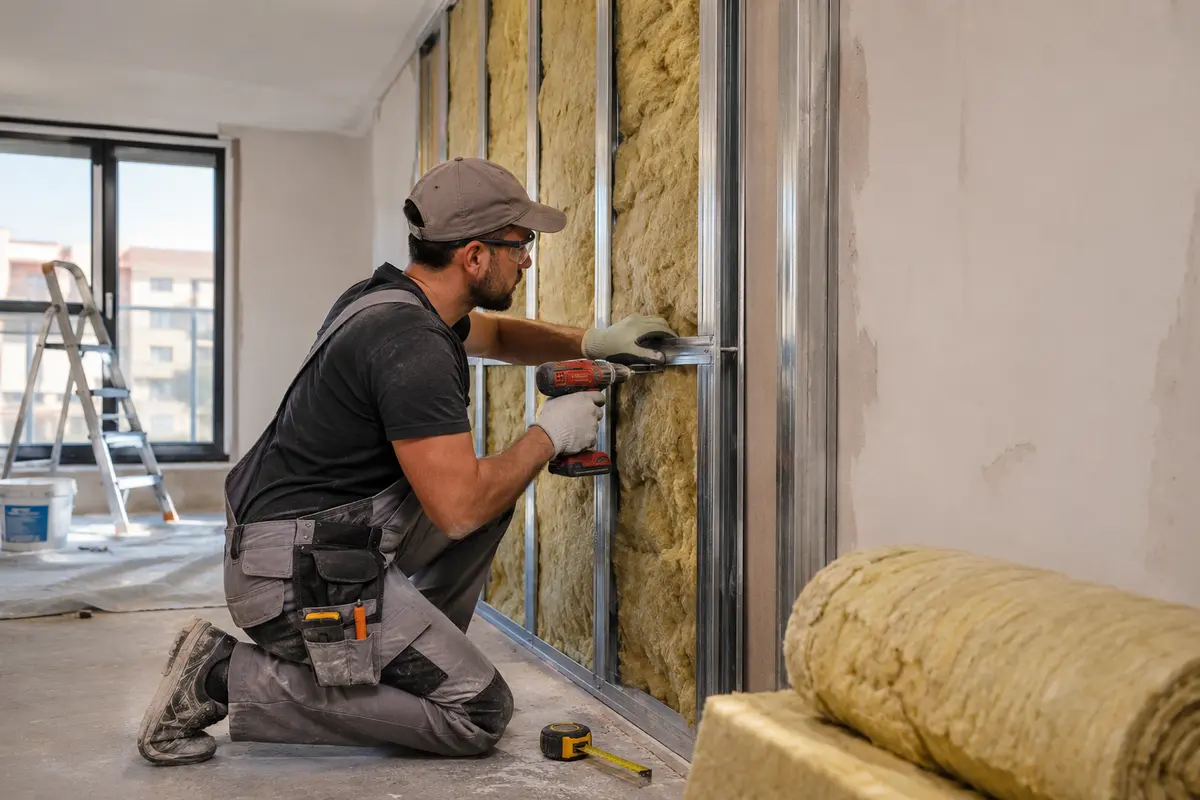
The partition that gained 11 dB without being touched
In a field test written up by a senior acoustic engineer at Ramboll Middle East, the wall between two flats scored DnT,w 40 dB, the on-site measure of how much sound a wall holds back between two real rooms. Only one thing changed before the second test: the hollow aluminium mullion, the upright of the façade frame that the partition ran into, was covered with plasterboard and insulation. The reading rose to 51 dB, and the engineer reported the perceived loudness almost halved.
So trace the route first. A lining on the wrong wall costs room depth and leaves the sound arriving as before, and under Dubai's jointly owned property law part of that route may belong to the building.
Decibels need a yardstick. Federal Highway Administration guidance in the United States treats a 3 dB change as barely perceptible, 5 dB as readily perceptible and 10 dB as half as loud.
Sort the noise by what made it, then trace how it reaches you
Airborne noise starts in the air: voices, a television, road traffic. Mass, a second layer standing clear of the first, and airtightness all work against it.
Impact noise starts with a blow to the building: footsteps, a dragged chair, a slammed door. It runs through the slab and walls, and it is easiest to stop where it lands. A steady hum from lifts or pumps travels the same way, from the building's own plant.
Wait for the noise, or ask someone to make it, and listen at each of these in turn:
- Mid-height on the party wall, then beside a socket on it. If the socket is clearly louder, the back box or a gap behind it is a likely path. Listen only: leave the faceplate on.
- Along the ceiling line, and at the AC or bathroom extract grille. Speech that is clearer there points to the ceiling void or a shared duct.
- Where the party wall meets the window. A clear voice at that corner points to the mullion case above.
- At the window frame with everything shut. Road and construction noise that is strongest at the glass and fades as you step back is most likely coming through the window.
- At the foot of the front door. Hold a rolled towel against the gap for a minute. If corridor voices drop, the door perimeter is a path. Take the towel away afterwards.
A crack or an open joint can be a sound path in its own right, and the guide to which wall cracks matter sorts those from movement. These checks narrow the field. They are observations, and only a site test by an acoustic consultant confirms a path.
What each fix buys, and what it takes from the room
Each option below answers the same five questions, so you can set them side by side.
An independent lining on the party wall
- Noise it answers: airborne sound through that wall. It leaves sound arriving by the ceiling, the façade or a duct as it was.
- Likely gain: British Gypsum lists a 100 mm plastered block wall with its lining at Rw 60 in the laboratory. That score covers wall and lining together, so the gain depends on what your wall scores before the work: ask for the system's report. Rw is a laboratory score, and a site figure normally comes in lower.
- Depth lost: about 60 mm on the British Gypsum build-up (a 35 mm cavity and two boards), more on a deeper frame.
- What goes wrong: UK guidance, Approved Document E, which a trade article on Dubai façade acoustics says the UAE follows, wants at least two layers of plasterboard, the frame at least 10 mm clear of the wall, 35 mm of mineral wool left uncompressed, and the perimeter sealed. It accepts a lining on one side only where the existing wall is plastered masonry at least 100 mm thick. A drywall party wall needs both faces treated, and one of those is your neighbour's.
- Approval: the party wall is the sticking point, covered below. A drywall installation crew should be able to show you the system before anyone orders board.
An independent ceiling under the flat above
- Noise it answers: airborne sound from above, and part of the impact noise.
- Likely gain: no tested figure for a Dubai retrofit could be found, so ask for the system's report. Approved Document E warns that wall linings may be needed as well, because the side walls keep carrying vibration, so expect footsteps reduced and still audible.
- Depth lost: at least 125 mm between the new ceiling and the slab, plus two boards. A false ceiling with its own problems should be sorted before it is covered or replaced.
- What goes wrong: any rigid connection to the slab short-circuits the isolation. Joists fixed only to the surrounding walls avoid the slab entirely, which is workable on shorter spans.
- Approval: hangers drilled into the slab need the building's consent and a scan first.
Treating the floor above
- Noise it answers: footsteps and dragged furniture, at the point they start.
- Likely gain: research from Canada's National Research Council found tile bonded straight to concrete adds nothing to the slab's impact performance, so the gain comes from a cushion or a floating floor. The UK benchmark for a soft covering is a resilient layer of at least 4.5 mm, or a tested reduction (ΔLw) of 17 dB or more.
- Depth lost: a few millimetres for a rug or underlay, more for a floating floor, with door bottoms and thresholds to adjust.
- What goes wrong: tile laid straight back on the slab keeps the problem. If you are the one above, rugs and underlay are yours to fit today, and a floating floor suits a hard finish. If you are the one below, the conversation starts with your neighbour.
- Approval: no Dubai-wide rule requiring acoustic underlay could be traced, though some building and community rules restrict floor finishes. Emaar's 2022 home-modification sheet listed removing existing tiles as not permitted in its apartments, with new tiles over the existing ones as the exception, so ask before planning around a new subfloor.
Secondary glazing or laminated replacement units
- Noise it answers: road, construction and aircraft noise, which usually enters through the glass.
- Likely gain: ordinary 6/12/6 double glazing gives about 32 dB. Pilkington lists a sealed unit of 6 mm glass, a 16 mm argon cavity and its 6.8 mm acoustic laminate at Rw 40, and notes that sealed-unit cavities between 6 and 16 mm make little difference. Selectaglaze's interpolated data for 6.4 mm laminated glass behind a 6 mm pane runs from Rw 38 to 41 at a 50 mm gap, 42 to 45 at 100 mm and 44 to 47 at 150 mm. Moving from 50 mm to 100 mm is worth about 4 dB, and swapping that glass for an acoustic laminate about 1 dB. Those tests pair single panes, and your existing window may be a double-glazed unit, so ask for a figure on your own glass.
- Depth lost: none for replacement units, while secondary glazing needs a window recess (the reveal) or sill that takes the frame at that gap.
- What goes wrong: seals. Selectaglaze says even a 1% opening can cost up to 10 dB.
- Approval: replacement units change the façade, so expect a formal process through the building. Secondary glazing sits inside the existing frame, but Law No. 6 of 2019 treats windows in external walls as common parts unless the site plan says otherwise, so ask about both. Door and window specialists can check both against your frame.
Seals on a front door that is probably fire-rated
- Noise it answers: corridor voices, lift lobby noise, the neighbour's door.
- Likely gain: no tested figure for adding seals to a fire door could be found, so the towel test above is your best guide. Approved Document E asks for good perimeter sealing, including the threshold where practical, on a door of at least Rw 29.
- Depth lost: none.
- What goes wrong: a fire door is a tested assembly of leaf, frame, hardware and seals, and UK guidance warns that site alterations can negate its certification. A Dubai Civil Defence review document circulated online lists a one-hour fire separation between residential units and corridors. Foam strip stuck over the seal that swells in a fire (an intumescent strip), or a routed-in drop seal, is exactly the kind of change to check first.
- Approval: ask the management company for the door's certificate and which seals it allows, and let the door's maker or the building's fire consultant confirm the rest.
Foam panels, paint and "soundproof" wallpaper
National Research Council work puts the gain from doubling the mass of a single layer at about 6 dB. A foam panel or a thick coating might add a kilo or two per square metre to a block wall weighing about 200 kg per square metre, which works out at a fraction of a decibel. Foam and egg boxes soak up echo inside your own room, and gypsum makers class that as a separate job from stopping sound passing through.
Makers of "sound-deadening" paint cite laboratory reports, but no published figure could be found showing a useful change on a masonry wall.
Wallpaper sold as soundproof has the same mass problem, and on an outside wall a vinyl face brings a damp and mould risk of its own.
Before anything is fixed to the wall or the slab
Law No. 6 of 2019 puts non-load-bearing internal walls inside your unit unless the site plan says otherwise. Structural elements and the façade are common parts, ventilation ducts serving the building are too, and a dividing wall that forms part of the common parts is shared with the neighbour. Substantial changes to the structure or external appearance need prior approval from the master developer, the Dubai Land Department and the competent authority.
The first desk is the management company or developer, working under RERA's oversight, then Dubai Municipality, Trakhees or the Dubai Development Authority depending on the area. Rules vary by building, so get the answer in writing. The guide to approvals in the right order covers the sequence.
Three further checks belong in that conversation:
- The slab. Many towers have post-tensioned slabs, with steel tendons held under high tension. Drilling can damage a tendon, and engineers routinely require a scan first because drawn positions can be out by several centimetres. Do not drill the soffit, the underside of the slab, yourself, even for one hanger.
- Fire lines. The same document calls for rated seals at penetrations through fire barriers, so a new cable or duct through a rated wall or riser needs a matching firestop.
- The AC and the outside wall. Fan-coil and duct access panels have to survive a new ceiling. On an outside wall, guidance from the United States Department of Energy for hot, humid climates warns against vapour-tight layers on the room side of an insulated, air-conditioned wall, because moisture can condense behind them. That rules out foil-backed board there, and road noise usually enters through the glass in any case.
The fix each situation points to
- Voices through a plastered block party wall, loudest at mid-height: seal gaps and treat sockets, then fit an independent lining if the remaining noise justifies 60 mm of room.
- Same noise, but the wall is drywall or unknown: get the build-up from the as-built drawings before paying for a one-sided lining.
- Clearest at the window corner, ceiling line or a grille: leave the wall alone and treat that path, starting with a question to the building about the mullion or duct.
- Footsteps from upstairs: start with the owner above. Consider an independent ceiling only if the room can spare 150 mm and you accept a partial result.
- Road or construction noise: secondary glazing where the reveal allows about 100 mm, laminated replacement units through the building's approval where it does not.
- Corridor noise: perimeter seals the door's certificate allows.
- A hum from lifts or pumps: this is building plant, so report it to the management company, which can reach the source.
- Renting: keep to measures that come away without a mark, such as rugs if you are the source of the noise, or a removable magnetic inner pane, and get your landlord's written consent for anything fixed.
What the quote has to say before "soundproofing" means anything
"100% soundproof" has no test behind it. Sound insulation is reported as a reduction in decibels, and sound taking other routes around a wall caps what that wall can deliver. Ask for these lines instead, modelled on a British Gypsum system sheet:
- The tested system by name, its report, and the background wall it was tested on.
- Frame type, gap from the existing wall, and how the frame stays isolated from floor, ceiling and side walls.
- Board type and layers, and insulation density and thickness.
- Perimeter sealing, in writing, as a line item.
- Sockets and back boxes: none back to back, no deep chases into the party wall.
- Depth lost from the room, in millimetres.
- Access panels kept for the fan coil and duct.
- Who secures approvals and any soffit scan, and who firestops penetrations.
If you want a number written in, ask for a site figure (DnT,w) measured by an acoustic consultant, since the UK yardstick for new flats is 45 dB on that measure, adjusted for low-frequency noise. A phone app will not settle it: in NIOSH testing of 10 shortlisted iPhone apps, only three on each frequency weighting averaged within 2 dB of a professional meter, and that testing started at 65 dB, louder than most noise that comes through a wall. An app's error can match the 3 dB you are trying to detect, so treat any reading as a rough guide.
Finding a contractor in Dubai who knows a post-tensioned soffit from a plain one, and a fire-rated door from an ordinary one, is harder than it sounds. Everlook surfaces drywall installers and door and window specialists with verified UAE experience and reviews from your neighbours.
Find your next pro on Everlook
Post a job in minutes and get offers from trusted local contractors. Free to start.
Find your next pro on Everlook
Post a job in minutes and get offers from trusted local contractors. Free to start.
Get started
