Read a Dull, Etched or Scratched Marble Floor Before You Book a Polish
Check that the floor is calcite marble at all
Crystallisers and marble polishing powders work by reacting with calcium carbonate, the mineral calcite that marble, limestone and travertine are made of. Granite has very little of it, and porcelain has none. So settle the material before anyone quotes for marble floor polishing.
Start with paper. The developer's finishes schedule, the specification attached to the sale agreement or the handover pack normally names the floor finish, sometimes down to the product. If the developer or a previous owner left spare tiles for repairs, one of those is the safest thing to test.
Then look at the floor. None of these signs proves the material on its own:
- Veins that come back. Marble-look porcelain carries a printed design, and on many products the same vein shape turns up again a few tiles along. Quarried stone does not repeat.
- A chip at a threshold or a cut edge by the skirting. A plain, differently coloured body under a patterned face points to glazed porcelain. A chip that matches the face settles less, because some porcelain is coloured all the way through.
- Separate flecks of crystal with little veining. The Marble Institute of America's care guide gives this as the usual look of granite, and veined, fine-textured stone as the usual look of marble.
- Angular chips of stone in an even background. This is often engineered (agglomerate) marble: crushed stone held in resin. Its face reacts like marble, but strong alkaline strippers can attack the resin and turn dark stone white.
The test that settles it is a drop of acid. The same guide, published by the body now called the Natural Stone Institute, puts a few drops of household vinegar or diluted muriatic acid on an out-of-the-way spot. Calcareous stone bubbles or fizzes. Siliceous stone, such as granite, shows little or no reaction.
Do it on a spare tile, with vinegar. On the floor itself the drop can leave a permanent dull spot, which is why the guide sends you to a corner or a closet. Leave muriatic acid alone: it is corrosive, and vinegar answers the question. Rinse with clean water and wipe dry afterwards.
A drop that does nothing on a shiny floor proves less than it seems. A sealer, wax or coating can keep the acid off the stone, and the guide's answer is to test a freshly broken surface, which on a finished floor means the spare tile again. With no spare tile, leave the acid test to the contractor, and ask in the quote how they identified the stone.
- It fizzed: marble, limestone or travertine. Everything below applies.
- No fizz, visible crystals: granite or another siliceous stone. Diamond polishing works on it. Crystallisation is the wrong chemistry, and an acid ring is much less likely.
- No fizz, printed look: porcelain. There is nothing to hone or crystallise. A deep clean restores what cleaning can, and a chipped or cracked tile is a replacement job.
When the shine is a film on top of the stone
Some floors sold as "polished" are coated. A wax or acrylic floor finish makes its own gloss, and it wears the way a film wears: thinnest where feet go, intact along the skirting and under the furniture.
- The edges of the room look glossier and a little amber, and the middle looks grey.
- At doorways and under chair legs the shine scuffs white or comes away in flakes.
- In a hidden corner, a fingernail drawn firmly across the surface leaves a mark in the shine. Calcite rates 3 on the Mohs hardness scale, harder than a fingernail, so a nail mark means something softer is sitting on top.
Wax and acrylic coatings yellow and hold dirt as they age. Once a coating has yellowed, buffing it brings back only the coating. The fix is stripping, and the stone underneath will look dull once the film is off, because the coating was covering a worn polish. A coated floor is two jobs: strip, then hone and polish.
Crystallisation, covered in the next section, leaves a layer that cannot be stripped. On a floor crystallised for years, the crystallised layer itself comes off only with diamond abrasives.
Dull lanes between the door, the sofa and the kitchen
A matt path that follows the way people walk, with the shine still there under the rug and along the walls, is usually wear: a mass of fine scratches scattering the light. Hold a phone torch almost flat to the floor across the lane. Wear shows as an even haze of short scratches running every way.
Grit does most of it. Quartz, the main mineral in most sand, rates 7 on the Mohs scale against calcite's 3, so the sand carried in on shoes, and the dust a shamal pushes under balcony doors, scratch marble the way fine sandpaper would. The Marble Institute of America guide names sand, dirt and grit as what does the most damage to stone floors, and reckons a person takes about eight steps to shed it from their shoes. That is the case for a mat on both sides of the door.
Wear this shallow is within reach of the lightest treatments: a polishing compound buffed in by machine, a fine diamond polishing pad, or crystallisation.
Crystallisation (also sold as vitrification) means spraying an acidic liquid, usually containing a fluorosilicate, onto the floor and buffing it with steel wool under a heavy single-disc machine. The acid dissolves a thin skin of calcite, and the fluorosilicate combines with the freed calcium to form calcium fluorosilicate, a harder and glossier surface layer. Crystallisers are made for calcium-based stone such as marble, limestone and terrazzo.
What it does not do matters as much for a quote:
- It works only on polished stone. Distributor guidance on the process says outright that it is not for honed, non-reflective surfaces.
- It reaches only microns down. It is a maintenance process for light traffic wear. Pushing it at deeper scratches builds up the surface without removing them, and that damage needs diamond abrasives.
- It cannot be undone chemically. The altered layer is now part of the stone, and only diamond honing takes it off.
- Some products contain wax, which builds up with repeated use until an alkaline cleaner or diamonds take it off.
- Steel wool sheds fibres that rust if they are left on the floor, which marks light stone.
Stone-care professionals still argue over the process. For a polished calcite floor with light, even wear, it is one reasonable option among several.
Rings and spots where something was spilled or splashed
Look at the mark at a low angle, and then for colour.
- An etch is dull, often a little paler, the same colour as the stone around it, and shaped like whatever touched it: the base of a glass, a run of drips, a splash. Acid has dissolved the polished surface, so on a polished floor it can feel very slightly rough under a fingertip.
- A stain is colour inside the stone: darker where oil soaked in, brown or orange from coffee or rust. The shine above it can be intact.
- Both at once happens too. Some liquids etch the surface and stain the stone beneath it.
The Natural Stone Institute's stone care guidance lists the usual culprits: lemon, vinegar and other acids, which dull or etch calcareous stone. Rust removers and toilet bowl cleaners can contain traces of hydrofluoric acid, which attacks every stone, granite and quartzite included. Bathrooms collect both. The white scale on shower glass and around the shattaf gets scrubbed with acidic descalers, and the drips land on the floor.
Shallow etches on polished marble come out with marble polishing powder worked in with a damp pad or a low-speed polisher until the mark goes. Deep etches need honing, the diamond work described in the next section. A stain needs a poultice, a paste that draws the colour back out of the stone, and no amount of polishing touches it.
Sealing is where quotes most often overpromise. Penetrating sealers sit in the stone's pores and repel liquids, which makes the stone more stain resistant without making it stain proof. Acid reacts with the calcite at the surface, above the pores, so a freshly sealed marble floor etches just as readily as an unsealed one. Sealing after polishing is sensible protection against stains. A sealer offered as protection against lemon juice or bathroom cleaner will disappoint.
Scratches a fingernail catches, and tile edges that stand proud
Run a fingernail across the scratch. If the nail catches, the scratch goes deeper than polishing powder or a crystalliser can reach, and the remedy is honing: a machine running diamond pads with water, starting at a grit coarse enough to cut below the bottom of the scratch, then moving through finer grits, each one removing the marks left by the last, until the floor is ready to polish. The Marble Institute of America guide sends deeper scratches and nicks to a professional for exactly this reason. This is the core work of flooring repair and refinishing contractors who handle stone.
Now check the joints. Slide a coin across from one tile to the next at several points in the room. Where it catches on a raised edge, the floor has lippage, the stone industry's word for one tile sitting higher than its neighbour. Polishing pads follow the surface up and over those steps, so they leave lippage exactly as it was. Only grinding takes it out.
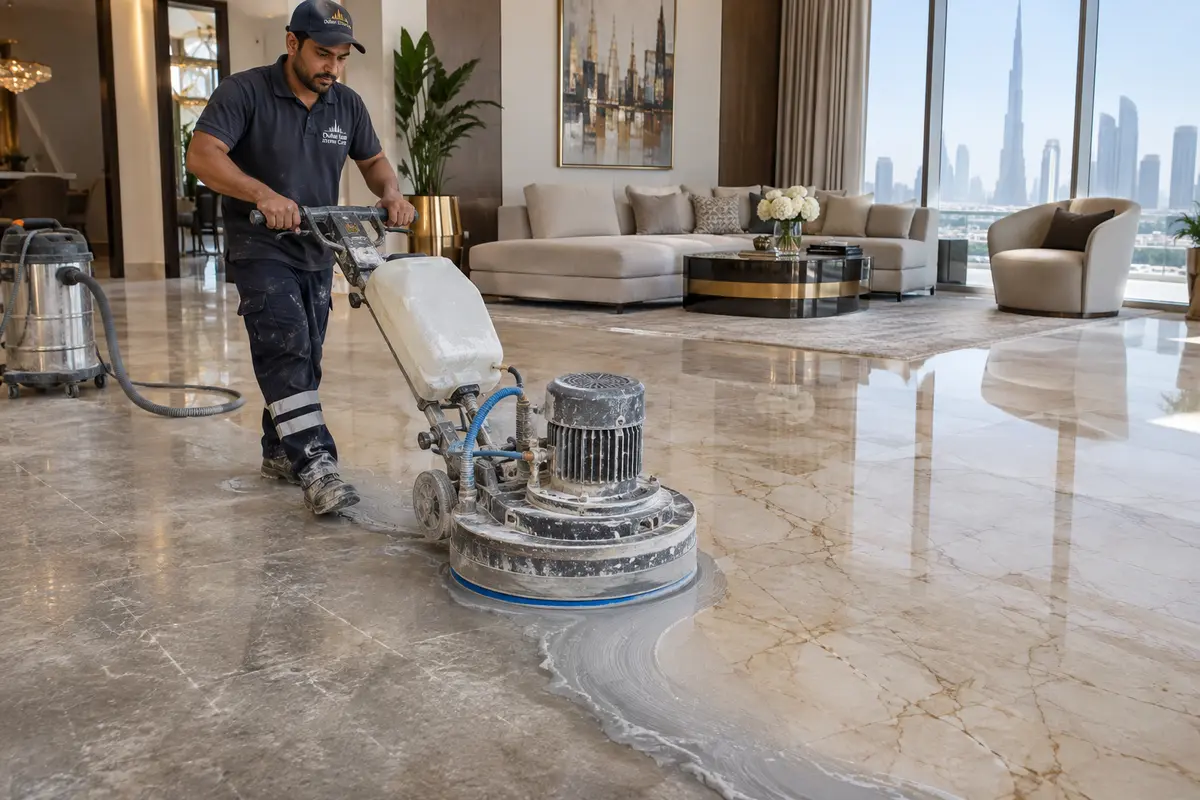
Grinding flat means coarse metal-bonded diamonds taking the high edges down until the whole floor is one plane. Restoration practitioners commonly start somewhere around 30 to 50 grit for lippage, then work up through resin-bonded diamonds into the hundreds to hone, and on to fine grits in the low thousands for a polish. A quote that claims to fix lippage but starts at a fine grit is describing a polish.
What grinding asks of you:
- Each room is emptied of furniture, and the room stays out of use until the final grit is done.
- The machines run with water, so the floor is covered in grey slurry that is wet-vacuumed and rinsed as the work goes on. Skirting, kitchen plinths and door frames need masking.
- Edges and corners the big machine cannot reach are done with a hand grinder. Ask how they will match the edges to the middle.
- Ask how many days each room will take, and get it in writing.
In an apartment tower, ask building management before you book what it requires for loud, wet work: whether the contractor needs a permit, which hours the machines may run, and where the slurry may go. Rules differ from one building to the next, so get the answer from yours and pass it to the contractor.
Some floors should not be ground at all. A tile that is cracked, or sounds hollow when tapped, is loose from its bed, and a heavy grinder can break it further. That is a fault of the bed and the bond, covered in the guide to hollow and cracked floor tiles.
Loose or cracked tiles get cut out and replaced first, through tile repair and restoration, and matching old stone can take some searching. Grinding also takes stone off the face each time, so a thin tile or a floor ground many times before leaves less to work with.
When many tiles have failed, or the floor would need grinding just to look ordinary, it may make more sense to cover it. Tiling over an existing floor has its own conditions, starting with every old tile still being bonded.
Setting your findings against the quote in hand
- Porcelain: a deep clean. Chipped or cracked tiles go to tile repair.
- A coating: stripping, then honing and polishing the stone underneath.
- An even haze in the traffic lanes, nothing a nail catches: a machine polish with compound or fine diamonds, or crystallisation if the stone is polished calcite.
- Shallow etch rings: polishing powder on the marks.
- Deep etches or nail-catching scratches: diamond honing from a coarse grit, then polishing. A honed patch can look different from the floor around it, so ask whether the contractor plans to do the whole room.
- Stains: a poultice, then a penetrating sealer.
- Lippage: a full grind, then the whole grit sequence.
- Cracked or hollow tiles: replacement before any machine goes over the floor.
Then put five questions to whoever quotes. What stone do they think it is, and how did they check? Which process are they pricing: polishing powder, crystalliser or diamond pads, and if diamonds, from which grit? Is there a coating, and how does it come off? Will bathrooms and the entrance be polished or honed? The Marble Institute of America guide describes honed as the finish generally preferred for floors and thresholds where heavy traffic would wear a polish away, and a bathroom floor also takes water from the shower and the hand spray every day. Finally, which sealer, and what is it meant to protect against?
Quotes for marble floor polishing vary widely across Dubai, mostly because companies looking at the same floor can be pricing different jobs: one a crystalliser pass, another a strip and re-hone, a third a full grind from coarse diamonds. Everlook lets you compare offers from licensed UAE stone floor restoration contractors side by side, so you can ask each one to write its process down before you commit, with no obligation.
Find your next pro on Everlook
Compare licensed contractors in your area in under a minute. Free to post, no signup needed to browse.
Find your next pro on Everlook
Post a job in minutes and get offers from trusted local contractors. Free to start.
Get started
