Why Does Your Circuit Breaker Keep Tripping in Your Dubai Apartment?
First, check these in 60 seconds
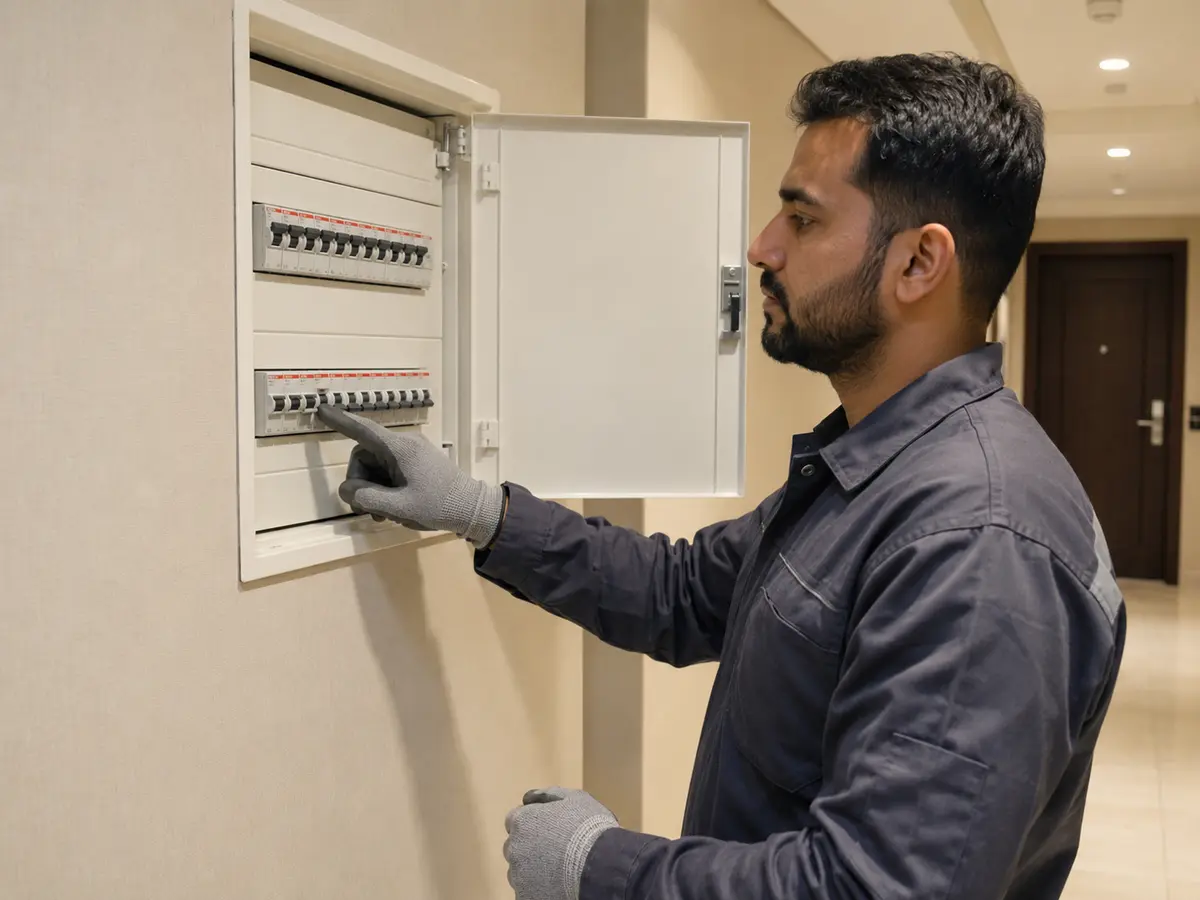
Power has just cut out and you want it back. Before you touch anything, find the consumer-unit panel — the grey box of switches usually inside the entrance cupboard or near the kitchen — and look at which device has actually moved.
Three things can trip. The main switch cuts the whole apartment. An individual MCB (miniature circuit breaker) protects one circuit, so only those sockets or that room go dead. The RCD or ELCB (the earth-leakage device) sits over several circuits at once, so a wider group drops together. Note which one flipped before you reset.
The safe reset is simple. Push the tripped switch fully to OFF first, then back to ON. If it snaps straight back to OFF, stop. A device that refuses to stay on is telling you the fault is still live, and forcing it is how a nuisance becomes a hazard.
The three reasons a breaker trips
A breaker does not trip for no reason. It is a safety device doing exactly one of three jobs, and knowing which one narrows the whole problem.
Overload: too much on one circuit
This is the classic summer trip. Across the UAE's hottest months, multiple split-AC units run for hours alongside the kettle, oven, and washing machine, and an older breaker panel was never sized for that combined draw. The circuit carries more current than its rating allows, heat builds in the breaker, and it trips to protect the wiring.
The tell is timing. An overload trips a few minutes after the load goes on, not the instant you reset, and it usually traces back to one obvious moment: the AC compressor cutting in while the oven is already running.
Short circuit: an instant trip
A short circuit trips immediately and hard, often with a small pop or scorch mark at a socket. Live and neutral touch directly somewhere they should not, typically inside a faulty appliance or a damaged flex on a cheap extension lead. If the breaker drops the moment you switch on a specific appliance, treat that appliance as the suspect and leave it unplugged.
Earth leakage: the shock-risk signal
When the RCD trips rather than a single MCB, current is leaking to earth. As little as 30mA of leakage will trip it, because that device exists to protect against electrocution and fire, not just to save the wiring. In a humid Dubai summer the common trigger is moisture ingress into an outdoor socket, a bathroom fitting, or the panel itself, or a slowly failing appliance element. Electrical Safety First is blunt about this one: a repeatedly tripping RCD means a real fault in either an appliance or the wiring, and it needs a registered electrician to investigate. This is not a nuisance trip to reset and forget.
How to find the appliance or circuit at fault
Once power is back on the healthy circuits, you can hunt the offender without any tools. The method is the same one electricians use, just slower.
Start with the dead circuit. Unplug everything on it and switch off every socket. Reset the breaker. If it now holds, the wiring is fine and an appliance is the problem — plug them back in one at a time, waiting a moment after each, and the breaker will drop again on the faulty one. The last thing you reconnected is your culprit.
For an RCD that covers several circuits, work at the panel instead. Switch the RCD and all its MCBs off, switch the RCD back on, then flip the MCBs on one by one. The RCD will trip again at the faulty circuit, telling you which room or run to focus on.
Now read the result. A circuit that holds with nothing plugged in and only trips once appliances and AC load come on is an overload story — manageable by spreading the load. A circuit that trips the instant you reset it with everything unplugged has a fault in the fixed wiring itself, and that is no longer a DIY job.
When the AC is quietly to blame
A split AC is the heaviest single thing on most apartment circuits, and a struggling one draws even more. A clogged filter or a fouled coil chokes airflow, so the compressor works harder and pulls extra current every cycle, enough to nudge an already-loaded circuit over its limit on a 40-plus-degree afternoon.
There is also the start-up surge. Each time a split-AC compressor kicks in it produces a brief capacitive inrush, a current spike far above its running draw, and on a marginal circuit that spike is often the exact moment the breaker lets go.
If your trips line up with the AC cycling, the fix may sit on the cooling side rather than the panel. Keeping filters clean and the unit serviced reduces the current it demands, and this AC maintenance schedule for UAE homes sets sensible intervals to work from. A breaker that only ever trips when a healthy, recently serviced AC starts up, though, points back at the circuit rating, not the cooling.
What the supply itself is doing
It helps to know the baseline. DEWA delivers a nominal 230V single-phase supply at 50Hz to apartments, and every fixed installation behind your meter is meant to comply with recognised IEC and BS standards. Your circuits and their breakers were rated against that standard for the loads the building was designed around.
The catch is age. Buildings handed over 10 to 15 years ago were wired for fewer appliances than a modern household runs, and the original consumer-unit panel reflects that. Add high-BTU ACs, an induction hob, and a tumble dryer to a panel from that era and repeated trips are less a fault than the system telling you it is at capacity, which is itself a reason for a professional assessment, not constant resetting.
What needs a licensed electrician
Some signs mean you stop diagnosing and call a professional straight away. Treat any of the following as a hard cutoff.
A breaker that will not reset, or an RCD that trips the instant you switch it back on, means a live fault you cannot see. So does any burning or hot-plastic smell, a socket or switch plate that feels warm or looks discoloured, or scorch marks around an outlet. Repeated trips with no appliance you can pin down belong in the same category.
The reason is regulatory as much as practical. Opening up the panel or the fixed wiring is work DEWA reserves for an approved contractor whose electrician holds a valid Competency Licence, and a municipal licensing framework sits behind that. A licensed electrician will confirm the fault, and resist the urge to swap a breaker for a higher-rated one yourself. A bigger breaker on the same old wiring removes the protection rather than fixing the cause.
If you are weighing up the warning signs more broadly, these signs your home needs an electrical inspection cover the wider picture.
A short guide to hiring a trade without getting scammed helps you pick a contractor well.
When you are ready to book, Everlook's licensed electrical services connect you with vetted contractors.
Frequently asked questions
Why does my circuit breaker keep tripping in summer?
Summer load is the usual answer. Several split ACs running for hours alongside kitchen appliances push a circuit past its rating, and the breaker trips to protect the wiring. A fouled AC coil or clogged filter makes the compressor draw even more, tipping a marginal circuit over. If trips track the AC cycling, the cooling side is worth checking before the panel.
Is it safe to keep resetting a tripped breaker?
Resetting once is fine; repeatedly forcing it is not. A breaker that trips again the moment you reset it, especially an RCD, is signalling a live fault, and overriding it removes your protection against fire and shock. Reset it once. If it will not hold, stop and have a licensed electrician find the cause rather than fighting the switch.
How do I find which appliance is tripping the breaker?
Unplug everything on the dead circuit, reset the breaker, then reconnect appliances one at a time. The breaker will trip again on the faulty one, and the last item you plugged in is the suspect. Leave it unplugged. If the circuit trips with nothing connected at all, the fault is in the fixed wiring and needs a professional.
Who pays for electrical repairs in a Dubai rental?
Fixed wiring and the breaker panel are usually the landlord's responsibility, as they form part of the property's structure, while a faulty appliance you own is yours. Many tenancy contracts set a minor-maintenance threshold the tenant covers. Check your contract, report panel or wiring faults to the landlord or facilities management in writing, and keep the record.
Can I replace a tripping breaker myself in Dubai?
No. Work inside the panel or on fixed wiring is reserved for an approved contractor whose electrician holds a valid Competency Licence. Beyond the legal point, swapping in a higher-rated breaker to stop the trips defeats the safety it provides on wiring that was never sized for the larger current. Diagnosing which appliance is at fault is safe DIY; the panel is not.
Booking an electrician on Everlook
Quotes for tracing a tripping circuit vary widely across Dubai: how old the breaker panel is, whether the fault is an appliance or the fixed wiring, and how urgent the callout is all push the number. Everlook lets you compare offers from licensed UAE electricians side-by-side before you commit, with no obligation.
Find your next pro on Everlook
Post a job in minutes and get offers from trusted local contractors. Free to start.
Find your next pro on Everlook
Post a job in minutes and get offers from trusted local contractors. Free to start.
Get started