What to Do When a Villa Roof Leaks While It Is Still Raining
Switch off the wet circuits before you look for the leak
Go to the distribution board (DB) and switch off the breaker for any light, fan or socket that water is running near or into. If the labels do not tell you which one it is, or water is reaching the board itself, switch off the main isolator and carry on by torch. Do not touch a wet fitting, switch or plug to see whether it still works.
Water dripping out of a downlight has found its way along the cable or through the hole cut for the fitting, and some of it may have come down a conduit from the roof. DEWA's rainy-season advice asks owners to close spare cable openings and conduits on rooftops for exactly that reason. Leave that circuit off until an electrician has checked it once everything is dry.
Then contain the water. Put buckets under each drip, move electronics and furniture out of the way, lift rugs, and lay towels where water runs down a stair, because a wet stone tread is easy to slip on in the dark.
A gypsum false ceiling that is bulging is holding water and can let go all at once. Keep people out from under it. Draining it with a single small hole is possible in a controlled way, and the method and its limits are in the guide to a sagging, water-stained false ceiling; skip it if the bulge is next to a light fitting or the board is already cracking.
Stay off the roof while it rains. A wet membrane or tile is slippery, standing water hides outlets and edges, and a low villa parapet will not stop a fall. Call Dubai Civil Defence on 997 if a ceiling has come down, if you see sparking or smell burning that the breakers do not stop, or if cracks are opening across a ceiling. DEWA's 991 line is for faults in the power and water supply.
The minutes between the first rain and the first drip
Write down two times: when the rain started, and when the first drip appeared. The first photo you took of the rain, or the weather app's history, gives you the first. The gap between them is one of the most useful observations you can hand a roofer, because different routes in take different amounts of water to open.
- Within minutes of the rain starting, before the roof could have flooded, the water probably found a short, direct route: an open joint in the parapet coping, a crack in the parapet render, the head of a window, or a cable or pipe entry.
- After an hour or more of heavy rain, the pattern fits water building up on the roof. An outlet blocked with sand lets a pond rise until it tops the point where the waterproofing turns up the parapet, or reaches the door from a roof terrace, where the turn-up is lower. IKO, a membrane manufacturer, cites British Standard BS 6229 at 150 mm above the finished roof for these upstands, with 75 mm allowed at a door only when a drainage channel runs across the opening.
- Only when wind drives rain at one side of the house, the wall, windows and AC pipe sleeves on that face are the first suspects.
- Still dripping hours after the rain stopped, the water is probably draining out of the roof layers. Many villa roofs carry tiles, screed and insulation above the membrane, and these hold water and release it slowly, so the entry point can be anywhere above.
Each of these is an explanation consistent with what you saw. Only an inspection confirms one.
The size of UAE storms is part of the reason a roof that stayed dry for years can leak in one night. Rain here comes in few, short events, and some are extreme: the National Center of Meteorology recorded 254 mm in under 24 hours at Khatm Al Shakla in Al Ain on 16 April 2024, the heaviest fall since records began in 1949. A storm like that can push water up to a door sill or the top of an upstand that ordinary showers never reach, without anything new having broken.
Where the water comes through the ceiling
Note every wet spot, and for each one what sits directly above it on the outside. Water often travels before it drops, so treat the spot as where it came out.
A drip in the open ceiling, away from the walls
Above the middle of a room there is usually only roof: the membrane itself, or something fixed through it, such as an AC condenser stand, a pipe, a satellite dish or solar brackets. Water that gets under the membrane can run along the slab to a crack or joint, so the drip may be metres from the entry. Measure the spot from two walls and write the distances down.
A wet line where the ceiling meets an outside wall
Under a parapet, this points at the parapet itself: an open coping joint, cracked render on the roof side, or the top edge where the waterproofing stops. Look for staining that runs down the inside face of the wall from the ceiling, which suggests water coming down inside the blockwork.
Water over a window, or under the door to a terrace
Water appearing at the head of a window, under the curtain box, often comes in through the wall or the window frame above it, though on an upper floor a parapet above can feed it too. Water seeping under the sill of a roof-terrace door while a pond stands outside points to the threshold, the lowest point of the waterproofing round that roof, being overtopped.
At a light fitting, an AC grille or a boxed-in pipe
These are holes already made through the ceiling, so water collected in the void finds them first. They also line up with services that come through the roof or the wall: cable conduits, and the sleeves that carry an AC unit's refrigerant pipes outside. Keep these circuits off, as above.
Down the stair, under a skylight
A skylight over the stair sits on a kerb that the roof waterproofing has to be turned up and sealed against, and water at the foot of the shaft during rain points there. If the same skylight also drips on dry winter mornings, read the guide to telling a skylight leak from condensation before anyone quotes for it.
What to look at from a window, and what waits for a dry break
Look at the roof from an upper window or from the open door at the top of the roof stair, without stepping out. Photograph:
- standing water, and how high it sits against the parapet or the door sill
- an outlet grating sitting under a pond, which means that outlet is not draining
- the overflow openings through the parapet: water pouring out means the main outlets are blocked or overloaded, and a dry overflow beside a pond means it is blocked too
- water running over the top of the parapet coping
- a tank overflow or an AC drain line discharging onto the roof
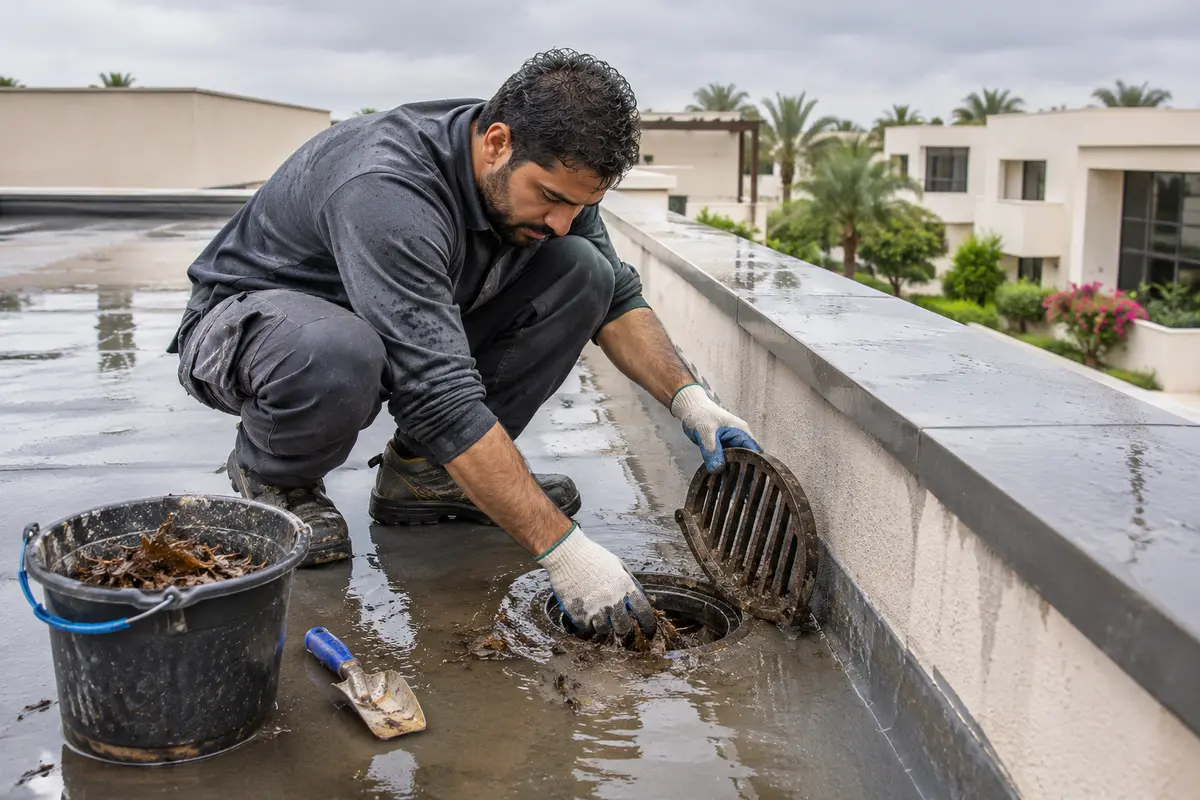
Sand is the usual blockage. The summer shamal season loads every flat surface with fine sand, and it settles in the outlet below the grating, as the pre-season roof drainage check explains. If the roof has a fixed stair or a proper hatch and a guarded edge, then in a dry break with no thunder you can lift the grating of a ponded outlet and scoop loose sand out by hand. Stop if the pond does not start to drain once the grating is off: the plug has set further down, and clearing it needs rods and vacuum extraction. On a roof reached by ladder, or with a low decorative parapet, leave the outlet to a roofer.
Leave the sealant in the drawer as well. Roof coatings and sealants are specified for dry surfaces (Sika's data sheet for its Gulf roof coating asks for substrate moisture below 6%), so a sealant pushed into a wet joint tonight will not bond, and it covers the joint the roofer needs to see. Tying a tarp down on a flat roof in wind is a job for the roofer too.
A roofer tonight, or the first dry day
In a big storm roofers get many of the same calls at once, and nobody should be working on a wet flat roof in lightning. What a same-night visit can do is limited to stopping more water getting in: clearing a blocked outlet, covering a broken skylight dome or an open hatch, sealing an open conduit temporarily. Call someone out tonight when:
- water is standing on the roof and still rising, and you cannot safely reach the outlet
- water is coming in faster than the buckets can take, or in more than one room
- a false ceiling is bulging across a wide area
- a skylight dome or roof hatch is broken or displaced and open to the rain
- water has reached the DB or several circuits, in which case the first call is an electrician
A steady drip that one bucket handles, a stain that spreads slowly, or water that stops when the rain stops can wait for the first dry day. Book a roof repair and leak inspection for then, while your record from tonight is fresh, because by the time the roofer arrives the wet path will have dried and your photos will be the only trace of it.
The record to keep while the water is still visible
Collect this before the rain stops:
- a short video of each drip, with the phone's clock or the date stamp visible
- photos of each wet spot, one wide enough to show the room and one close
- the time the rain started, and when each leak started and stopped
- photos of the roof from the window: ponds, outlets, overflows, water over the coping
- a rough sketch of the floor plan with each wet spot measured from two walls, and what sits above it outside: parapet, AC stand, skylight, terrace door
- what you know of the roof: tiled or exposed membrane, its age, and any recent work on it, such as solar panels, a dish or a replaced condenser
- how the roof is reached: internal stair, hatch, or only by ladder
A first message built from it lets a roofer decide whether to come tonight and what to bring. For example: "Two-storey villa, flat tiled roof behind a parapet, internal stair to the roof. Heavy rain from 21:00. Drip started 21:40 at the ceiling and outside wall of the north bedroom, 1.5 m from the corner, under the parapet. Nearest roof outlet is under standing water; parapet overflow dry. Video and photos attached. Solar panels fitted last year."
If the villa is still new, send the same record to the developer in writing first. Where the villa is part of a master project, Article 40 of Dubai Law No. 6 of 2019 keeps the developer liable for one year from handover for defective installations, and for ten years from the completion certificate for defects in the structural parts. The law does not say which of the two a failed roof waterproofing falls under, so ask the developer to confirm in writing what they accept. Report before any other contractor opens the roof, and say in the message what you did on the night to limit the damage.
If you built the villa on your own plot, the UAE Civil Transactions Law (Federal Decree-Law No. 25 of 2025, Article 821) makes the contractor and engineer jointly liable for ten years for collapse and for defects that threaten the building's stability. A leak on its own may fall short of that, so the build contract's defects clause is the first place to look.
Once the roof is dry and the entry is found, the choice between a local repair, a coating and a new membrane follows from what the inspection shows, and the guide to choosing the repair for a leaking flat roof covers it.
Water that gets into a roof build-up stays there after the sky clears. Tiles, screed and insulation can hold it long after the storm, the slab stays damp, and the next downpour finds the same way in with the ceiling below already weakened. Everlook connects you with licensed UAE roofing contractors, with verified credentials, transparent quotes and reviews from Dubai customers. Send them tonight's record, and favour the replies that say how they will trace the entry before they name a repair.
Find your next pro on Everlook
Post a job in minutes and get offers from trusted local contractors. Free to start.
Find your next pro on Everlook
Post a job in minutes and get offers from trusted local contractors. Free to start.
Get started
