Dead or Dormant? Resetting a Villa Garden While the Planting Window Is Open
Check the water before you judge a single plant
A shrub that sat on a blocked dripper all summer died of thirst, and whatever goes into its place will die the same way. So the reset starts at the irrigation controller, and the verdicts on plants come after.
Run each zone by hand and walk it. Look for:
- drippers that leave the sand around them dry, usually blocked by grit or mineral scale
- dead plants along one line with live ones either side, which usually means that line failed, since heat would have hit the neighbours too
- sprinkler heads that are buried, tilted or watering the path
Then change the schedule. Plants need less water as it cools, and National Center of Meteorology figures show temperatures dropping by around 4 to 6°C from October to November. DEWA's irrigation advice is to set timers to the season and water before 8 am or after 6 pm. Drop the extra summer cycle, shorten the rest, and next morning dig a trowel's depth beside a shrub. Damp sand at root depth means the new settings still reach the roots.
Stop at the controller and the pipes you can see. A controller that will not hold a programme, a zone that never opens, wet sand with the system off or a leak under paving needs an irrigation and sprinkler technician. Digging blind can split a supply line or reach garden lighting cables in the same beds.
Scorched, cut back or finished: shrubs, hedges and palms
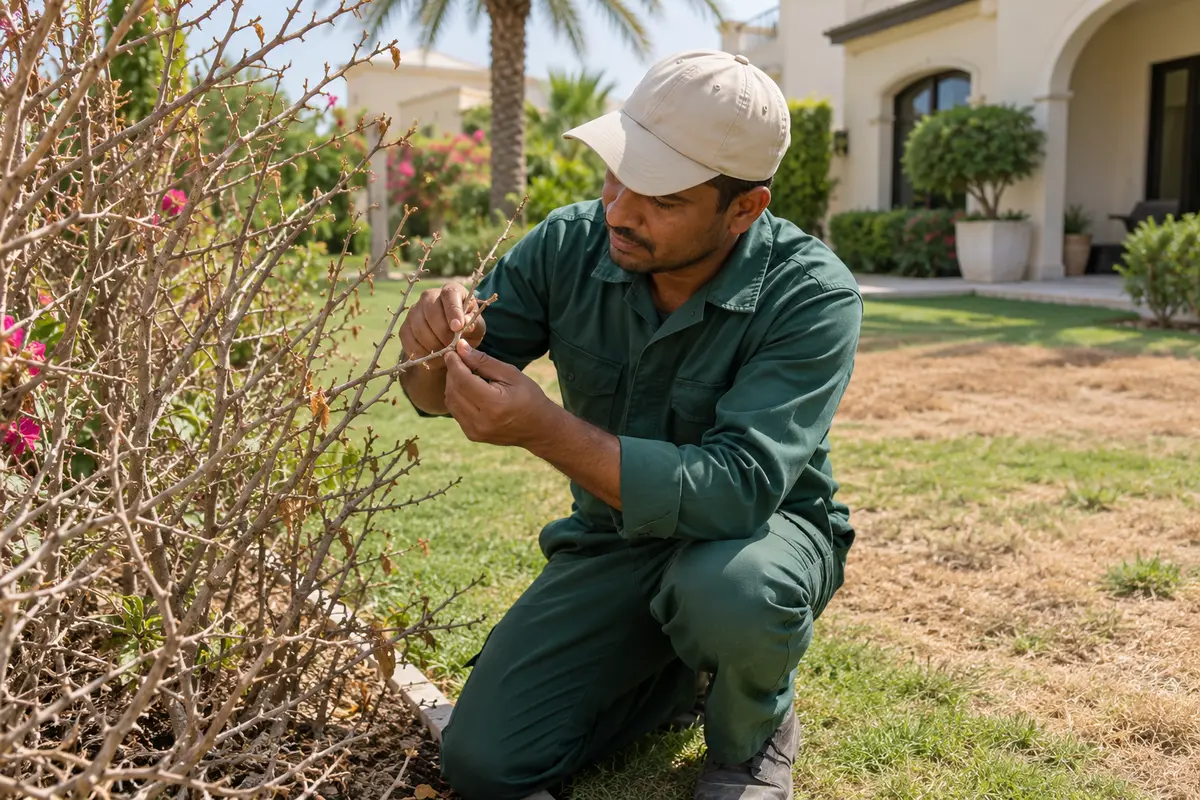
Leaves are poor evidence. Bougainvillea drops its leaves readily when its conditions change, and New Mexico State University's extension horticulturist notes that new growth and flowers can follow. The stems hold the answer.
The scratch test, from the tips down
Scrape a thumbnail-sized patch of bark with a fingernail or a clean knife. University of Georgia Extension's rule of thumb: green, moist tissue underneath usually means the stem is alive, brown and dry usually means it is dead. Test several stems, working from the tips down towards the base, because tips often die while lower wood survives. A thin twig that bends is alive; one that snaps clean is dead.
Each shrub or stretch of hedge then lands in one of three groups:
- Green near the tips. Keep it, water it and leave the shears alone.
- Green only lower down. The plant is alive and has died back. Wait until new buds show where the live wood ends, then cut to just above them.
- No green anywhere, down to soil level. Dead. Dig it out with the root ball.
Hedge work that needs a ladder goes on the gardener's sheet.
How long to give a plant that is still green
Extension guidance on drought damage ranges from a few weeks to a full growing season before giving up on a plant with green tissue. A Dubai garden cannot wait a season, because the planting window closes first. A workable rule: re-test in mid-November, about four weeks after the water is right. A large, established shrub still green but budless then can have another month, since it would take years to replace. Replace a small one while its successor can still root.
Yellow or brown leaves that the summer did not cause
Two patterns look like heat damage and return every year. University of Florida IFAS warns that ixora beside paths and foundations grows new leaves yellow between green veins, an iron and manganese shortage caused by alkaline soil. It needs regular treatment or a replacement suited to that ground.
Salt, as UC IPM describes it, yellows and then browns leaf tips and margins, older leaves first. Only a soil or water test confirms it, but the pattern decides whether the bed is flushed before replanting.
Palms: look at the spear
Green fronds prove little. University of Florida IFAS notes that a palm's older leaves can stay green for months after the bud at the top has died. Look instead for a new spear leaf rising from the centre. A failing spear discolours and wilts; in advanced bud rot it pulls out easily with a rotten base, and a mature palm in that state usually dies. Binoculars from the ground are as far as you go: touching the spear or cutting fronds is work at height for a palm climber.
Last winter's bedding plants need no test. Petunias and similar annuals were always going to finish in the heat. Pull them, roots included.
Lawn patches: repair now, overseed later, or skip it
Pull a handful of grass in a brown patch. If it lifts away with no roots holding, it is dead. If it holds, dig out a small plug, wash the sand off and pull it apart. Oklahoma State University's method for bermudagrass looks at the runners: firm stem segments between the joints that are white, green, red or purple are alive, soft or straw-tan ones are dead. Live runners should fill the patch again with water and warmth. A plug with none is a patch to replace.
Ask why it died first. A patch under a failed sprinkler head comes back once the head is fixed. A patch in the strip of shade along a boundary wall usually dies again, and that strip is where it is worth weighing turf or real grass, zone by zone.
Why the repair belongs in October
Bermuda and seashore paspalum are warm-season grasses, still growing fast in October. Run on Dubai's 2013 temperatures, turf scientist Micah Woods's growth-potential model had cool-season grass overtaking warm-season grass only in the third week of November. Sprigs take five to eight weeks to cover, according to the Sports Turf Managers Association. Woods's figures have Bermuda growing well until the end of December and slowly after that. Laying a patch by the end of October is the conservative date: it gets all of those weeks while growth is strongest. One laid in late December may sit thin until spring.
Patch with the grass the lawn already has. Bermuda and paspalum differ in colour and texture, and the join stays visible.
Overseeding with ryegrass, and what it commits you to
Ryegrass gives a denser winter surface on a schedule of its own. Texas A&M AgriLife's overseeding guide sets the trigger at average daily soil temperatures falling consistently below 22°C (72°F), or the point where the Bermuda has nearly stopped growing. Seeded earlier, it struggles against the Bermuda. The Dubai golf courses Woods visited in 2013 seeded between early November and 10 December.
- Water. Light watering one to four times a day until the seed emerges, then a winter of regular mowing.
- Spring. As the heat returns, the ryegrass has to go so the Bermuda can recover. Texas A&M notes that perennial ryegrass usually has to be killed out, while annual ryegrass dies back in the heat on its own, so ask which one the gardener is sowing.
- New patches. Leave out anything sprigged or re-turfed this season. The Sports Turf Managers Association advises against overseeding new bermudagrass in its first year, because spring competition weakens it.
- Paspalum. Woods found that the paspalum courses in the city did not seem to be overseeded; the overseeded ones were Bermuda.
Skipping it is reasonable for a lightly used lawn: Woods noted that Dubai bermudagrass "retains an excellent color" through the cool weather while its growth slows.
Getting a bed ready for new plants
- Clear it. Remove dead plants with their root balls and old roots.
- Flush it if you saw the salt pattern. Give the bed one slow, deep soak, more water than it takes to wet the root zone, so salts move below where new roots will grow. UC IPM calls that extra the leaching fraction; short summer cycles never supply it.
- Feed the sand. Garden sand in villa beds, including the "sweet soil" sold for planting, holds little water or nutrient. Dig compost and well-rotted manure into the top of the bed and the planting holes.
- Mulch after planting, kept clear of stems. Organic mulch also helps bring soil pH down, which ixora needs.
- Hold the fertiliser. University of Georgia Extension advises none for drought-stressed plants until they recover.
Before digging, find out where the drip lines run, and dig by hand within a spade's width of them.
The dates that decide whether replacements survive the next summer
New trees and shrubs need the cool months to root before temperatures climb back above 40°C. The Arizona Municipal Water Users Association puts the low-desert window for trees and shrubs at late September to early December. Part of what closes Arizona's window is winter frost, which Dubai does not get, so here the limit is simply how many cool weeks a plant has left before the heat returns. Planting in October and November gives it the most.
- First half of October: zones walked, drippers cleared, controller on its cool-season programme.
- By the end of October: dead plants out, beds flushed and amended, lawn patches sprigged or turfed.
- October and November: replacement trees and large shrubs in, the earlier the better.
- Mid-November: wait-and-see shrubs re-tested.
- Mid-November to mid-December: ryegrass overseeding, if you choose it, once soil is below 22°C.
- December to February: a tree or shrub can still go in, with fewer cool weeks to root each month it waits. Seasonal flowers can go in all winter.
- March and April: irrigation run times raised step by step as the heat returns, and every zone walked again before May.
What to put on the job sheet for one reset visit
Offers only compare when every gardener prices the same list. Tenants: check first whether the tenancy contract puts garden upkeep on you. Then book a garden maintenance visit with this written into the request:
- walk every irrigation zone, clear or replace blocked drippers, set the cool-season programme and leave the settings in writing
- scratch-test shrubs and hedges, mark each keep, cut back or replace, and cut back only where buds show
- remove dead plants with root balls, flush and amend the beds, mulch after planting
- plug-test lawn patches and replace dead turf with the same grass, stating sprigs or turf rolls
- check palm crowns for a new spear, stating whether work at height is included
- take all green waste off site
- a follow-up visit in mid-November for the re-test and the overseeding decision
If the pool also came out of the summer green, do the cut-back before clearing a green pool, since leaves and clippings end up in the filter.
Finding a gardener who knows that Bermuda and paspalum will not patch each other, that villa sand needs compost before planting, and that a new tree wants every cool week it can get is harder than it sounds. Everlook lists garden maintenance pros with verified UAE experience and reviews from villa owners nearby, so the same job sheet can go to several.
Find your next pro on Everlook
Compare licensed contractors in your area in under a minute. Free to post, no signup needed to browse.
Find your next pro on Everlook
Post a job in minutes and get offers from trusted local contractors. Free to start.
Get started