How Long a Dubai Villa Build Takes, From Plot Handover to the DEWA Meter
·
The months before anyone files for a permit
Say you sign a consultant in January. On the official side, very little happens for months; one Dubai agent's guide estimates four to six for design and approvals. The first stretch of a villa build is design work, and the person holding that clock is you. The consultant cannot draw until you settle the brief: number of bedrooms, a basement or not, a pool, a roof terrace, a lift. Each late change sends the architectural, structural and services drawings back for another round.
In Dubai only a registered engineering consultant or contractor may submit a new building permit, so the consultant is the first hire, and often the same firm supervises construction later. Ask at the appointment who will commission the soil investigation. The foundation design depends on its report, and boreholes on a sandy plot can take a few weeks to book, drill and write up.
If the plot sits in a master community (Nakheel, Emaar, Meraas and the like), the developer has its own design guidelines and reviews the drawings before any authority sees them. Its turnaround varies between communities, and comment rounds restart it. Ask the community's technical team for their review period and their list of common rejections before the consultant starts drawing.
Read the plot sale agreement too. Some master developers write a build window into it, a period within which construction has to start or finish, with remedies against the owner who misses it. The terms differ by developer and by sale, so the clause itself is the only reliable answer. If there is one, it sets the latest date you can afford to spend on design.
The permit desk, and what its published times cover
Which authority issues the permit depends on where the plot is. Dubai Municipality covers most of the emirate, Trakhees covers the Nakheel communities and the free zones under the Ports, Customs and Free Zone Corporation, and the Dubai Development Authority (DDA) covers its own zones. The order of NOCs and permits for an extension follows the same desks, and the plot's affection plan tells the consultant which one applies.
The municipality's published service time for a new building permit is three working days once the application is complete, according to the service description summarised by Property Finder. Every missing document or code comment returns the file to the consultant, and the desk time counts again from resubmission.
Two deadlines run in the background. The consultant has nine months from drawing approval to obtain the permit, or must request an extension, and drawing approvals can be extended up to four times for six months each. Ask your consultant to track both.
In August 2026 the Dubai Media Office announced an AI system that checks villa drawings against the Dubai Building Code and issues the permit automatically, rolled out in three phases over 26 weeks, ending with every private and investment villa application submitted by a consultancy. Faster checking shortens the desk time. A drawing that fails the code still goes back to be redrawn.
Site work may start only after the permit and its demarcation certificate are issued. Local Order No. 3 of 1999 bars construction works without the permit, so work started before it is a breach of that order. The times quoted in this article are Dubai Municipality's; Trakhees and the DDA publish their own permit, inspection and completion procedures.
Tender the contractor while the drawings are in review
Once the permit drawings are close to final, the consultant can prepare the tender package and invite bids while the developer and the permit desk review. Bids take weeks to collect and compare; run in parallel, the tender lets the contractor start soon after the demarcation certificate arrives.
Check the contractor's registration before you shortlist. Dubai Law No. 7 of 2025 on contracting activities bars project owners from engaging an unregistered contractor, and the permit names the contractor. Replacing one mid-build is possible under the municipality's 2024 rules on replacing engineering firms and contractors, but without the outgoing firm's consent it takes your declaration, stated reasons and an engineering firm's technical report, and the site handover can run to 30 days.
The bid is where you buy timeline protection. Ask every bidder to price against the same programme terms, so you can compare them line by line:
- A baseline programme with the bid, showing the sequence of phases, each phase's duration and the inspection points between them, signed off by your consultant before work starts.
- Payment milestones tied to stages an inspector or your consultant has passed, such as foundations cast or roof slab cast.
- A completion period written as a number of months from the start date. Under the UAE Civil Transactions Law (Federal Decree-Law No. 25 of 2025, in force since 1 June 2026), Article 813 lists the completion period among the terms a construction contract has to state.
- A procedure for extensions of time: what counts as a delay you caused, how quickly the contractor must notify it, and how the programme is updated. Article 816(3) of the same law requires the contractor to notify you promptly of anything hindering the work.
- Delay damages at a stated rate per week, with a cap. Article 340 lets a court reduce pre-agreed compensation it finds exaggerated, so a realistic rate holds up better than a punitive one.
- A monthly updated programme showing actual progress against the baseline.
The payment schedule, variations and the defects period are covered in how to read a villa building contract. To put the drawings out to registered firms, you can post the tender as a new villa build job and collect bids against the same programme terms.
On site: what each phase waits for
The construction phase is the longest, and the contractor holds its clock under your consultant's supervision. Estimates published by Dubai agents and contractors put a custom villa's construction at roughly 10 to 18 months, longer for bespoke finishes. A basement or slow decisions on finishes push it up. Each phase below waits on something before the next may start.
Excavation and shoring
Where the dig is deep, the municipality inspects the shoring at set points: after the first 2 metres below original ground, at anchor level if there is one, and at foundation level. The published service time for each structural inspection visit is three working days, so the contractor should request it ahead of the day the excavation reaches each level.
Foundations and the structural frame
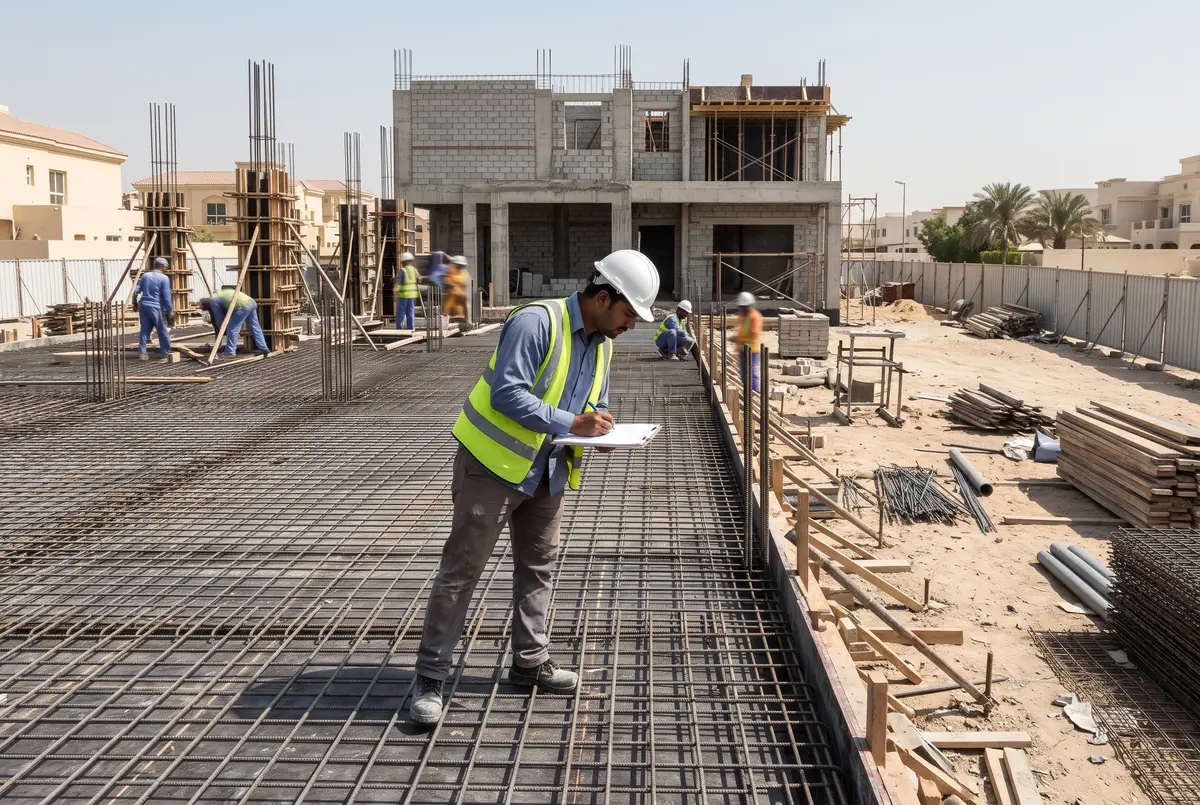
Footings and slabs are inspected before concrete is cast, with pile and soil test results uploaded beforehand where the design uses piles. Each slab is a hold point: rebar fixed, inspected, cast, then cured before formwork comes down and the next floor goes up. A G+1 villa with a roof slab has at least three such cycles. Curing and cover to the steel are what make the frame last, and rusted steel behind spalled concrete is the cost of hurrying them. Your consultant signs off each pour. Do not instruct the contractor to cast on your own say-so, even when an inspection slot is late.
Summer on site
From 15 June to 15 September 2026 the Ministry of Human Resources and Emiratisation banned outdoor work under direct sunlight between 12:30 and 15:00. The ban returns each summer. A contractor can move pours to night or early morning, when concrete is cooler and sets more slowly. A programme that puts the structure in July and August without allowing for this is optimistic, and you can ask the bidder how they have planned those months.
Blockwork, services and finishes
Blockwork follows the frame, then the electrical, plumbing, drainage and AC first fix goes into the walls and slabs before plaster and screed cover it. Your consultant should inspect the first fix before it is buried, because a missed conduit or a wrong drain fall costs weeks to open up later. Finishes are where owner decisions return as a delay. Imported stone, custom joinery and some sanitaryware have long lead times, so choose and order them while the frame is still going up. External works and the pool run alongside finishes.
Completion certificate, then the meter
When the contractor finishes, the consultant applies for the building completion certificate. A unified committee covering the municipality, Civil Defence and the service providers inspects the villa, and approval brings the completion certificate, the Civil Defence completion certificate and the final survey certificate, which together allow services to be connected. The published service time is three working days on a contractor or consultant application. An owner application can take up to ten, because the contractor is first given seven working days to respond. Any snag the committee finds sends the file back into the queue.
Plan the power connection at the start of the job. The utility's ASRA'A initiative lets the contractor run construction power from the permanent cable to the same plot, provided both supplies are applied for together at the start, and DEWA disconnects the construction supply after the first permanent supply inspection. DEWA's builder pages list low-voltage design approval and inspection at one working day each for loads up to 150 kW. After the inspection the meter is handed over, and the supply is turned on once the security deposit is paid. Ask the contractor's electrical subcontractor to book the permanent inspection as soon as the completion inspection is booked.
Waits you can shorten, and waits to plan around
You have the most influence before the permit and the least after the slab is cast. The waits you can shorten:
- Your own design decisions, settled before the consultant draws and kept settled after the permit.
- Comment rounds, by asking the developer's technical team for their rejection list first.
- The contractor tender, run in parallel with the permit review.
- Long-lead finishes, chosen and ordered while the structure goes up.
- Utility applications, filed for construction and permanent supply together at the start.
The waits to plan around are the developer's review period, the permit desk's queue, inspection slots, slab curing and the summer midday ban. Put them in the baseline programme as fixed durations, and judge the contractor's progress against the rest.
Every month a finished design waits for a contractor is a month added to the move-in date. Everlook lists vetted contractors for new villa construction across the UAE, with verified licences, transparent quotes and reviews from past clients, so you can put the tender out while the drawings are still at the permit desk. Its construction services page covers the wider category.
Find your next pro on Everlook
Compare licensed contractors in your area in under a minute. Free to post, no signup needed to browse.
Find your next pro on Everlook
Post a job in minutes and get offers from trusted local contractors. Free to start.
Get started
