Rats or Mice in a Dubai Villa: Tracing the Signs Back to the Way In
Dropping length, gnaw width and the tail separate the three rodents
Put on disposable gloves, pick up a few droppings with a damp paper towel, lay them on white paper beside a ruler and photograph them. Cornell University's integrated pest management programme gives these lengths for the three rodents that live around houses in the UAE:
- House mouse: 3–6 mm, with at least one pointed end.
- Roof rat: about 12 mm, with pointed ends.
- Norway rat: 19–25 mm, thicker, with blunt, rounded ends.
Gnaw marks back the droppings up. Cornell measures the tooth marks of an adult mouse at 1–2 mm wide and those of an adult rat at 3.5–4 mm. If you see the animal itself, look at the tail: a roof rat's is longer than its head and body together, while a Norway rat is stockier, with a shorter tail, small ears and a blunt snout. A young rat can pass for a mouse, though the mouse has larger ears and eyes for its size and a pointier nose.
All three are here. An article in the Emirates Natural History Group's 1989 bulletin recorded the house mouse, the black or roof rat (Rattus rattus) and the brown or Norway rat (Rattus norvegicus) in the UAE, with both rats probably brought in through the seaports and found mostly along the coastal strip. No published count says which of them is commonest in Dubai today, which is why the droppings and gnaw marks in your own villa are the better guide.
Dark droppings with a chalky white tip come from a gecko. The white is uric acid, which lizards pass with their droppings, and rodent droppings have none. Timber that is hollowed along the grain and lined with soil is a different problem again, covered in reading termite signs in a villa; rodents leave rough grooves on the surface.
Scratching over the ceiling after dark
Noise in the roof void or above a false ceiling at night fits a roof rat best. The University of California's pest note on rats describes roof rats nesting indoors in "attics, wall voids, ceiling voids, and cabinets", outdoors in trees, shrubs and dense creepers, and lists noises from the attic or drop ceilings among the signs. Mice also run in ceiling voids, so let the droppings settle which one you have.
A climbing rat reaches the roof by whatever touches it. Rats were found nesting more than 12 metres up in trees in Abu Dhabi's Bateen Wood in the late 1980s, according to the same 1989 bulletin, and a University of Florida fact sheet lists the skirts of old palm fronds among roof rat nest sites. Walk round the outside at dusk with a torch and look for:
- date palm fronds, bougainvillea or other creepers resting on the parapet, an upper wall or the roof edge;
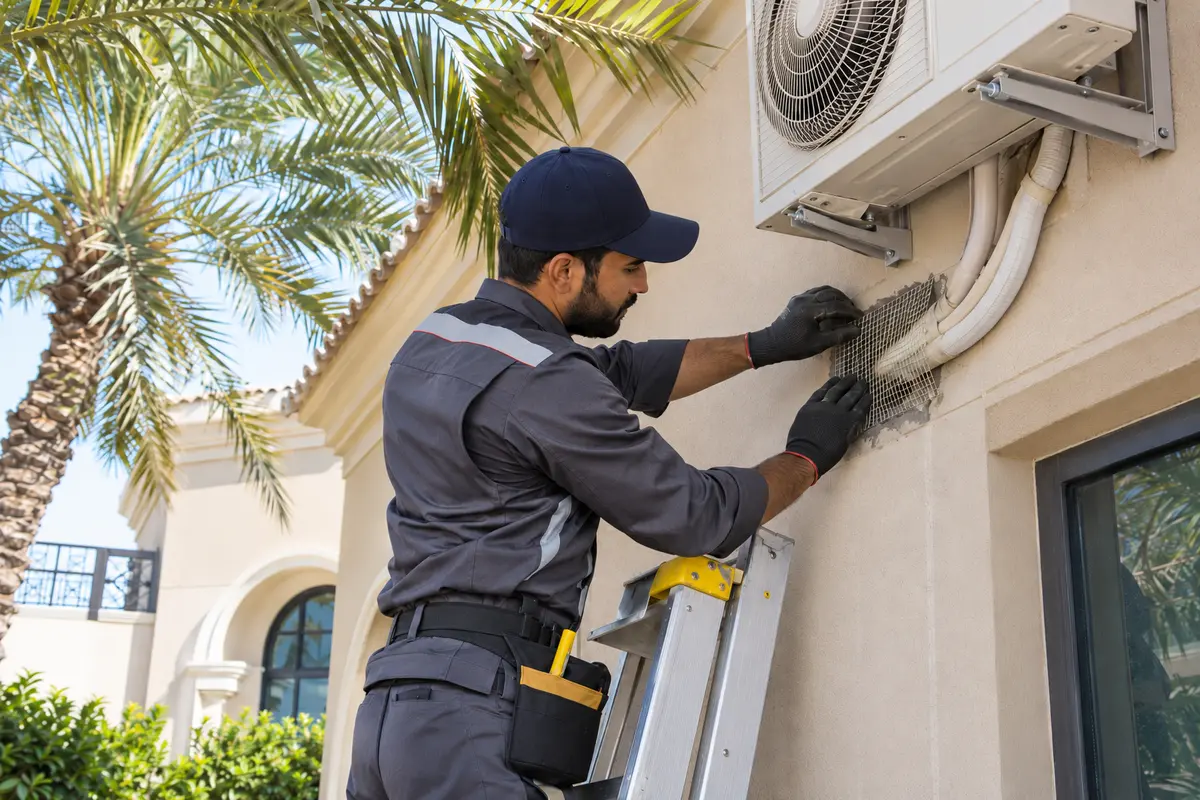
- gaps around the holes where the split-AC refrigerant pipes and drain lines pass through the wall, especially behind the outdoor units;
- dark, greasy smudges on render, pipes or beams, which the University of California attributes to rats rubbing their fur along a regular run;
- pipes or cables running up the wall to the roof, and gaps at roof vents and under the eaves.
Small gaps count. NC State Extension puts the limit at about 13 mm for an adult rat and about 6 mm for a young one, and the University of California tells owners to seal any opening wider than about 6 mm.
Do all of this from the ground and from upstairs windows. The roof, the parapet and the space above the false ceiling are work for someone with the right ladder and a second person below, and a gypsum ceiling board will not take a person's weight.
Droppings in the garage, the store room or the kitchen cupboards
Droppings at ground level, with nothing heard overhead, point toward mice or the Norway rat. The Norway rat lives mostly on the ground and burrows: the University of California says its burrows turn up along building foundations, under rubbish or woodpiles and around gardens. Mice nest behind boxes, in drawers and in garages, in nests of finely shredded paper or fabric, and a musky smell in a cupboard is typical of them.
At floor level, check these ways in:
- the gap under the garage door, or under a kitchen or store-room door to the outside; the University of California says mice squeeze under a gap about 6 mm tall, and NC State's standard for an exterior door is no more than 6 mm of clearance;
- unsealed holes around the pipes under the kitchen sink and behind the washing machine, where they pass through the wall;
- a floor drain in the garage, laundry or store room with a missing or broken grating;
- a burrow in the soil beside the foundation, or under stored timber, tiles or garden furniture.
The same floor drains and pipe gaps let in the large cockroaches that come up from drains, which why cockroaches keep coming back covers. Move dry food and pet food into closed containers and clear cardboard off the store-room floor. Once one patch of floor or shelf has been cleaned (method below), new droppings on it in the following nights mean the activity is current.
A rat on the boundary wall, in a palm or by the irrigation box
A rat seen in the garden does not prove there is one in the house. It does show a route. Roof rats climb trees and rough walls and run along overhead cables, using the tail for balance, according to University of Arizona Extension. Fruit eaten on the tree is another sign: an older Arizona extension bulletin describes oranges hollowed out on the branch until only the rind is left.
On the ground, look for burrow openings beside the foundation, in planters, under anything stored against the boundary wall and in the soft soil around irrigation valve boxes, then lift each valve box lid. Pet bowls left out overnight and bins without lids feed whatever lives nearby; the University of California advises tight-fitting bin lids and picking up fallen fruit.
Sometimes the source sits outside your plot: an empty villa next door, the community bin store or a sewer manhole in the road. A pest company can proof your house against that source; the land itself is for whoever manages it. Report it in writing to the community's management company, with dated photos and the exact location, and ask what will be done and by when. Dubai Municipality's Public Health Pest Control Section lists rodents among the disease-carrying pests it controls in public areas, and a municipal official told Gulf News in 2018 that residents can call 800900 about any rodent problem.
Traps you can set, and why bait in a villa belongs to a licensed company
For one mouse in a cupboard or a single rat in the garage, snap traps are a reasonable first step; the University of California calls them the safest, most effective and most economical way to trap rats. Buy rat-size traps for rats, since mouse traps generally fail against them. Set them along walls, behind objects and in dark corners for mice and Norway rats, and on ledges, shelves, beams and pipes for roof rats, with mouse traps no more than about 3 metres apart. NC State notes that rats may take up to a week to start taking traps, so leave one in place that long before deciding it has failed.
Put traps where children and pets cannot reach them, or inside a lockable trap box. The University of California says not to use glue boards anywhere children, pets or wildlife can touch them, which in a villa with a garden leaves few places.
Rat poison is where a do-it-yourself job in a villa goes wrong. The municipality's line has long been that pesticide work in homes belongs to licensed companies: a municipal pest control expert told Khaleej Times in 2012 that the public should not apply pesticides at home, and in 2018 the municipality warned residents against concentrated products meant for those companies. The bait itself also works against you in a house with a roof void:
- Anticoagulant baits kill slowly. The label of one brodifacoum bait block says the first dead rodents appear four or five days after feeding begins, long enough for a roof rat to return to the roof void or a wall cavity and die where no one can reach the carcass.
- The same label warns that dogs, cats and other predatory and scavenging mammals and birds might be poisoned if they eat animals that have taken the bait. The University of California adds that a single dead rodent might be enough to poison a pet, and in a 1980 feeding study owls that ate rats killed with brodifacoum, bromadiolone or diphacinone died of internal bleeding.
- Loose bait can be reached by children and pets. The label requires all above-ground outdoor bait to sit in tamper-resistant stations built to resist dogs and children under six.
If a child or a pet may have eaten bait, take the packaging and go to a doctor or vet at once. The label names vitamin K1 as the antidote.
Cleaning droppings and nests without raising dust
Rodent urine and droppings can carry disease; the University of California lists leptospirosis and salmonella among the infections house mice carry. The clean-up below follows the Centers for Disease Control and Prevention in the United States:
- Open the doors and windows for 30 minutes and stay out while the room airs.
- Put on rubber or plastic gloves.
- Spray the droppings, urine marks and nest with a household disinfectant, or a fresh mix of 1 part bleach to 9 parts water, until soaked. Leave it 5 minutes, or as long as the disinfectant label says.
- Wipe it up with paper towels and bag them. Do not sweep or vacuum, because both throw contaminated particles into the air.
- Spray any dead rodent and nesting material, seal them in a plastic bag inside a second bag, and put it in a lidded bin.
- Wash your gloved hands, take the gloves off, then wash your hands with soap and warm water.
Never mix bleach with other cleaners. A nest in the roof void, or a large soiled area above the false ceiling, is for the company's crew with masks and eye protection, so raise it when you book.
What a licensed rodent job covers, from the roofline to the last visit
Book a company when you hear rats in the roof, find rat droppings indoors, or keep catching mice after you have closed the gaps you can reach. Check the company against the municipality's approved list and ask the technician for the Pest Control ID card the section issues; the list itself tells customers to make sure staff carry one. The other checks that apply to any pest company in Dubai are in pest control before moving in.
A proper rodent treatment and extermination job puts these in writing:
- An inspection that names the rodent and lists each entry point found, from the roofline and AC pipe holes to door gaps, drains and burrows, with photos.
- Proofing of those points with materials rats cannot chew through. NC State lists 00-grade steel wool or copper mesh sealed with caulk, galvanised sheet metal over large holes, 6 mm hardware cloth over vents and rodent-proof door sweeps, and warns against expanding foam on its own because rats chew through it.
- Who cuts palms and creepers back from the roof, since a gardener may have to do it before the proofing visit.
- Snap traps inside the roof void and the house, with any bait kept outdoors in locked, tamper-resistant stations fixed in place.
- The product name and active ingredient of any bait, and its safety data sheet. Dubai Municipality's classification guide for pest control companies requires each service vehicle to carry the company's pesticide list and data sheets.
- How many follow-up visits, and what each covers: emptying traps, recording bait taken from each station, and searching for carcasses.
Ask what order the company will work in. Sealing the outside while rats are still living in the roof void can shut them in, to die there or chew a new way out. The University of California also advises cutting down entry points before baiting outside, so that poisoned rats do not come indoors to die. A plan that traps inside, proofs the gaps and then keeps checking for new activity deals with both.
The job has worked when cleaned surfaces stay free of new droppings, the traps stay empty over several checks, the noise overhead stops and the stations show no fresh bait taken. NC State notes that bait eaten can show up as coloured droppings, so dyed droppings after the last visit suggest a rat is still feeding.
A rat left in the roof void keeps gnawing, and University of Arizona Extension notes that rats chew wiring, which is a fire risk, and tear up insulation to nest in. Everlook lists licensed pest control companies with verified credentials, clear quotes and reviews from Dubai customers, both for the treatment and proofing visit and, once the gaps are closed, for scheduled bait-station checks. Ask each company to price the inspection, the proofing and the follow-up visits as separate lines.
Find your next pro on Everlook
Compare licensed contractors in your area in under a minute. Free to post, no signup needed to browse.
Find your next pro on Everlook
Post a job in minutes and get offers from trusted local contractors. Free to start.
Get started