Who Has to Approve a Home EV Charger in Dubai, and in What Order
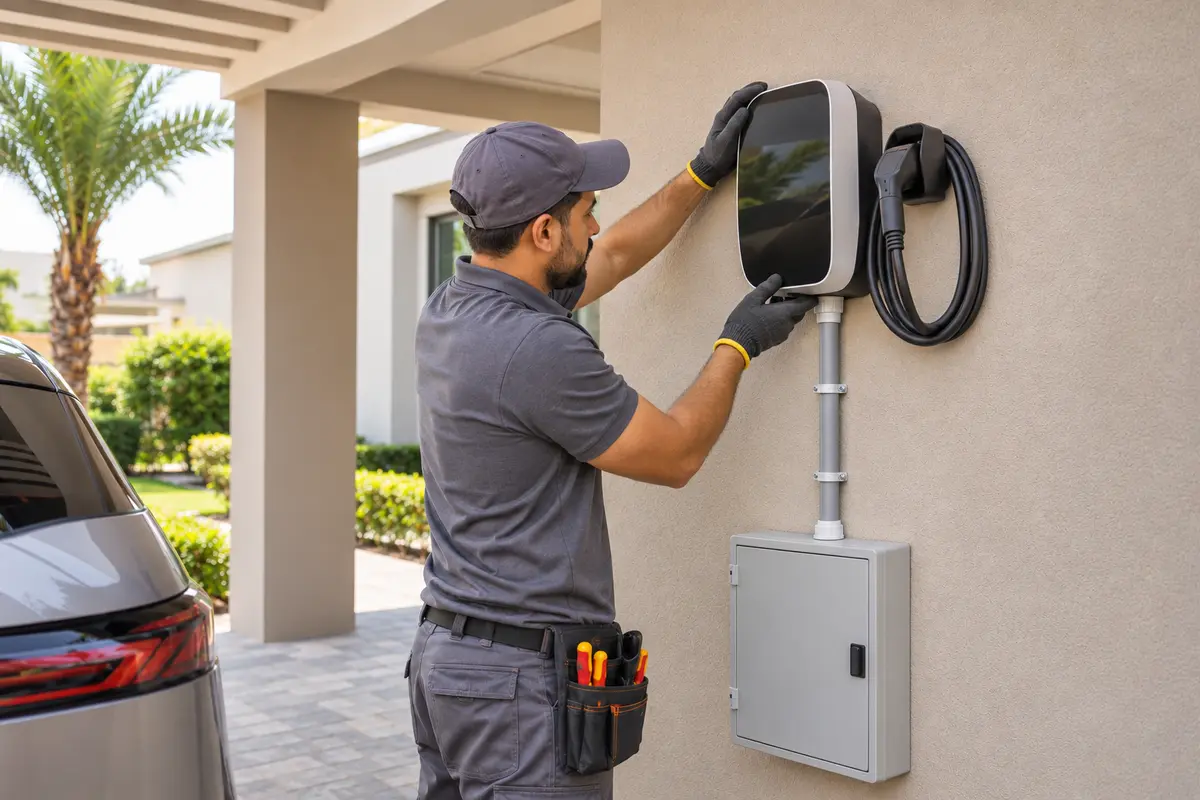
The rule that covers a charger on your own supply
DEWA's EV charging regulation gives private home chargers one line. In version 1.1, issued 9 December 2024, Article 8 says anyone deploying private charging equipment at their premises "shall follow the applicable procedure to obtain DEWA's approval and comply with the EV Charging Technical Regulations." A wallbox on a villa drive or in your own parking bay is covered by it. DEWA has revised the regulation since (version 1.3, November 2025, is the one on its site now), so ask the contractor to confirm the current procedure. Some installer guides still say a private charger needs no permit, and the 2024 wording does not support that.
You do not file this yourself. The utility's consumer FAQ says a home charger is fitted by a third party behind the customer's meter, and that approved electrical contractors should install any electrical equipment in Dubai, home charging stations included. In practice the enrolled contractor makes the application. Ask the contractor which application they will file, and ask for its reference number once it is in.
The technical regulations (version 1.0, May 2025) apply to private chargers as well as public ones and point the installation at BS 7671 and the IET code of practice for EV charging equipment. A contractor who works to them asks about your supply, protection and cable route before quoting.
The same regulation defines a private charger as one used only by the household of the customer whose electricity account it is connected to. Anything else counts as public charging equipment, which only the utility or an operator it licenses may run. On a villa this changes nothing; in an apartment it decides which meter feeds the charger.
The EV Green Charger account and card are for the public network; registering your car there does nothing for a wallbox at home, whose charging goes on your ordinary electricity bill at residential rates.
Read the main breaker and the car's AC limit before any quote
Open the door of the distribution board (DB) and leave the inner cover in place. Everything you need is printed on the front of the breakers, and nothing behind that cover is a job for an owner.
- The main switch. It is the largest device on the board, usually at one end, marked with a current rating such as 63A or 100A.
- Single or three-phase. A single-phase main switch is usually two modules wide; a three-phase one is three or four, and the outgoing breakers are often grouped or labelled by phase (R, Y, B or L1, L2, L3).
- Spare ways. A blanking plate marks room for the charger's new circuit. A full board means extra work, which the quote should show.
- The car's AC rating. The specification sheet lists a maximum AC charging power, for example 7.4 kW or 11 kW, and whether the car takes three-phase AC at all.
From those four facts you can estimate the size of the job. A 7.4 kW single-phase wallbox draws 32 A on one phase for as long as the car is charging, which can be most of the night. An 11 kW three-phase unit draws about 16 A on each of three phases, and a 22 kW unit about 32 A on each. On a three-phase villa supply the 11 kW unit is therefore the lighter load per phase, provided the car can take three-phase AC.
The charger also has to share the supply with the air conditioning. Through summer, split units and a ducted system can run at full load into the evening, and a charger holding 32 A on the same phase can push the total past the main switch rating. When that happens the main breaker trips on overload, the same mechanism behind a breaker that keeps tripping when too much runs at once.
On a tight supply, the simplest fix is to set the charger's current lower. Dynamic load management can be added: in Wallbox's set-up guide, an energy meter on the incoming supply measures the house load, the installer enters the main breaker's rated current, and the charger cuts its own current to stay under it. Or the supply itself can be increased, which is a separate application to the utility, filed by an enrolled contractor with connected-load and maximum-demand figures. Ask for it as a separate line in the quote, because it is a separate job.
Take your latest DEWA bill as well. The contractor needs the account and premise numbers for the application. The summer months show what the car's consumption will sit on top of, and under the slab tariff on a summer bill those extra units are charged at the rate of the highest band your month reaches.
A villa: survey, community NOC, the utility, then the wall
On a villa the approvals run in this order, because each one needs the paper produced by the step before it.
- A survey and a written design. An electrician enrolled with the utility looks at the board and the wall and puts on paper the charger model, its position, the new circuit, the cable route and whether load management or a supply increase is needed. Electricians who do new circuits and DB work are the trade for this; a charger reseller who only supplies the box may not survey at all.
- The community or master developer. If the charger goes on an exterior wall, a carport column or a boundary wall, or the cable is trenched across the garden or the drive, ask community management whether it counts as a home modification. Emaar's home-modification fact sheets require a NOC for additions, and the owner applies for the contractor's entry permit only after the NOC and any authority approvals are in hand. Its community FAQs also restrict changes to a villa's exterior, including lights on the street-facing side of boundary walls. Nakheel and Dubai Properties communities, many of them now managed by Dubai Holding Community Management, have their own rules. Get the community's answer in writing, even for a charger inside a closed garage.
- The utility's approval. The contractor files it with the design attached. If the supply needs increasing, that application goes in at the same time and has to be approved before the charger can run at the current it was designed for.
- Entry permit. In a gated community the crew needs one for the days they work. Book it once the NOC is issued.
- Installation and tests. Ask for the test results in writing: insulation resistance, earth continuity, the trip time of the residual current device (RCD) and a real charging session with your car. Any inspection the utility books comes after this.
Skipping a step costs you in different ways. A community can refuse the entry permit, or ask for a fitting it did not approve to come off the wall. A charger running without the utility's approval breaches Article 8 however well it is wired, and Article 4 empowers the utility to act on violations. A missing load check can show up on the first hot evening the AC and the car run together, as a tripped main breaker.
An apartment bay: what the building must answer before anyone quotes
Under Dubai Law No. 6 of 2019 a RERA-registered management company runs a tower's common parts, or the developer does in a major project; owners associations no longer exist. Write to that company, usually through the building's facilities management (FM) office, before any electrician visits.
A parking bay allocated to your unit is part of the unit under Article 9 of that law. Wiring and conduits serving more than one unit are common parts under Article 7, which usually takes in the car-park cable trays and the risers. A charger in your own bay is yours to fit, but the cable that reaches it almost always crosses common parts, and works there need the management's consent on whatever conditions the building's rules set. Article 39 can also bring in the master developer or the Land Department for works on common parts, which the management will know.
The meter is the second constraint. Because a private charger has to sit on the account of the household that uses it, it is fed from a meter on your own DEWA account. Usually that is your unit's meter, which may be in a meter room on your floor, many storeys above the car park. Some buildings may allow a separate meter in your name near the bay instead, if the building and the utility agree to it. A charger fed from the building's own supply and billed back to you by the management does not fit the regulation's private definition as written. The alternative is a building-wide scheme run by the utility or a licensed operator.
Send the management these questions before you book anyone:
- Is my bay allocated to my unit on the title deed, or is it a common or rotating bay?
- Does the building have an EV charging policy, an approved cable route, or a charging scheme with a licensed operator?
- Where is my unit's meter, and will you allow a cable from it to my bay, through which risers and trays? If not, would the building allow a separate meter in my name for the bay?
- What do you need before work starts: drawings, the contractor's trade licence and insurance, a method statement, working hours, fire-stopping where the cable passes through walls?
- Was the car park designed with capacity or containment for chargers? The Dubai Building Code has a section on EV charge points, and what applies depends on when the building was permitted.
- Do the building's fire and life-safety rules set conditions for chargers in the car park?
Home charging is off the table when the bay is not allocated to your unit, when the management will allow neither a route from your meter nor a meter of your own at the bay, or when the building refuses individual chargers while it plans a shared scheme. Ask for any refusal in writing, with the reason. The owners' committee can press the management on a building-wide scheme, though under the law it advises and does not decide. If you rent, the landlord's written consent comes before all of this, and it is the landlord who asks the building.
Once the building says yes in writing, the job is the villa sequence from step one, with the management's conditions added and a much longer cable run.
What a charger quote has to state
Two quotes for the same charger can describe very different jobs. Ask each contractor to put these lines in writing:
- Charger model, its rated power, and the current it will be set to.
- A new dedicated circuit from the DB: breaker rating and type, cable size, length and route, and how the cable is protected outdoors or in the car park.
- The RCD type. A Type A device is enough only where the charger has built-in 6 mA DC fault detection; otherwise the circuit needs Type B. The datasheet says which applies.
- How the charger is earthed, and the test readings that prove it.
- Whether load management is included, and the main breaker rating it will be set to.
- Whether a supply increase is needed, priced as its own line.
- Who files the utility application and the community or building approval, and whether that work is in the price.
- The charger's outdoor rating and operating temperature range, and where on the wall it will go.
Check the operating range closely if the wall takes the afternoon sun. Wallbox's Pulsar Plus installation guide rates the unit IP54 for indoor and outdoor use, gives an operating range of -25°C to 40°C with derating up to 50°C, lists built-in DC 6 mA residual current protection, and asks for an external Type A or Type B RCD as local rules require. A Dubai summer afternoon often passes 40°C in the shade. A carport, a garage or a shaded north or east-facing wall keeps the box inside its range.
Charger quotes tend to differ on what they leave out: the NOC, the utility application, load management, a long cable run. Everlook lets you send the same job to licensed electrical contractors in Dubai and compare their answers line by line against the list above before you commit, with no obligation.
Find your next pro on Everlook
Describe your job once, get quotes from verified UAE contractors. Free, no commitment.
Find your next pro on Everlook
Post a job in minutes and get offers from trusted local contractors. Free to start.
Get started
