TV Wall Mounting in a Dubai Apartment: What to Know Before You Drill
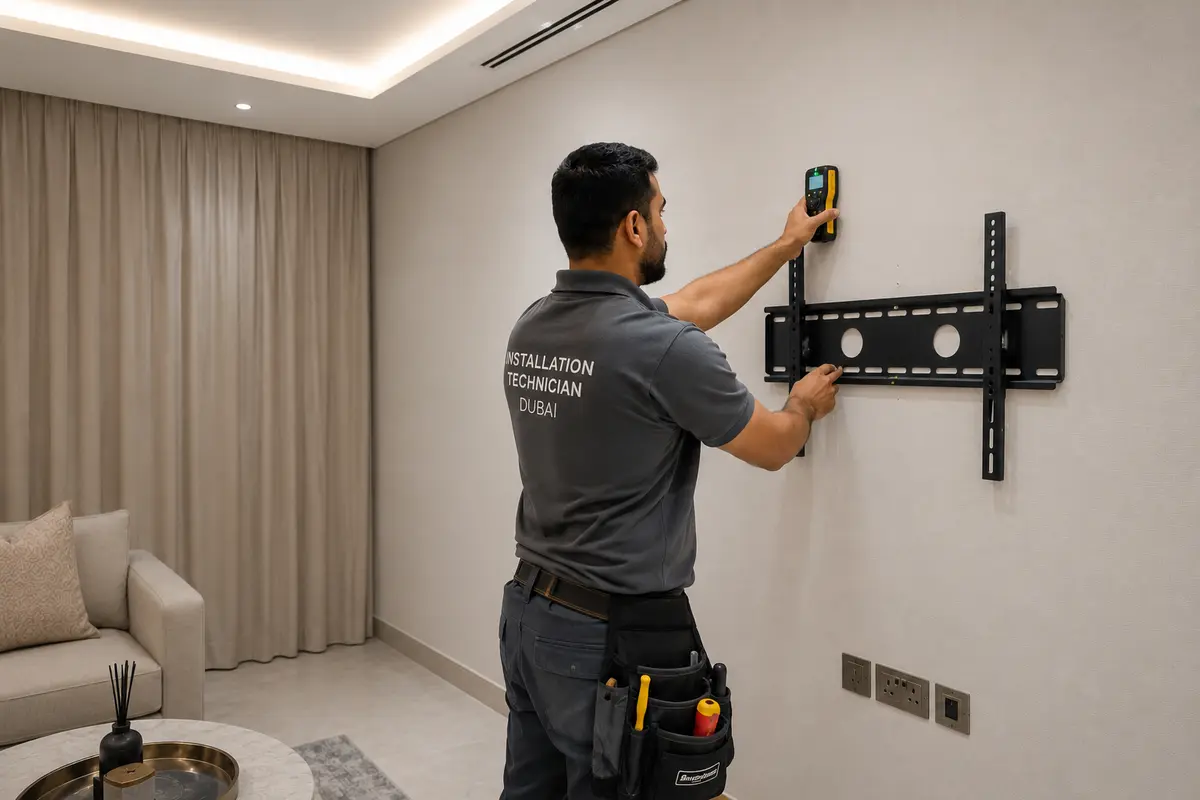
First, work out what you're drilling into
The single most important question before a screw goes in is what's behind the paint. A Dubai apartment can have two completely different wall types in the same room, and the fixing that holds 40 kg in one will tear straight out of the other.
Start with a quick assessment. Knock along the wall with a knuckle. A solid, dull thud that doesn't change as you move across means concrete or blockwork, the structural skin of the building. A hollow, drum-like sound that echoes between fixed points means a gypsum or plasterboard partition with a cavity behind it. The change in tone as you tap across the wall is the giveaway.
Then test for what's framing the cavity. Run a fridge magnet across a hollow wall: a faint pull every 40 to 60 cm usually means light-gauge metal studs behind the board, which is the norm in newer towers. No pull at all can mean timber framing or simply that the studs sit deeper than the magnet can reach. An inexpensive stud finder removes the guesswork and, crucially, warns you off buried cables and pipes before you commit.
The third type you'll meet is a tiled wall, common where a TV goes near a kitchen or an open-plan wet zone. Tile hides whatever is behind it, so you still need to know whether that substrate is block or board, and you need the right bit to get through the glaze without cracking it.
If it's a solid wall vs a hollow partition
This is the main fork in the decision tree, because the wall type dictates everything downstream: the drill, the fixing, and how much weight you can trust.
Concrete and blockwork, the strong option
Solid concrete or hollow-block walls are the structural skin of most towers and they carry serious load when you fix into them properly. Drilling them is the harder part: a standard drill on hammer mode will struggle in dense concrete, so this usually calls for a rotary hammer or an SDS drill with a masonry bit. Once the hole is in, the load comes from an expansion bolt or sleeve anchor that grips as you tighten it.
Embedment matters more than people expect. A heavy bracket anchor typically needs to seat 50 to 70 mm into solid material to develop its rated hold, so the bit length and the wall depth both have to cooperate. Get that right and a concrete wall will hold almost any domestic screen without complaint.
Gypsum partitions, where TVs come down
Plasterboard partitions look identical once painted, but the board itself holds almost nothing. A large screen has to be fixed into the metal studs behind the board or into a reinforced backing, never into the gypsum alone. Where you can't hit a stud, cavity fixings such as toggle or spring anchors spread the load across the back of the board, but only for light items. Never trust a plastic rawl plug in gypsum for a flat-screen; it works loose and the whole mount peels away over months.
The honest read: a hollow partition is the wall most likely to fail under a TV, and it's the wall where a pro earns their fee by finding and fixing into the framing.
Tiled walls and crack risk
On tile, the enemy is the glaze. Drill through a grout line where you can, or use a dedicated tile or diamond bit at low speed with no hammer action until you're through the ceramic, then switch to the right mode for the substrate behind. A cracked tile is exactly the kind of damage that surfaces at move-out, so on tile the margin for error is thinnest.
Match the fixing to the TV and bracket
The wall sets the ceiling on what's possible; the fixing and the bracket decide whether you stay under it.
Start with the numbers on the box. The bracket's VESA pattern, the spacing of the four bolt holes on the back of the TV written as width by height in millimetres, has to match your set. The VESA mounting interface standard runs from 75×75 mm and 100×100 mm on small screens up to 400×400 mm and 600×400 mm on large ones, with M4 screws on smaller sets and M6 or M8 on the big patterns. Check the mount's stated weight rating too, and leave headroom over your TV's actual weight rather than buying to the limit.
Then factor in the bracket type, because it changes the maths on the wall. A flat fixed mount pulls more or less straight down. A full-motion or cantilever arm swings the screen out from the wall, and that leverage multiplies the pull-out force on the anchors — a moderate screen on a long arm loads the fixings like a much heavier one bolted flat. The heavier the screen and the longer the arm, the less forgiving the wall has to be, which pushes you firmly toward solid material and expansion anchors.
Tie it together: a light screen on a fixed mount in blockwork is a benign job. A large screen on a swing arm in a gypsum partition is the combination most likely to end with the mount on the floor and a row of torn holes you'll be filling.
Power and cabling — where it becomes electrical work
There's almost always a 13A socket sitting behind or just beside where the TV lands, which is convenient until you start thinking about hiding cables.
Running the HDMI and power leads down the wall face inside surface trunking is a tidy, tenant-safe job. It's reversible, it doesn't touch the building's wiring, and you can pull it off cleanly at move-out. That's firmly DIY territory.
Concealing mains cables inside the wall is a different matter. Chasing a channel for a new fused socket, or routing the existing supply through the wall cavity, is electrical installation work and should be left to a licensed electrician. In Dubai, electrical installations are governed by DEWA's Electrical Installation Regulations, and modification work is meant to be carried out by approved contractors working to recognised wiring standards.
Unauthorised mains work can also complicate insurance if anything goes wrong later. If your plan involves the socket itself rather than just hiding a visible cable, book a licensed electrical contractor rather than improvising.
Permission and your security deposit
Drilling holes in someone else's wall is, technically, altering the property, so the tenancy angle matters as much as the engineering.
Get the landlord's sign-off before you drill, ideally in writing, even if it's only an email exchange you can point to later. Your tenancy contract (registered through Ejari in Dubai, or Tasjeel in Abu Dhabi) and the inventory you signed at move-in are the documents that decide who pays for what at the end. Those registered contracts are what make any later dispute enforceable. If you photographed the walls when you moved in, those photos are now your evidence of original condition.
The deposit risk is real but manageable. A few clean, filled, sanded and touched-up anchor holes generally read as fair wear and tear; a column of gaping, un-made-good holes, or a cracked tile, reads as damage and can be deducted from what you get back. The line between the two is largely about whether you made good on the way out.
It's worth reading the fine print on changes and permissions the same way you would for any alteration, much as you would before a larger rental change.
Documenting the wall as part of your move-in condition record gives you proof of its original state before any screw goes in.
When you leave, filling and repainting the holes is the same discipline that protects you across a wider move-out deposit checklist.
When you can DIY, and when to call a pro
Put the branches together and the hire-or-DIY decision falls out cleanly.
DIY is reasonable when most of these line up: a small-to-mid screen, a solid blockwork or concrete wall you've confirmed by knock test, a fixed flat mount rather than a long arm, and cable you're happy to run in surface trunking. With the right masonry bit, a level and the matching anchors, that's a methodical afternoon's work.
Lean toward hiring when any of these is true: a large or heavy screen, a gypsum partition where the studs have to be found and fixed into, a tiled wall with its crack risk, any plan to conceal mains cabling, or an awkward height that needs two people and coordination with the building's facilities management team for access. A pro brings a proper stud detector, an SDS drill, the correct anchors for each substrate, and the experience to know when the wall in front of them won't take the load you're asking of it.
The cost of getting it wrong isn't only a fallen TV — it's the made-good wall, the cracked tile and the deposit argument that follow. When the wall or the screen sits on the harder side of any branch above, posting the job to vetted pros is usually the call.
Frequently asked questions
Can I mount a TV in a rented Dubai apartment?
Yes, in most cases, but get the landlord's permission first, ideally in writing. Drilling is an alteration to the property, so your tenancy contract and the landlord's sign-off govern it. A few neatly filled and touched-up holes at move-out usually count as fair wear and tear, while un-made-good or excessive damage can be charged against your deposit.
How do I know if my wall is concrete or gypsum?
Knock on it. A dull, solid thud that stays consistent means concrete or blockwork; a hollow, drum-like sound means a plasterboard partition with a cavity behind. On a hollow wall, run a magnet or stud finder across it — a pull every 40 to 60 cm usually signals metal studs you'll need to fix into rather than the board itself.
Do I need an electrician to mount a TV?
Not for the mount itself, and not for running cables in surface trunking on the wall face. You do need a licensed electrician if you want mains cables concealed inside the wall or a new socket added, because that is electrical installation work governed in Dubai by DEWA's regulations. Hiding a visible HDMI lead is fine; chasing the wall for power is not a DIY job.
Will mounting a TV cost me my security deposit?
Only if you leave the wall damaged. Clean anchor holes that you fill, sand and touch up before handover generally read as normal wear. Holes left open, a cracked tile, or a mount torn out of crumbling gypsum read as damage and can be deducted. Photograph the wall at move-in and make good on the way out to protect the deposit.
What size drill and anchors do I need for a heavy TV?
On concrete or block, a rotary hammer or SDS drill with a masonry bit, plus expansion bolts or sleeve anchors seated roughly 50 to 70 mm into solid material. On a gypsum partition, fix into the metal studs; cavity toggles only suit light loads, not a large screen. Always match the bracket's VESA pattern and weight rating to your set, with headroom to spare.
Booking TV mounting on Everlook
Finding someone in Dubai who can tell a load-bearing block wall from a hollow gypsum partition at a glance — and who carries the SDS drill, the stud detector and the right anchors for each — is harder than it sounds, especially when the building's facilities management team controls access and timing. Everlook surfaces furniture and fit-out contractors with verified UAE experience and reviews from your neighbours, so you can match the job to someone who has hung the same screen on the same kind of wall before.
Find your next pro on Everlook
Compare licensed contractors in your area in under a minute. Free to post, no signup needed to browse.
Find your next pro on Everlook
Post a job in minutes and get offers from trusted local contractors. Free to start.
Get started