Which Outdoor Furniture to Clean, Restore or Replace After the Summer
A magnet and a bent strand: what the set is actually made of
Every verdict below depends on the material, and outdoor sets are often sold under names that hide it. "All-weather wicker" can be HDPE or PVC. "Hardwood" can be teak, acacia or eucalyptus. A dark frame can be aluminium or painted steel. Four quick checks settle most of it.
- Metal frames. Hold a fridge magnet against a leg. If it sticks, the frame is steel or iron. If it does not, it is aluminium or stainless steel, and neither rusts through the way painted steel does. On a wicker piece, press the magnet through the weave onto the frame tube.
- Synthetic wicker. Pick a strand on the underside, where a crease will not show, and bend it back on itself. Good HDPE flexes and recovers. PVC that has spent a summer in the sun tends to crack, snap or leave a white crease, because the plasticisers that kept it supple leach out under UV.
- Wood. Teak is heavy for its size and feels slightly oily where it has been freshly sanded. The receipt is more reliable than touch: a set sold as "acacia", "eucalyptus" or plain "hardwood" at well below teak prices is usually one of the lower-oil woods.
- Cushion covers. The sewn-in label names the fibre. Solution-dyed acrylic carries its colour through the whole fibre. Printed or surface-dyed polyester carries it on the outside.
Then note where each piece stood. Qualicoat's UK guidance for building projects treats anything within 5 km of the coast as a site that needs its tougher Seaside class of coating. No UAE rule sets such a band for furniture, but it is a useful yardstick: a villa garden or roof terrace near the beach or the creek is in salt air, and salt air changes the metal verdicts more than anything else on this list.
Teak and other hardwoods: grey is cosmetic, movement in a joint is structural
Teak turns silver-grey outdoors because the pigment in its outer surface layer fades, as Gloster, which makes teak furniture for outdoor use, explains it; the wood underneath is unchanged. Barlow Tyrie, whose teak is sold to stand outside uncovered all year, says in its teak care guidance that oil or preservative "will not extend the life of your furniture". A grey bench after a summer in the sun is a bench in normal condition.
Fine hairline cracks in the end grain of legs and arms are also expected. The same care sheet says they open and close as the wood's moisture content follows the weather, and do not affect the furniture's life. A Dubai summer works that movement hard. The National Center of Meteorology puts July's mean maximum relative humidity at 64 to 81 per cent against a mean minimum of 19 to 36 per cent, and recorded 11 fog occasions in July 2023: wet nights, bone-dry afternoons.
These are the signs that change the verdict:
- Black spotting on the grey surface. Usually mould growing on dust and moisture held in the grain. A teak cleaner and a soft brush worked along the grain is a weekend job. Keep the pressure washer away: Gloster warns it erodes the surface.
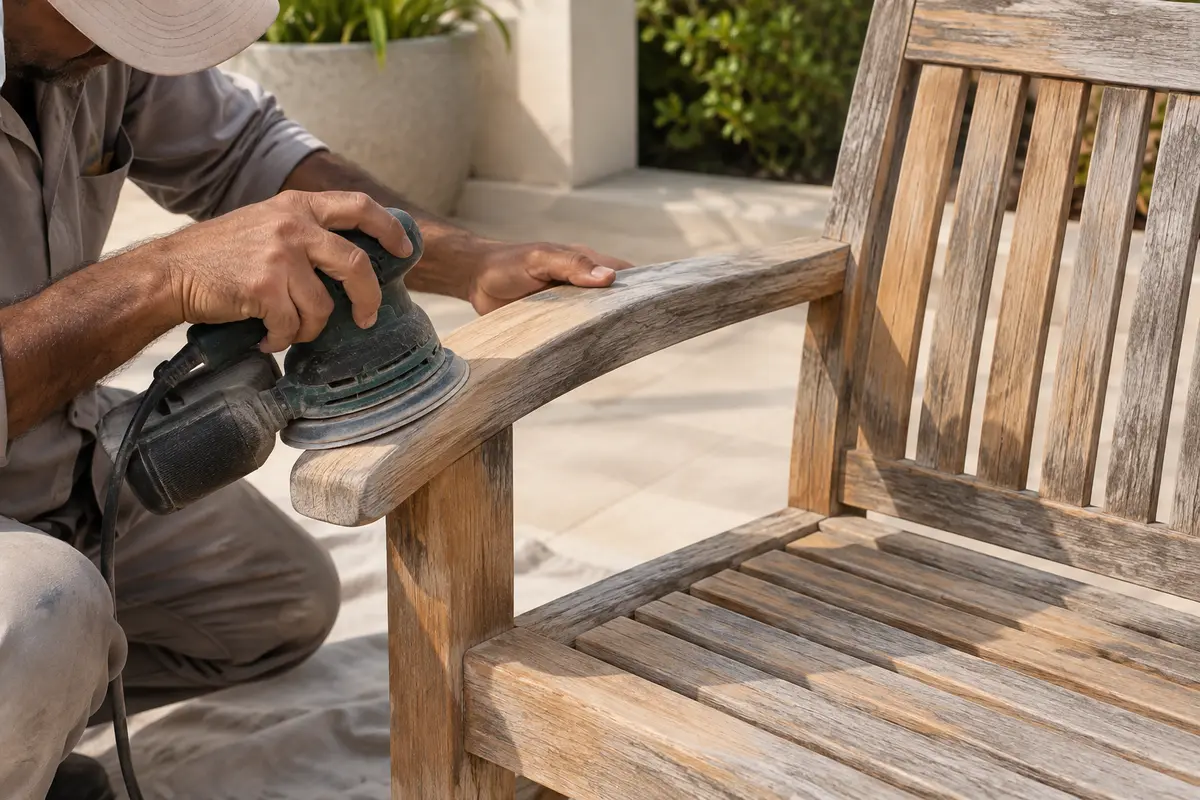
- A finish that has lifted or gone patchy. An old sealer or oil is peeling in flakes or has darkened in blotches. Sanding back to even wood is restorer work, because a patchy finish has to come off the whole surface for the new one to sit evenly.
- A joint that moves. Rock the chair on a flat floor and watch where each leg meets its rail. If a bolt is visible at the joint, tighten it first. If the leg still rocks, or there is no bolt, the glued joint has probably let go, and re-gluing it is restorer work.
- A split running along a leg or rail. A check stays in the end grain and closes again in cooler air. A split runs along the part and stays open. Whether that part can be glued, pinned or remade decides between restoring and replacing.
- Soft wood at the feet. Press a screwdriver tip into the bottom of each leg. If it sinks in, rot has started where water sat on paving or in the throw of a garden sprinkler. One soft foot can be cut back and capped. Several usually mean the piece is finished.
On oil, the manufacturers mostly point one way. Barlow Tyrie does not recommend oiling at all and notes that repeated coats of its own teak oil darken the wood. Some teak specialists add that oil left on the surface holds dust and mildew, which matters on a humid terrace. If you want the honey colour back, the route the sources support is a teak cleaner followed by a clear teak sealer, renewed as its label directs. If you are happy with grey, a thorough clean once or twice a year is the whole job.
Acacia, eucalyptus and similar woods need a different reading. They carry far less natural oil than teak, so grey on those woods marks a finish that has worn through and wood that is now taking in water. Clean and re-seal them this autumn, and look hardest at the feet and the joints.
Synthetic rattan: bend a strand, then find out what it is woven onto
Faded colour on HDPE wicker is cosmetic, and a weave whose strands still flex under your thumb is doing its job. Clean it with warm water, a gentle soap and a soft brush. DEDON's care guidance rules out alcohol and solvents, which attack the fibre's surface.
The strands
A few broken strands in one area, on a weave that is supple everywhere else, can be re-woven. A restorer cuts back the broken ends and weaves in new strand of the same width. The catch is colour: the new strand is unfaded and the weave around it has had a summer of sun, so a repair on a seat front tends to show while one under an arm usually does not.
Strands cracking across a whole seat or back, or crumbling when bent, mean the plastic itself has failed. That pattern fits PVC, or a polyethylene made with too little UV stabiliser, and patching one section only buys time until the next one goes. A full re-weave is possible, but it is a long job to weigh against what the piece is worth to you.
The frame under the weave
The frame usually decides more than the weave does. If the magnet says steel, look for rust stains bleeding out through the weave at the corners and feet, and for a seat that sags or creaks under your weight. Rust under the weave cannot be treated without unwinding the weave over it, so a rusting steel frame under a tired weave is normally a replacement. An aluminium frame under a failing weave is the combination worth re-weaving.
Aluminium and steel: read the coating where it meets a weld or a screw
Powder coat that has gone dull, or leaves a chalky film on your finger, has weathered at the surface. Wash it with water and a pH-neutral mild detergent, rinse, and dry it. The Qualicoat licensing body for the UK recommends that routine every few months for coated aluminium, and outdoor furniture care guides add fresh-water rinsing more often near the sea, because salt left on the coating is what starts the next problem. The trouble that matters starts underneath.
On aluminium
Thin, worm-like tracks under the paint, spreading from a chip, a cut edge, a weld or a screw hole, are filiform corrosion. The Aluminum Anodizers Council's fact sheet on filiform corrosion links it mainly to marine air and says it lifts the coating while leaving "little damage to the aluminum surface". The frame is sound, then, and the question is how it looks.
Touch-up paint over a track seldom stops it, because the corrosion keeps advancing under the coat around the dab. A few short, stable tracks can be left or touched up for appearance. Tracks along most of a frame call for stripping it to bare metal and re-powder-coating, a job a restorer sends to a coating shop with a curing oven.
On steel and wrought iron
Bubbles in the paint, orange-brown staining at welds and flaking around bolts mean rust is growing under the coating, and on steel it eats the metal. Press a screwdriver into the worst patch. Layers of flaking rust, or a tip that goes through, mean the section is thinning, and on a chair leg or a joint that is a safety question. Surface rust on a sound frame is worth stripping and repainting. Pitted, thinned metal at a weld, or a crack beside one, puts a mass-market frame past restoration unless a welder replaces the section.
Stop before you grind. Wire-brushing or sanding old paint throws fine dust, and paint of unknown origin can contain lead: when the Abu Dhabi Quality and Conformity Council tested 51 paints, stains and varnishes on sale in the emirate in 2013, five carried 1,000 to 20,000 parts per million. On an older painted steel set, especially an inherited or second-hand one, have a restorer strip it where the dust is contained, and keep dry sanding off the balcony and out of the garden.
Cushions: the cover shows the fading, the foam decides
A faded cover that is not torn or brittle at the seams is cosmetic. Solution-dyed acrylic fades slowly because its colour runs through the fibre. A printed polyester cover fades faster, since UV breaks down colour that sits on the surface. Clean and keep it, or re-cover in a better fabric if the colour bothers you.
Mould is the harder call. Open the zip and look at the foam and at the inside of the cover.
- Spots on the outer face only. Sunbrella says its acrylic fabrics resist mould and that growth comes from dirt and debris left on them. Its method is a cup of bleach and a quarter cup of mild soap per US gallon (about 3.8 litres) of water, left for 15 minutes, worked with a soft brush, rinsed thoroughly and air-dried. Bleach can discolour other fabrics, so test a hidden seam on a polyester cover first.
- Mould on the inside of the cover or on the foam. The insert has been holding water. Standard polyurethane foam soaks it up and dries slowly, so mould inside it returns after cleaning. Replace the insert, and keep the cover if it cleans up.
- Foam that stays flat, crumbles or has yellowed at the edges. Replace the insert with quick-dry reticulated foam, whose open cells let water drain straight through.
Wear gloves and a mask to handle mouldy foam, and bag it before carrying it through the house. Built-in benches and odd-shaped loungers are where re-foaming and re-covering by a restorer pays, because nothing off the shelf will fit.
Where your weekend ends and a restorer's workshop begins
The jobs above that are yours: cleaning teak and other woods with a soft brush and cleaner, re-sealing acacia, washing powder coat and rinsing off salt, cleaning cushion covers, and tightening the bolts you can see.
Hand the piece over when it needs power sanding of hardwood, chemical strippers, grinding or wire-brushing old paint, re-gluing a joint, re-weaving, re-powder-coating, or new foam cut to shape. A furniture restoration specialist does all of these, and most of them happen in a workshop because a balcony or a garden is a poor place for strippers and sanding dust.
Before you book, ask:
- Which finish will go on the wood, and is it made for furniture left in full sun? For teak, would they seal it or let it grey?
- Will they collect and return the pieces, and how long will they be away?
- For re-weaving, can they show the new strand against the faded weave before they start?
- For metal, will they strip to bare metal before recoating? Coating over rust or filiform tracks seals the corrosion in.
- Will loose joints be re-glued, or only reinforced with screws and brackets?
A written assessment from the restorer has a second use if a piece was damaged in a recent move and not by the weather: it is the evidence a claim against the movers depends on.
Keeping next summer's verdict shorter
Most of the damage above started with water or dust left sitting on the piece, and the sources support a few habits that cut it down.
- Brush dust off after a shamal or a day of blowing dust. On fabric and in wood grain, trapped dirt is what the mould lives on.
- Use covers that breathe, as Barlow Tyrie advises for teak. A sealed plastic cover on a humid night traps condensation against the wood and the cushions.
- Stand cushions on edge or bring them in after irrigation or heavy dew, so the foam drains.
- Near the sea or a pool, rinse metal frames with fresh water. Care guides for powder-coated aluminium treat chlorinated splash the way they treat salt. If the pool itself came through the summer green, clearing a green villa pool is a separate job.
- Lift wooden feet off wet paving, out of the sprinkler's throw.
Weather damage on outdoor furniture compounds. A joint that rocks in October has more play by May, and a rust bubble at a weld on a steel chair is a thinner leg after another summer of humid nights. Everlook connects you with licensed UAE restorers and outdoor furniture specialists who re-glue, re-weave, recoat and re-foam, with verified credentials, transparent quotes and reviews from customers in Dubai.
Find your next pro on Everlook
Describe your job once, get quotes from verified UAE contractors. Free, no commitment.
Find your next pro on Everlook
Post a job in minutes and get offers from trusted local contractors. Free to start.
Get started