How to Store Furniture in Dubai Between Homes: Cooled Unit, Plain Unit or Mover's Warehouse
What a Dubai August does inside a closed unit
The National Center of Meteorology's Dubai bulletin issued on 12 August 2026 forecast a high of 47°C for the following day. For 15 August it gave relative humidity between 30% and 85% within the same day, with the humid hours at night and early morning. Outside air reaches an uncooled storage unit through the roller door and its gaps, so furniture inside can go through much of that daily swing.
For a steel container in an open storage yard it gets worse. The Container Handbook published by the German insurers' association puts average daily overheating inside a container on a sunny summer day at 20°C above the outside air, even in temperate latitudes. An uncooled unit inside a warehouse building is shaded, but with no cooling it can still sit close to the outdoor temperature.
Humidity does the slower damage. The Canadian Conservation Institute (CCI), the Canadian government's conservation body, gives mould timings at about 25°C for organic materials such as leather: around 100 days at 70% relative humidity, 10 days at 80%, and two days at 90% or more. It also notes that air at 50% humidity, cooled by 10°C, reaches 100%, which is how a carton against a wall that cools at night turns damp on one side.
"Climate-controlled" and "air-conditioned" are used loosely on Dubai furniture storage listings. The listings read for this article quote temperature bands of roughly 18–25°C, and few give any humidity figure. Ask in writing for the set temperature, the humidity range the facility holds, and whether the cooling runs around the clock. If you hold the key, a small temperature-and-humidity logger left in the unit for the first week shows whether those figures hold.
Which pieces need the cooled unit, and how to pack them for months
Solid wood, veneer and anything glued
Wood swells as humidity rises and shrinks as it falls. The CCI names veneer laid over corner joints, as on many wardrobe doors, as a place where that movement concentrates stress, and describes veneer buckling when damp softens the glue. Months of days swinging that widely can lift veneer and open joints, so dining tables, wardrobes, veneered sideboards and anything you cannot replace belong in a cooled unit for any gap that runs through the hot months.
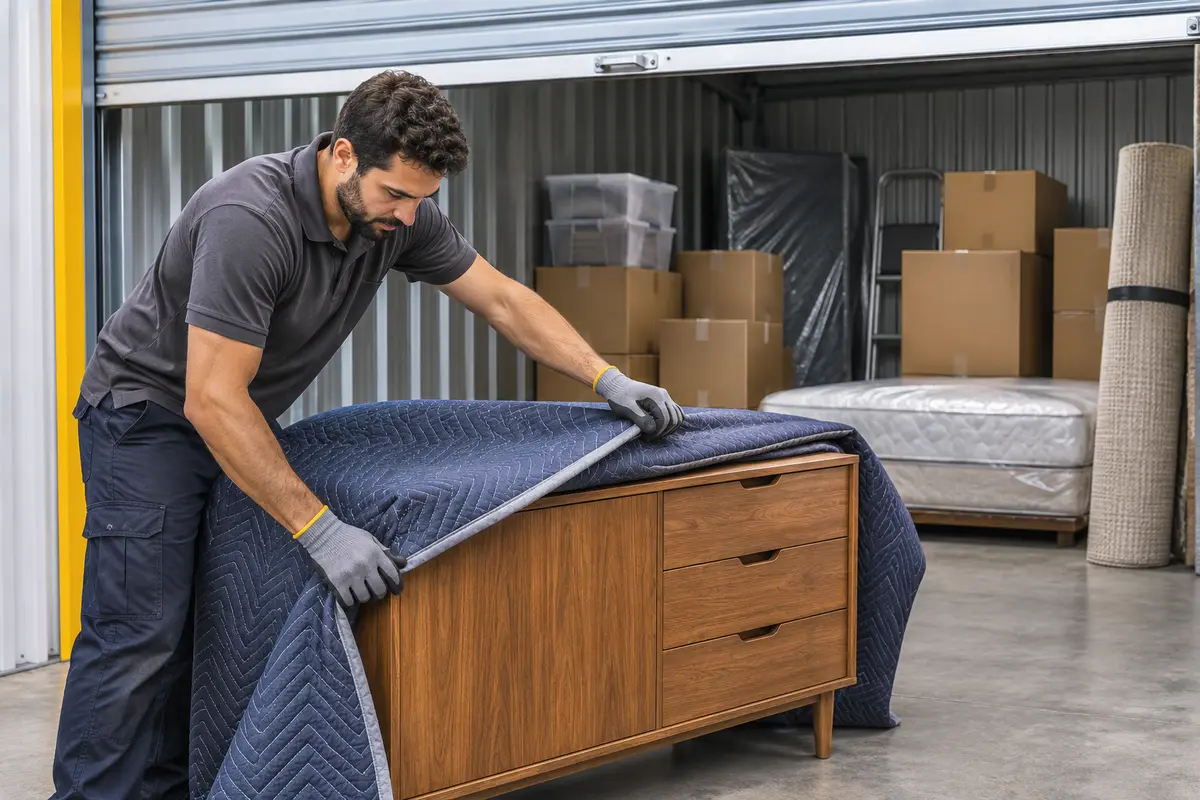
Wrap them in furniture blankets or paper pads, and keep stretch film off polished and veneered surfaces; the CCI warns that plastic wrap traps damp against whatever it covers when there is moisture to trap, as there is in humid air. Stand tables on their legs or on battens, clear of the walls, so air can move around them.
Leather, fabric sofas and mattresses
Mould is the risk here. The CCI's mould timings above are for materials like leather, and the guidance on upholstered furniture from the National Park Service in the United States puts the mould risk for textiles at relative humidity above about 65%. Winter does not remove that risk: the National Center of Meteorology's December figures put the average daily peak in humidity across the country between 79% and 90%, so damp hours still come round in the cool months.
Simba, a mattress maker, asks owners to store mattresses flat and warns that sealing one in airtight plastic traps moisture against it. Some mattress warranties also exclude damage from storing a mattress on its side, so read yours before the crew stands it against a wall.
Screens, instruments and white goods
Samsung's TV manuals give a storage range of -20°C to 45°C and 5% to 95% humidity, non-condensing, for the models checked. The 13 August forecast high of 47°C was above that before any heat from a unit's roof. Keep screens, speakers, computers and a piano in the cooled unit. Steinway treats a humidity swing of more than 30 points as excessive for a piano; the 15 August forecast spanned 55.
For a fridge or a washing machine, the bigger risk in storage is the water left inside. Samsung's long-term storage steps for refrigerators are to empty, clean and dry the interior, turn off and drain any water line and dispenser, unplug it, and prop the doors open. For a front-loading washer, drain the leftover water through the pump filter at the base, leave the door ajar, and refit the transit bolts that locked the drum when it was new, if you still have them.
If the washer or a plumbed-in fridge is connected to a supply with no isolation valve you can turn, stop there and have a plumber or the moving crew's technician disconnect it. A hose pulled off a live supply can flood the flat below.
What a plain unit can hold
Metal and plastic outdoor furniture, ceramics, glass, pans and tools cope with heat that would harm a veneered sideboard, though cardboard softens in humid air and tall stacks of cartons can sag. Fine dust can get in under a roller shutter on shamal days, so cover everything.
Your own lock or the mover's vault
The two quotes on your table sell different services. A self-storage facility rents you a room that only you open. A mover takes the goods into its own warehouse and keeps them for you.
Self-storage unit
You or a hired crew pack, carry and stack the unit. The goods sit at the facility's address behind your lock. You come during the access hours in the agreement and take out one chair or the whole load, usually with no charge for the visit, though transport each way is yours to arrange. The monthly charge follows the unit's floor area, whether it is cooled, the term you commit to and any insurance you add. The risk of a badly stacked load or a damp carton stays with you.
A mover's warehouse
The crew packs and loads, often into wooden vaults or crates that are closed at your door or at the depot and stacked in a warehouse. You do not see the goods again until they come out. One item back usually means a booked date and a charge to bring the vault down and open it. The monthly charge follows the volume in cubic metres or the number of vaults, whether the storage area is cooled, and the handling-in, access and redelivery lines on the quote. The mover answers for the goods, within the limits its contract sets.
Redelivery is a second move. The new building will want its own move permit and service-lift slot, and the warehouse needs enough notice to pull your vaults out for that date.
Matching the storage to your furniture and the gap
- If the gap runs through any of the hot months, roughly May to October, and the load includes solid wood, veneer, leather, mattresses or electronics, book cooled space: a climate-controlled self-storage unit, or a mover's warehouse that confirms in writing that its storage area is cooled around the clock.
- If the gap sits inside the cooler months, heat is less of a worry for wood and screens, but the humid nights still reach leather, fabric and mattresses; keep those in cooled space for a gap of more than a few weeks.
- If you will need things back during the gap, or plan to sell pieces from storage, a self-storage unit costs nothing per visit and needs no appointment.
- If you are leaving Dubai for months and cannot be there to pack or collect, the mover's warehouse lets one company pack, store and redeliver, with the inventory and cover agreed before the vaults are closed.
- If the load is mostly metal and plastic furniture, kitchenware and boxed household goods, a plain unit is a defensible saving for a short gap, with any upholstered pieces in a small cooled unit beside it.
Then ask for quotes from storage companies that collect and from a self-storage facility, and put the climate figures and the clauses below to both.
Cover from the depot door onward
A mover's transit policy often ends when the goods reach the depot, as the guide to vetting a moving company notes, so storage cover is a separate line to ask for by name. At a self-storage facility, cover is sold with the unit or left to your contents policy, which may not reach goods kept away from home.
Storage policies tend to exclude the slow damage a Dubai summer causes. One published goods-in-storage wording, a New Zealand insurer's policy dated 1 July 2026, excludes rot, mildew, mould and gradual deterioration; insects, rodents and vermin; mechanical and electrical breakdown; spoilage of items that need temperature control; and loss of tone in musical instruments. Check the policy you are offered for the same words. Where mould and gradual deterioration are excluded, only the cooling protects the sofa.
Cover is usually priced off a value you declare, item by item or as a total. An inventory line that reads "sofa" gives you little to claim on; one that records the make, age and condition, with photos taken as each piece is loaded, is the same evidence a damage claim against movers depends on. Cartons you packed yourself can carry narrower cover: one UK storage operator's policy excludes mould, mildew and leakage in owner-packed containers.
Under the UAE's Civil Transactions Law, Federal Decree-Law No. 25 of 2025, in force since 1 June 2026, a business that takes your goods into its keeping is a depositary. Article 908 requires it to look after them with the care an ordinary person gives their own property, in a place suited to goods of that kind. Article 906 makes it liable when they are destroyed through a cause attributable to it, unless the parties agreed otherwise. Read the liability cap in the contract next to the insurance exclusions.
Clauses to read before you sign
- The minimum term, any refund of a prepaid term if the new flat is ready early, and the notice that ends the agreement.
- Any right to raise the monthly rate during the term, and the notice it needs.
- Access hours and days at a self-storage facility; at a warehouse, the notice needed to see or retrieve goods and the charge for each access or for taking out part of the load.
- The temperature and humidity the operator holds, written into the agreement or an attached sheet.
- The address where the goods will sit, and a commitment that they stay there. Article 909 of the Civil Transactions Law already bars a depositary from placing your goods with someone else without your permission, except under pressing necessity.
- The redelivery charge and who pays it. Article 924 puts the costs of handing over and returning deposited goods on their owner, so a quote that says nothing about redelivery leaves that bill with you.
- The prohibited-items list; gas cylinders, fuel, paint and food are commonly refused.
- What the operator says it may do with the goods if payment stops.
On that last clause, the law lets an unpaid business hold the goods until it is paid (Article 350, and Article 723 for a landlord's hold over movables in rented premises, if a self-storage unit is treated as a lease). Selling them is harder. Under Article 351, a business holding goods that risk spoiling or losing value has to ask the court for permission to sell, with a faster route only for goods that perish quickly. Whether a clause allowing sale after a set number of days stands without a court has not been settled; ask about it before signing, and take it to a lawyer if a dispute starts.
Check the company itself as well. A DED trade licence check shows whether the licence is active and which activities it covers; look for a storage or warehousing activity alongside any moving activity. A free-zone company is licensed by its zone's authority and is checked there.
Storage quotes for one flat are hard to line up: one prices floor area, another prices vaults by volume, and cooling, minimum term, insurance, access charges and redelivery each move the monthly figure. On Everlook you describe the furniture and the dates once, then compare offers from licensed moving and storage companies side by side before you commit, with no obligation.
Find your next pro on Everlook
Post a job in minutes and get offers from trusted local contractors. Free to start.
Find your next pro on Everlook
Post a job in minutes and get offers from trusted local contractors. Free to start.
Get started