Pack It Yourself or Pay the Movers in Dubai: How to Decide
When packing it yourself is the right call
Most Dubai tenants should pack part of the flat themselves and pay the crew for the kitchen, the electronics and anything framed. That split decides what transit cover pays on, and whether you are boxed before the service-lift window opens.
Self-packing works when three conditions hold at once: the flat is small, the fragile count is low, and the moving date has slack in it.
A one-bedroom apartment takes most people 10 to 20 hours of concentrated packing. A two-bedroom runs 20 to 35 hours once the store cupboard and the balcony are counted in. Those are working hours, not calendar days.
Spread over weekday evenings after work, 20 hours is about six evenings. Start on the Saturday nine days before the truck arrives and you finish with a day spare. Start on the Wednesday and you will be taping the kitchen at 2am on load morning.
The order that survives contact with reality: store cupboard and wardrobes first, then books and decor, then the kitchen, then the bed and bathroom on the final morning. Anything you have not touched since the last move goes into a donate pile before it earns a carton.
Self-packing also suits a tenant moving inside the same building or the same community, where the truck does a short hop and the loading bay gets booked twice on one morning. What makes owner-packed cartons risky is time in transit, and a 10-minute drive has very little of it.
When to hand the whole flat to the crew
Full pack is the right hire when either the calendar or the contents is the binding constraint.
The calendar case: you have one working week between handing back the keys and the new tenancy contract starting, an exit clean booked into that gap, and no free evenings. A crew of three will box a two-bedroom flat in a single day — the same job that would eat the better part of two weeks of your evenings.
The contents case: framed art, a piano, a mirror over a metre, marble or glass table tops, a wine rack, studio or lab equipment, anything whose original crate went into a skip years ago. These want custom-cut cartons, corner protection and sometimes a built-to-size wooden case, and a crew carries that material on the truck.
Full pack also earns its place when you will be out of the country between the pack date and the load date, or when the move is the domestic leg of an international shipment and a surveyor has to sign off the packing list before the container is sealed.
The trade is control. A crew packs fast and packs to a standard, and it will box the half-empty bottle of olive oil and the contents of the bathroom bin along with everything else unless you clear those first. Walk the flat the evening before and pull out what should never travel.
The middle tier most tenants should actually book
Almost every Dubai moving company quotes three levels of service. The middle one gets skipped because nobody names it unprompted on the phone.
Transport only
Truck, driver, loading crew. You pack everything; they carry, drive, and place furniture in the right room. Dismantling and reassembly of beds and wardrobes is usually still inside this tier, and blankets go over the sofa. It suits a studio or a light one-bedroom with a flexible date.
Part pack
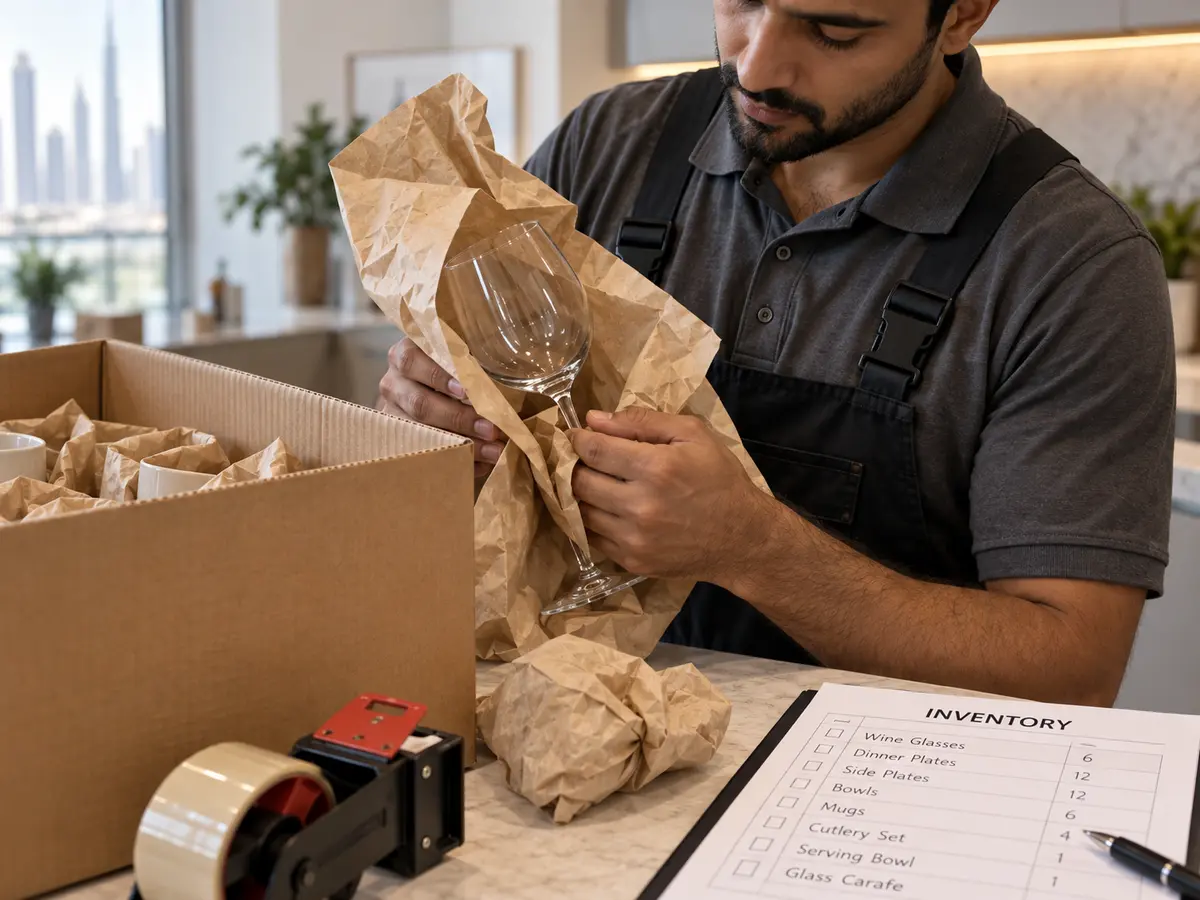
The crew packs a named list. In practice that list is kitchen glassware and crockery, electronics with their screens and cables, framed pictures and mirrors, and lamps. You handle clothes, books, linen, toys and shoes, which make up most of the carton count and almost none of the breakage risk.
This is where the money lands on the risk. When you book a crew for the fragile rooms, you are buying two things at once: materials designed for the job, and liability on precisely the boxes that generate every argument afterwards.
Get the list written into the estimate line by line, because "part packing" on its own means whatever the crew decides on the day. The same discipline that applies to reading a moving estimate properly applies to this line of it.
Full pack
Every room, every cupboard, all materials supplied, each carton labelled by destination room and contents, and a complete inventory handed over before the truck leaves.
What the inventory sheet does to a box you packed
How a crew marks a carton it did not pack
On load day the crew writes an inventory: every carton and every loose item gets a line and a number. A box you packed and sealed yourself is recorded as PBO (packed by owner), usually as a code in the condition column, sometimes as a coloured label stuck to the box as well.
Read the sheet before you sign it and photograph every page. That signature is the document a claim is later assessed against, and the PBO codes on it are the part nobody looks at until something is broken.
What cover survives on a PBO carton
Cover narrows to the carton as a unit. If the box is lost, stolen, or simply never comes off the truck, a transit policy will generally still pay on its declared contents. If the box arrives with no external damage and the glassware inside is in pieces, the claim fails.
The reason is verification. A packer who wraps each glass, fills the voids and closes the flaps knows what went in and how it was cushioned, and can say so. Nobody can establish that after the fact about a carton that arrived taped shut, so the insurer pays on the event it can observe (the box going missing or being visibly crushed) and declines the one it cannot.
Evidence order matters as much here as it does anywhere else in a move, and what a damage claim needs from you is worth reading before load day, while you can still change how a box gets marked.
Declaring a high-value item in writing
Anything genuinely valuable goes on paper before the load, on the inventory itself or on a separate high-value list: item, description, and a stated value. Above a threshold the mover will name, most policies require the declaration for the item to be covered at all. Below it, the piece sits inside a general per-item limit that is usually far under what it is worth.
A written declaration is also, in most cases, a condition of the crew packing that item themselves, which puts it back into full cover and takes it out of the PBO column entirely.
What no crew will load, whoever packed it
Standard moving trucks are not certified to carry dangerous goods, so this exclusion applies equally to a box you packed and a box the crew packed. The list runs longer than most tenants expect.
- Aerosols of every kind: deodorant, insect spray, air freshener, spray paint, dry shampoo. A pressurised can in a hot vehicle is the whole reason.
- Paint, thinner, varnish, solvent adhesives, and nail-polish remover in quantity.
- Gas cylinders, camping gas, barbecue bottles, and fire extinguishers.
- Petrol, diesel, generator fuel, lighter fluid, and charcoal starter.
- Pool and garden chemicals, pesticides, bleach, and drain cleaner in bulk.
- Car batteries, and loose lithium packs sitting outside a device.
These are the same materials Dubai Municipality lists as hazardous waste (oil-based paints, cleaning fluids, pesticides, batteries and fluorescent tubes among them), which is why household quantities do not belong in the building's chute or a general skip either.
Handle them a fortnight before the move, in this order. Give away what is usable to a neighbour who wants it. Empty and rinse containers that can be emptied safely. For the remainder, ask building management or the FM team which collection route the property uses, since Federal Law No. 12 of 2018 on integrated waste management requires hazardous material to be segregated and treated under the supervising authority.
One or two part-used items you genuinely need on the other side — a single aerosol, a sealed tin of touch-up paint — can ride in your own car, upright, boxed, and moved the same day. Keep them out of a car parked in the sun for six hours.
What both routes run into: the lift window and a hot truck
The service-lift slot is short, and it is booked
Towers here run moves on a permit plus a booked lift block, often a fixed span of hours on a named day, with restricted times around Friday prayers and, in some buildings, no weekend moves at all. Building management holds the slot; the facilities management team holds the lift key. The mechanics live in the guide to the permit and lift-slot paperwork.
For the packing decision, the consequence is narrow and expensive. A half-packed flat when the window opens burns the slot: the crew stands in the corridor while you tape boxes, the lift reverts to residents on the hour, and whatever is left waits for the building's next free day. Through summer, in a tower where a dozen leases turn over at once, that next day can be a week away.
This is the strongest single argument for the part-pack tier. A crew arriving to a flat where the clothes, books and linen are already boxed still clears the window comfortably, because the kitchen and the electronics are exactly what a crew is fast at.
Loading bays and truck beds get hot
Through summer (Mar–Oct) an unairconditioned box truck standing in a loading bay reaches temperatures that ordinary packing simply ignores. Candles slump. Sealed liquids and toiletries expand and weep past their caps. Vinyl records warp inside their sleeves. Sealed lithium cells and anything with a screen do poorly across several hours at that temperature.
Build a hand-carry list for your own air-conditioned car: laptops and external drives, medication, candles and wax items, vinyl and photographic film, instruments with glued joints, wine, cosmetics, any sealed liquid you care about, and the document folder: passports, tenancy contract (Ejari in Dubai, Tawtheeq in Abu Dhabi), certificates, spare keys.
Professional materials change part of this and none of the rest. Double-wall cartons hold their shape in heat where supermarket boxes soften at the corners and collapse under a second box; honeycomb and foam wrap absorbs movement that newspaper transmits straight through. No carton refrigerates a truck. Dust is the quieter problem — a shamal blowing across an open bay drives fine sand into anything left open, which is why a crew tapes every seam closed and reinforces the base of each box.
Unpacking is a separate line, and it means two different things
Unpacking appears on most quotes as its own item, and two services of very different size hide behind the single word. Ask which one the number covers.
Cartons emptied and debris removed
The crew opens every box, tips the contents onto the nearest flat surface or the floor of the right room, then takes away the cardboard, paper, bubble wrap and tape when it leaves. Your things are in the flat and out of their boxes. Nothing is put away.
Items placed and put away
The crew puts crockery into cupboards, clothes onto rails, books onto shelves, working to a plan you give them room by room. It is priced separately, it runs longer than people expect, and it needs you present and decisive for most of it.
The debris half is the one tenants underestimate. A two-bedroom move leaves a wall of flattened cardboard and several bags of wrap, and a tower's waste room will often refuse that volume, which leaves the building charging for a skip or the cardboard sitting in your hallway for days.
Timing sharpens it. If the handover inspection at the old flat falls the next morning, or an exit clean is booked into the same gap, you want debris removal at both ends written into the quote. Inspectors deduct for what they find left behind, and those deductions come off the security deposit.
Frequently asked questions
Can I use supermarket boxes for a Dubai move?
You can, with limits. Single-wall grocery cartons soften in loading-bay heat, and their bases give way once a second box sits on top. Use them for clothes, linen and soft goods only, keep each under about 15 kg, and tape the base in an H pattern. Books, crockery and anything heavy need double-wall boxes.
Will movers take houseplants and pets?
Neither travels on the truck. Pets go with you, in a carrier, in an air-conditioned car. Most crews will decline houseplants outright, and the ones that agree exclude them from cover. Water plants lightly two days before, move them yourself in the footwell, and keep them out of a parked car in summer.
Do I need to be in the flat while the crew packs?
Yes, for the start and the end. Be there when they arrive to point out what stays, what is fragile, and what has been declared. Be there at the end to walk the inventory sheet before you sign it. In between you are free, though someone should stay reachable for the questions that come up.
What happens to food in the fridge and freezer?
Run the freezer down for the last fortnight and stop replacing it. Defrost and dry the appliance a full 24 hours before load day, since a wet fridge grows mould in transit and a crew may refuse to load one. Pack dry goods and sealed jars; bin or give away everything chilled.
Booking packing and unpacking on Everlook
Everlook lists licensed UAE moving and packing crews with verified credentials and reviews from real Dubai customers. Filter by response time, rating and quote, then ask each shortlisted crew one question before you book — what exactly its part-pack list covers, and whether debris removal is inside the unpacking line. The answers separate the crews faster than any website will.
Find your next pro on Everlook
Describe your job once, get quotes from verified UAE contractors. Free, no commitment.
Find your next pro on Everlook
Post a job in minutes and get offers from trusted local contractors. Free to start.
Get started